IADR Abstract Archives
Optimization of Collagen-ELP-Bioglass Composite Scaffolds for Guided Bone Regeneration
Objectives: Mechanical and biochemical properties determine success of guided bone regeneration (GBR) scaffolds. Currently used collagen GBR scaffolds possess excellent biochemical properties but fail due to poor rigidity. To overcome this limitation, we developed multicomponent composite scaffolds in which the collagen matrix is reinforced with temperature-responsive elastin-like polypeptide (ELP) and a biodegradable ceramic (Bioglass). We optimized the scaffold composition using response surface methodology (RSM) to achieve a combination of maximized mechanical properties.
Methods: Rat tail collagen I was purchased from Corning and ELP was produced from genetically-modified E. coli. Bioglass particles (Mo-Sci) were size-sorted and characterized using scanning electron microscopy (SUPRA-40, Zeiss) followed by ImageJ analysis. 0-10mg (0-13.3mg/mL) Bioglass particles having mean sizes 142-278µm were added to the previously optimized collagen:ELP composition (6:18mg/mL) to form 12 scaffolds (Table1). Uniaxial compression (Sintech 2/G, MTS) was performed at 1mm/min strain rate on scaffolds (n=6) aged for 8 days in PBS at 37°C. Compressive strength and modulus were correlated with Bioglass amount and size using RSM (DOE++, Reliasoft) to optimize the composition.
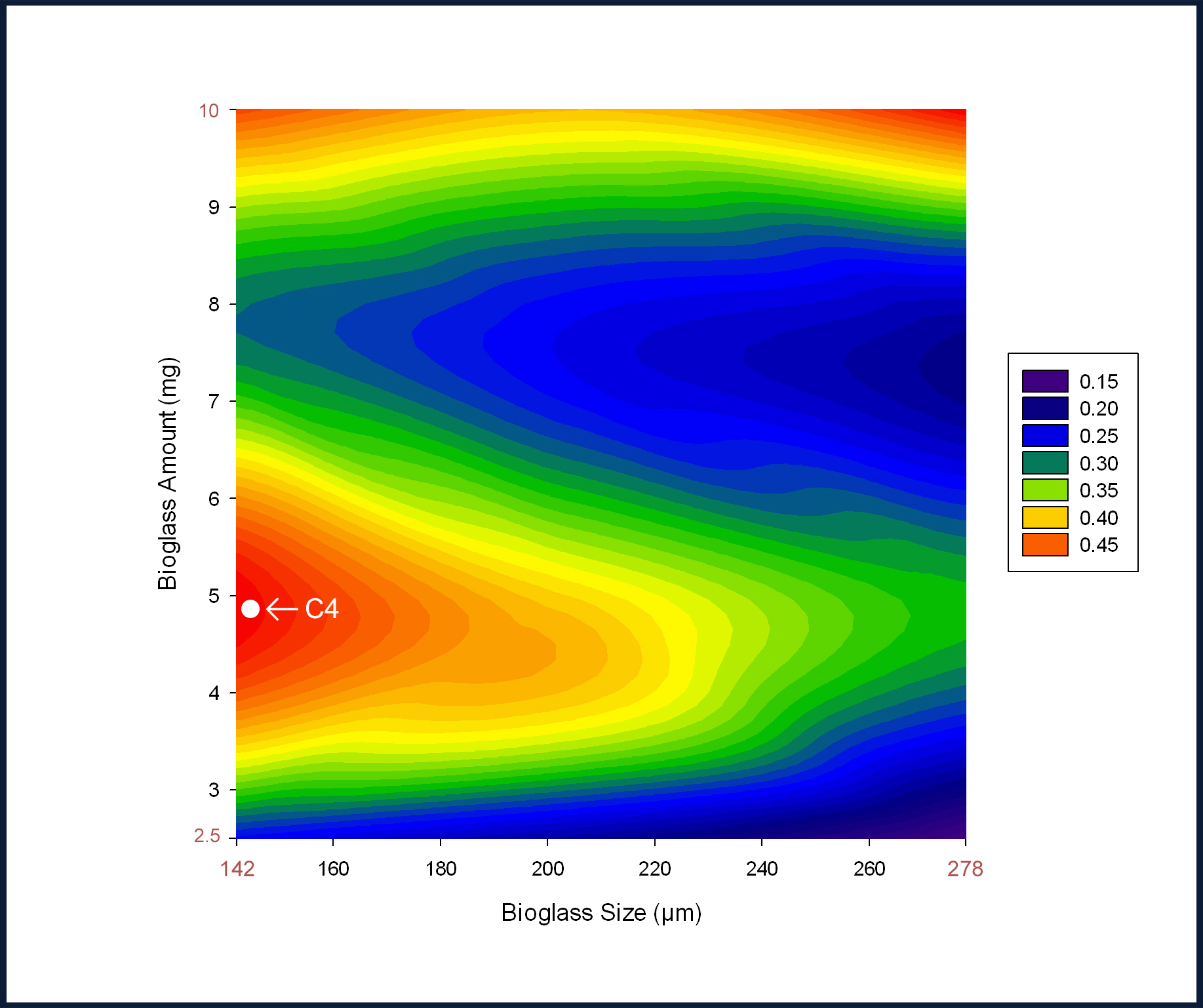
Results: Adding Bioglass improved the strength and modulus (Table1) of scaffolds compared to collagen-ELP scaffold. Adding Bioglass improved the strength (0.5-1.9kPa) and modulus (12-57kPa) over a wide range based on the amount and size. RSM performed a two-factor optimization and demonstrated the interaction effect of particle amount and size on properties. RSM directed us to 5mg and 142±6µm as the optimal values of Bioglass amount and size (Fig.1) that can be mixed with collagen:ELP (6:18mg/mL) to achieve a combination of maximized strength (1.6kPa) and modulus (45kPa).
Conclusions: Bioglass addition improved the mechanical properties and RSM efficiently optimized the collagen-ELP-Bioglass composition to obtain a combination of maximized mechanical properties. This composition is currently being evaluated for its physical, in vitro, and in vivo characteristics. Overall, the collagen-ELP-Bioglass scaffolds show improved mechanical properties compared to collagen-only scaffold.
Methods: Rat tail collagen I was purchased from Corning and ELP was produced from genetically-modified E. coli. Bioglass particles (Mo-Sci) were size-sorted and characterized using scanning electron microscopy (SUPRA-40, Zeiss) followed by ImageJ analysis. 0-10mg (0-13.3mg/mL) Bioglass particles having mean sizes 142-278µm were added to the previously optimized collagen:ELP composition (6:18mg/mL) to form 12 scaffolds (Table1). Uniaxial compression (Sintech 2/G, MTS) was performed at 1mm/min strain rate on scaffolds (n=6) aged for 8 days in PBS at 37°C. Compressive strength and modulus were correlated with Bioglass amount and size using RSM (DOE++, Reliasoft) to optimize the composition.
Results: Adding Bioglass improved the strength and modulus (Table1) of scaffolds compared to collagen-ELP scaffold. Adding Bioglass improved the strength (0.5-1.9kPa) and modulus (12-57kPa) over a wide range based on the amount and size. RSM performed a two-factor optimization and demonstrated the interaction effect of particle amount and size on properties. RSM directed us to 5mg and 142±6µm as the optimal values of Bioglass amount and size (Fig.1) that can be mixed with collagen:ELP (6:18mg/mL) to achieve a combination of maximized strength (1.6kPa) and modulus (45kPa).
Conclusions: Bioglass addition improved the mechanical properties and RSM efficiently optimized the collagen-ELP-Bioglass composition to obtain a combination of maximized mechanical properties. This composition is currently being evaluated for its physical, in vitro, and in vivo characteristics. Overall, the collagen-ELP-Bioglass scaffolds show improved mechanical properties compared to collagen-only scaffold.
IMAGES
2840432_File000000.jpg
2840432_File000000.jpg