IADR Abstract Archives
Composite-resin Bonded to Silicoated Amalgam-restorations Can Serve as Short-term Repairs
Objectives: Fractured cusps of teeth with large amalgam restorations are common clinical occurrences. Purpose of this study was to determine if composite-resin can be bonded to amalgam restorations to serve as short-term repairs.
Methods: Spherical alloy (Tytin) was triturated (8-s), hand condensed in to cylindrical molds (diameter 6-mm, height 8-mm), and aged (8-weeks, deionized water, 37°C). After aging, amalgam surfaces were abraded (50-µm alumina, 45-psi, 10-mm distance, rinsed 10-s) to produce micro-mechanical retention. Specimens were randomly divided in to two groups: one group received a ½ round bur macro-retentive point, the other group did not. All specimens were abrasively silicoated (Co-Jet, 45-psi, 10-mm distance, until surface was uniformly black). Prior to application of adhesives, silane coupler (ESPE-Sil) was applied (60-s, air dried). Three adhesives were evaluated: Optibond Solo Plus (OBSP), Scotchbond Universal Adhesive (SUA) and Panavia F2.0 (PF2.0). OBSP was applied (20-s scrub, solvent evaporated 10-s with air), application repeated and photo-cured (20-s, 500mW/cm2). SUA applied (20-s scrub, solvent evaporated 5-s with air), photo-cured (10-s, 500mW/cm2). PF2.0 applied by hand mixing (30-s) equal amounts Catalyst and Base, lightly covering the amalgam surfaces then photo-curing (20-s, 500mW/cm2). Using Ultradent bonding jigs columns of Filtek-Z250 resin (2.38-mm diameter, 2.0-mm height) were photo-cured (40-s, 500mW/cm2) against treated amalgam surfaces. Specimens (n=10) were stored for 24-hrs or 75-days (deionized water, 37°C) then shear tested (Instron Universal Testing machine, cross-head speed 0.5mm/min, 1.0-mm chisel-shaped bar). Data was analyzed (three-way ANOVA, Tukey's HSD p<0.05).
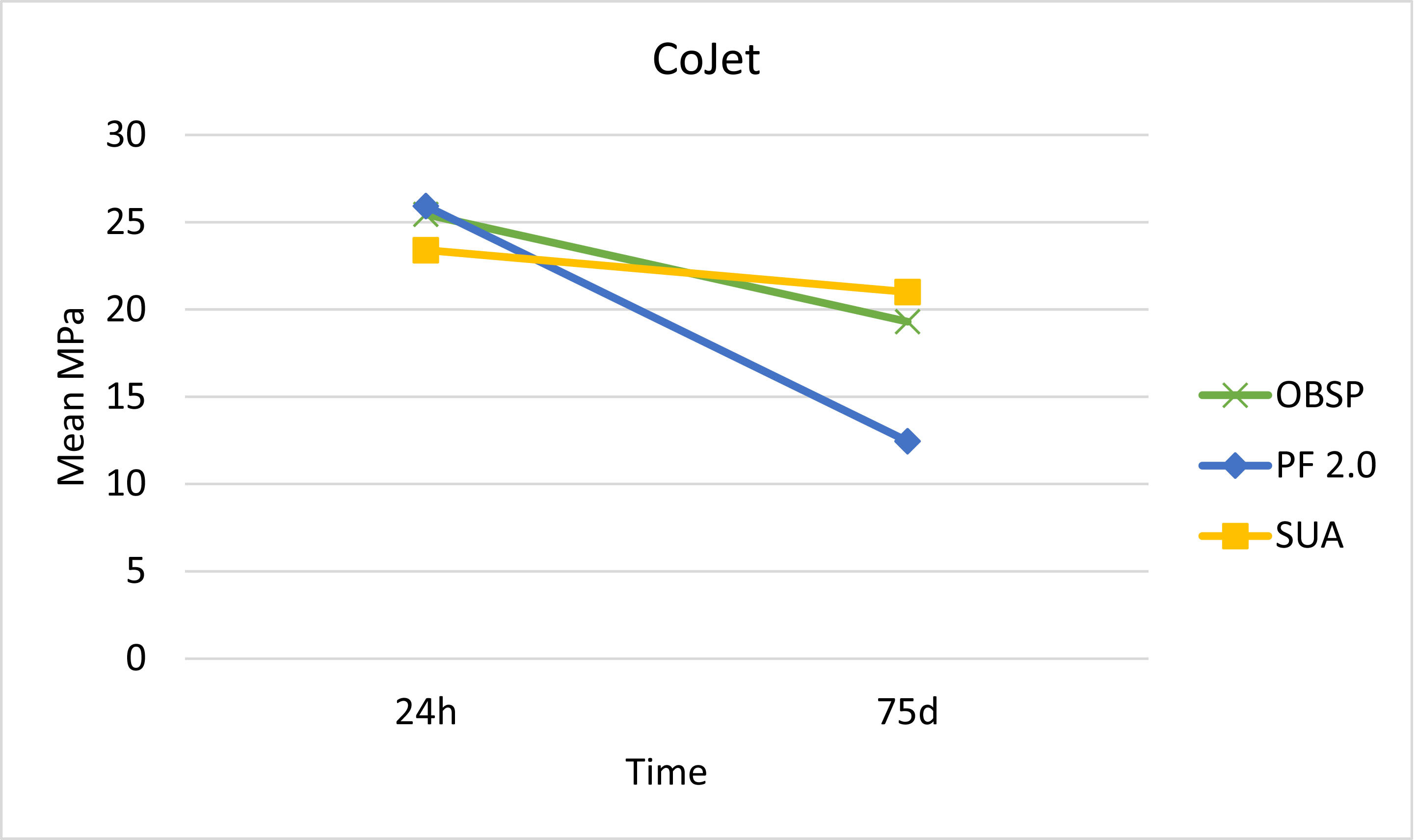
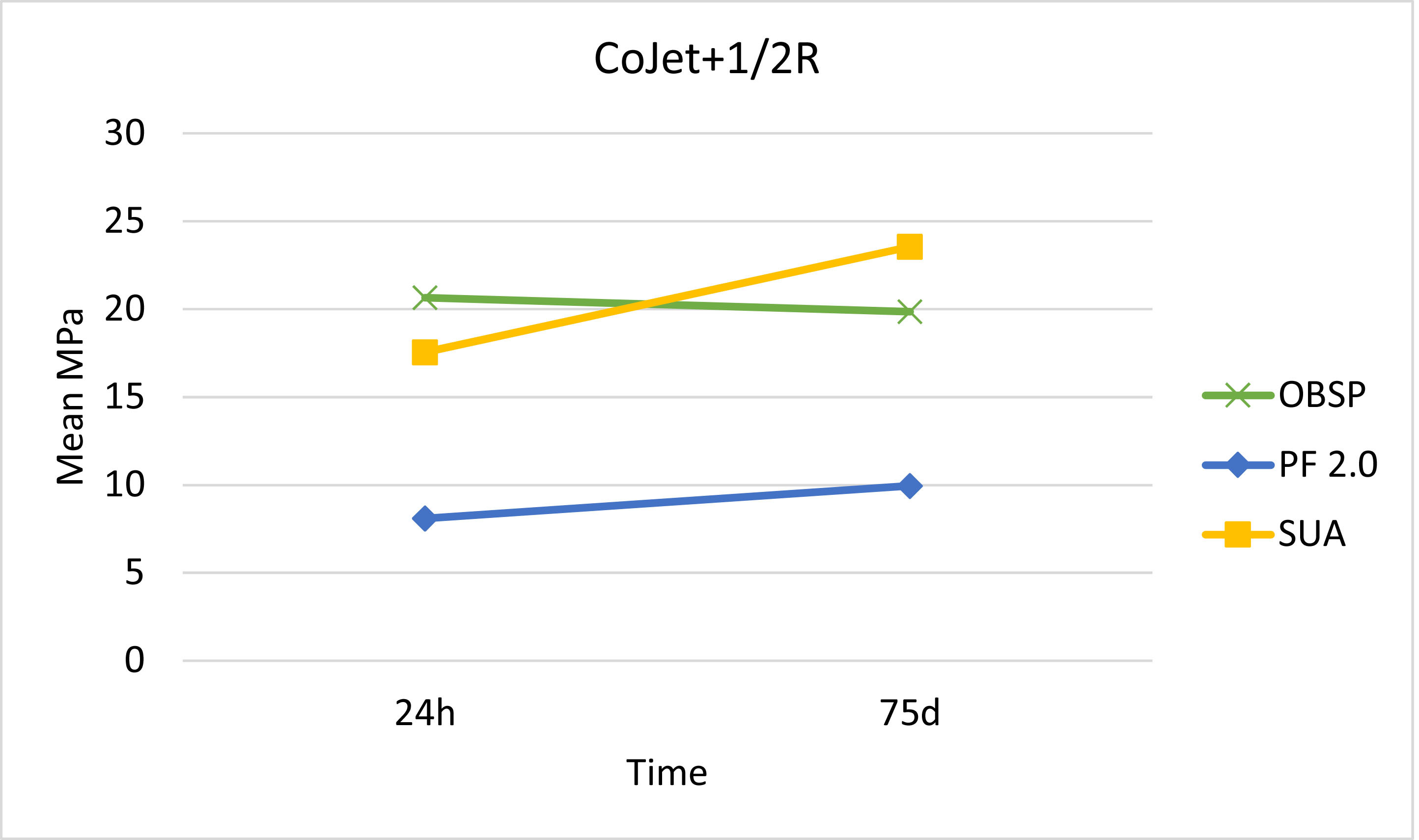
Results: Mean shear bond strengths (MPa) and standard deviations (SD) are illustrated in Table 1. Specimens whose bond strengths were greater than 20-MPa experienced cohesive failures within amalgam. Macro-mechanical retention wasn't generally beneficial. Figures 1 and 2 are plots of interactions.
Conclusions: Composite-resin may be bonded to silicoated amalgam restorations to serve as short-term repairs.
Methods: Spherical alloy (Tytin) was triturated (8-s), hand condensed in to cylindrical molds (diameter 6-mm, height 8-mm), and aged (8-weeks, deionized water, 37°C). After aging, amalgam surfaces were abraded (50-µm alumina, 45-psi, 10-mm distance, rinsed 10-s) to produce micro-mechanical retention. Specimens were randomly divided in to two groups: one group received a ½ round bur macro-retentive point, the other group did not. All specimens were abrasively silicoated (Co-Jet, 45-psi, 10-mm distance, until surface was uniformly black). Prior to application of adhesives, silane coupler (ESPE-Sil) was applied (60-s, air dried). Three adhesives were evaluated: Optibond Solo Plus (OBSP), Scotchbond Universal Adhesive (SUA) and Panavia F2.0 (PF2.0). OBSP was applied (20-s scrub, solvent evaporated 10-s with air), application repeated and photo-cured (20-s, 500mW/cm2). SUA applied (20-s scrub, solvent evaporated 5-s with air), photo-cured (10-s, 500mW/cm2). PF2.0 applied by hand mixing (30-s) equal amounts Catalyst and Base, lightly covering the amalgam surfaces then photo-curing (20-s, 500mW/cm2). Using Ultradent bonding jigs columns of Filtek-Z250 resin (2.38-mm diameter, 2.0-mm height) were photo-cured (40-s, 500mW/cm2) against treated amalgam surfaces. Specimens (n=10) were stored for 24-hrs or 75-days (deionized water, 37°C) then shear tested (Instron Universal Testing machine, cross-head speed 0.5mm/min, 1.0-mm chisel-shaped bar). Data was analyzed (three-way ANOVA, Tukey's HSD p<0.05).
Results: Mean shear bond strengths (MPa) and standard deviations (SD) are illustrated in Table 1. Specimens whose bond strengths were greater than 20-MPa experienced cohesive failures within amalgam. Macro-mechanical retention wasn't generally beneficial. Figures 1 and 2 are plots of interactions.
Conclusions: Composite-resin may be bonded to silicoated amalgam restorations to serve as short-term repairs.
IMAGES
2814783_File000000.jpg
2814783_File000001.jpg
2814783_File000000.jpg
2814783_File000001.jpg