IADR Abstract Archives
Sizes of silica fillers and their influence on composite mechanical and optical properties
Objectives: Dental resin composites represent an important family of materials that have been evolving in response to the needs in biocompatibility and mechanical properties. These are composite materials consisting of mostly inorganic fillers and additives bound together with a polymer matrix. Many fillers have been studied, but the largest body of research remains proprietary in the industrial sector. This work examines the effect of different sizes of silica particles on the mechanical and optical properties of the end composite materials.
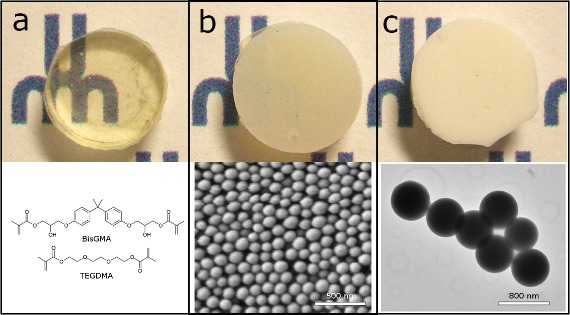
Methods: The Stöber method was used to synthesize several sizes of silica particles that were then surface functionalized using γ-MPS. The particles were characterized by dynamic light scattering and scanning electron microscopy. These particles were then fully integrated with the commercial monomers BisGMAand TEGDMA using a three roll mill to obtain the final composite pastes. These were then photopolymerized using a dental lamp, and mechanical testing was performed, measuring flexural strength and modulus. Optical testing was performed by measuring the transmittance and reflectance of the samples. Finally, depth of cure was evaluated by measuring the degree of conversion of the samples at different depths using Raman spectroscopy.
Results: Particles of 70, 100, 125, and 500 nm were tested in addition to polydisperse commercial macro-silica (0.5-10 µm). The composites yielding the best mechanical properties were shown to be the 500 nm silica particles, owing to their higher possible loading (70% vs 60% for the smallest silica). These materials, however, had low transparency, which lead to the inadequate depth of cure of 3 mm for one minute of curing. The optical properties were most favorable with the smallest particles, showing materials that were almost fully transparent, and showed the greatest depth of cure at > 6 mm.
Conclusions: The nanometer silica showed inferior mechanical properties, but the impressive increase in depth of cure proved to be a very useful counterpoint.
Methods: The Stöber method was used to synthesize several sizes of silica particles that were then surface functionalized using γ-MPS. The particles were characterized by dynamic light scattering and scanning electron microscopy. These particles were then fully integrated with the commercial monomers BisGMAand TEGDMA using a three roll mill to obtain the final composite pastes. These were then photopolymerized using a dental lamp, and mechanical testing was performed, measuring flexural strength and modulus. Optical testing was performed by measuring the transmittance and reflectance of the samples. Finally, depth of cure was evaluated by measuring the degree of conversion of the samples at different depths using Raman spectroscopy.
Results: Particles of 70, 100, 125, and 500 nm were tested in addition to polydisperse commercial macro-silica (0.5-10 µm). The composites yielding the best mechanical properties were shown to be the 500 nm silica particles, owing to their higher possible loading (70% vs 60% for the smallest silica). These materials, however, had low transparency, which lead to the inadequate depth of cure of 3 mm for one minute of curing. The optical properties were most favorable with the smallest particles, showing materials that were almost fully transparent, and showed the greatest depth of cure at > 6 mm.
Conclusions: The nanometer silica showed inferior mechanical properties, but the impressive increase in depth of cure proved to be a very useful counterpoint.
IMAGES
2412429_File000000.jpg
2412429_File000000.jpg