IADR Abstract Archives
Effect of Polishing on the Surface Hardness of a Bulk Fill Resin
Objectives: Some researchers measure surface hardness of resins after polishing while others do not polish the specimens. This study measured the Vickers hardness before and after polishing away a 0.2 mm layer from a flat, lateral surface.
Methods: A 10 mm deep split metal mold with a semi-cylindrical 6 mm diameter form facing a 6 mm wide 0.2 mm deep indent was filled with Tetric EvoCeram Bulk Fill IVA (Ivoclar Vivadent) resin. The resin was cured with a 3M ESPE DeepCure-S light for 10 seconds and stored in the dark at 37°C. The samples were removed after 24 hours and Vickers hardness (1000 g load for 8 seconds) was measured at the top and at 1.0 mm increments from the top and going down the lateral surface of the sample. The samples were then polished using copious water coolant to remove the excess 0.2 mm layer of resin, and the Vickers hardness was measured again at the same locations. The Vickers hardness of the unpolished and polished surfaces at each depth were compared using ANOVA and Fisher's PLSD (p<0.05)
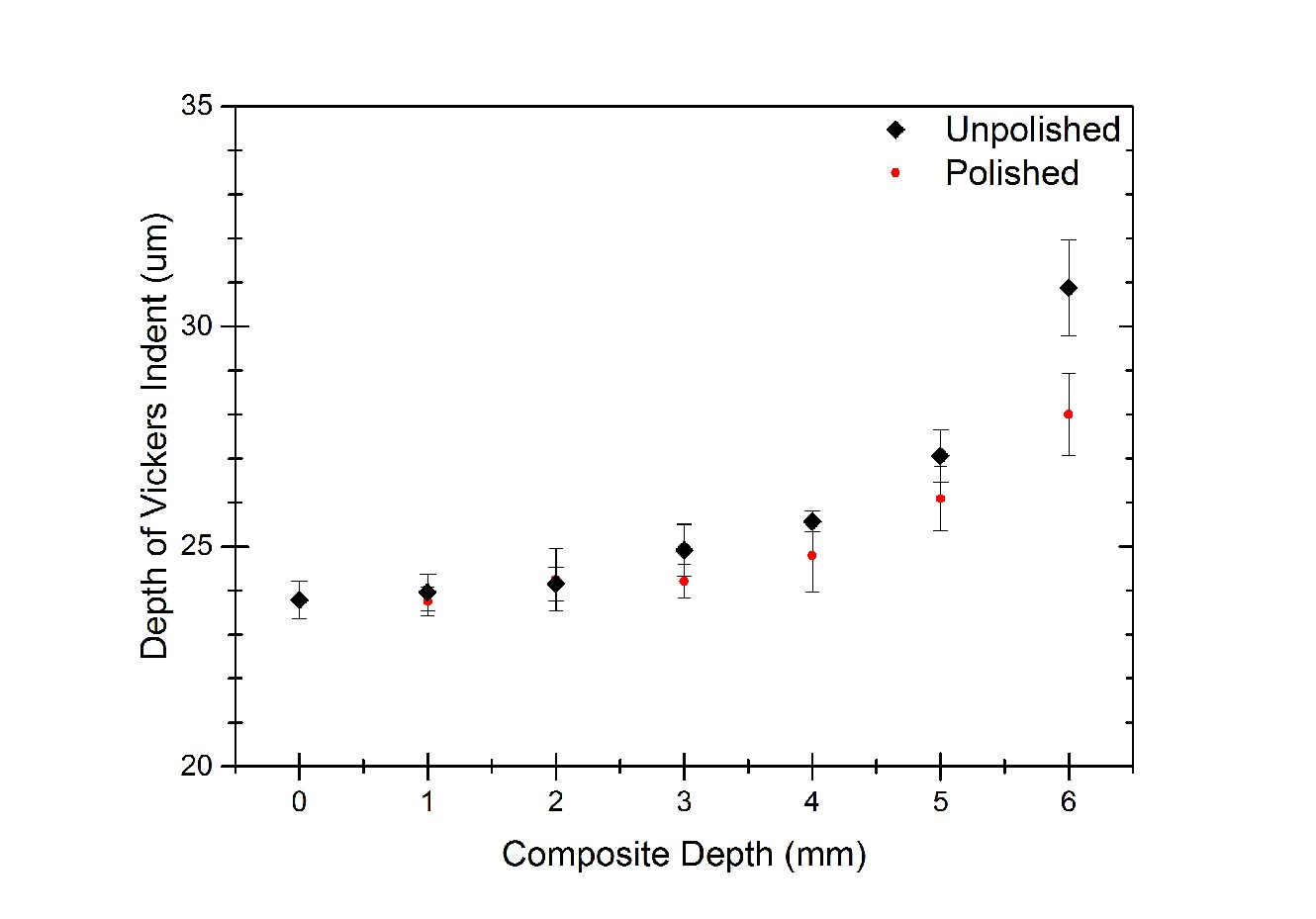
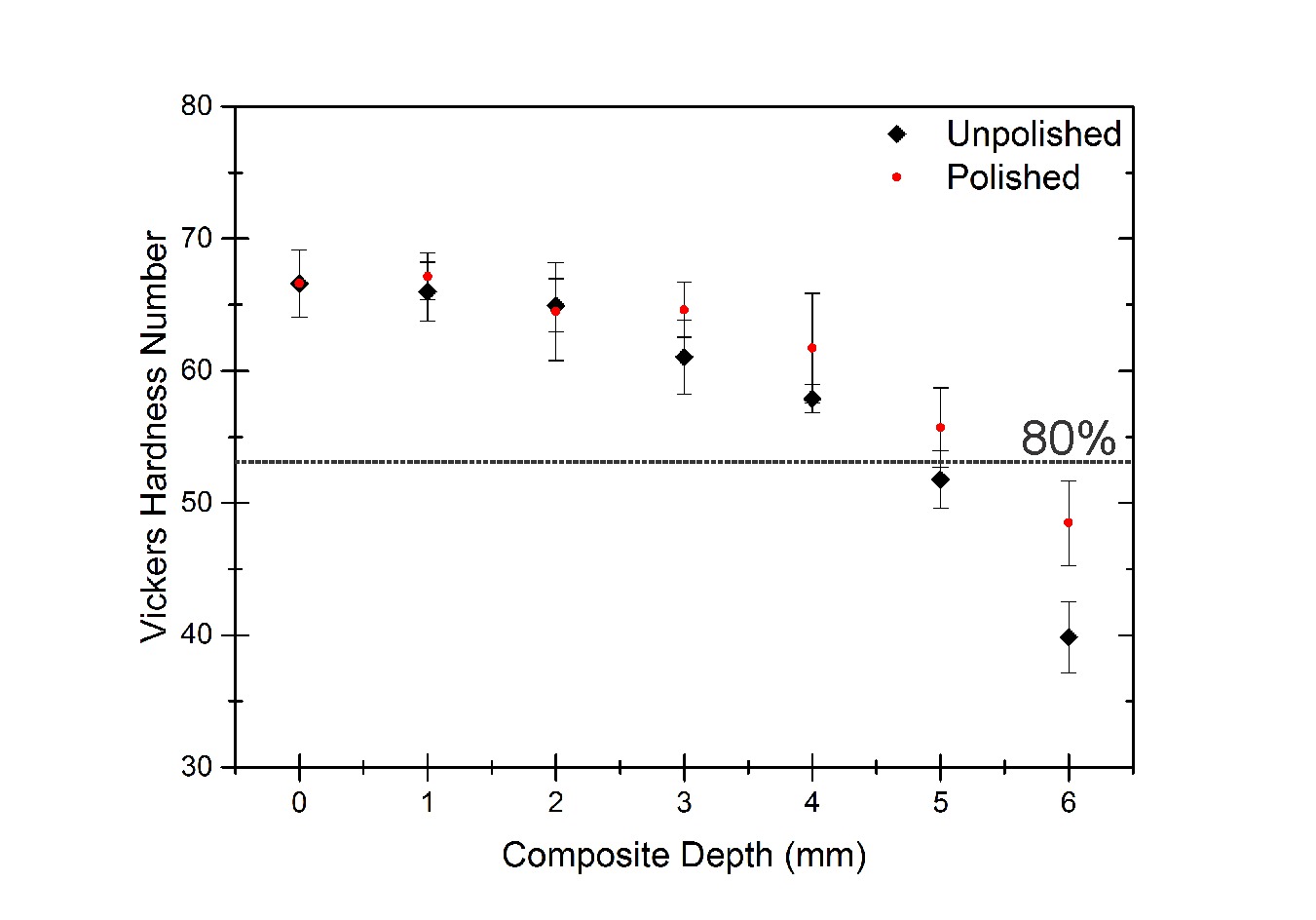
Results: Depending on the hardness, the indentation depth was between 24 and 31 microns (Figure 1). There was no significant difference in the Vickers hardness of the unpolished and polished specimens at 1 or 2 mm only (Table 1). Beyond 2 mm from the top surface, the Vickers surface hardness of the resin increased after polishing, and the effect of polishing was more evident at greater depths where the material was initially softer. The percent difference in hardness began increasing after 2 mm depth, and reached a 9.3% increase in hardness at a depth of 6 mm. Figure 2 shows that the Vickers hardness remained greater than 80% of the top hardness value down to a depth of 4 mm from the surface in the unpolished specimens, and to a depth of 5 mm in the polished specimens.
Conclusions: Polishing a resin sample may increase the hardness at the surface and increase the perceived depth of cure. The effect of polishing is greater on resin surfaces that are initially softer and potentially less well polymerized.
Methods: A 10 mm deep split metal mold with a semi-cylindrical 6 mm diameter form facing a 6 mm wide 0.2 mm deep indent was filled with Tetric EvoCeram Bulk Fill IVA (Ivoclar Vivadent) resin. The resin was cured with a 3M ESPE DeepCure-S light for 10 seconds and stored in the dark at 37°C. The samples were removed after 24 hours and Vickers hardness (1000 g load for 8 seconds) was measured at the top and at 1.0 mm increments from the top and going down the lateral surface of the sample. The samples were then polished using copious water coolant to remove the excess 0.2 mm layer of resin, and the Vickers hardness was measured again at the same locations. The Vickers hardness of the unpolished and polished surfaces at each depth were compared using ANOVA and Fisher's PLSD (p<0.05)
Results: Depending on the hardness, the indentation depth was between 24 and 31 microns (Figure 1). There was no significant difference in the Vickers hardness of the unpolished and polished specimens at 1 or 2 mm only (Table 1). Beyond 2 mm from the top surface, the Vickers surface hardness of the resin increased after polishing, and the effect of polishing was more evident at greater depths where the material was initially softer. The percent difference in hardness began increasing after 2 mm depth, and reached a 9.3% increase in hardness at a depth of 6 mm. Figure 2 shows that the Vickers hardness remained greater than 80% of the top hardness value down to a depth of 4 mm from the surface in the unpolished specimens, and to a depth of 5 mm in the polished specimens.
Conclusions: Polishing a resin sample may increase the hardness at the surface and increase the perceived depth of cure. The effect of polishing is greater on resin surfaces that are initially softer and potentially less well polymerized.
IMAGES
2409370_File000001.jpg
2409370_File000000.jpg
2409370_File000001.jpg
2409370_File000000.jpg