IADR Abstract Archives
Microleakage Evaluation of Elevated Temperatures in Adhesive Systems
Objectives: Compare marginal microleakage across three different generations of bonding agents after heating the materials prior to placement. Adjusting the delivery and storage of materials that were exposed to prolonged high temperatures before application may compromise their restorative properties.
Methods: Standard Class II slot preparations (120) were performed on non-carious human molars with approximately 3mm depth at gingival floor and 4mm width bucco-lingually. Samples were randomly assigned into 12 groups (n=10). Three bonding agents were tested: ExciTE® F Ivoclar Vivadent (EF), CLEARFILTM SE Bond Kurary Dental (CF), and ScotchbondTM Universal Adhesive 3M ESPE (SB). ACTIVATM BioACTIVE Restorative Pulpdent (AB), was tested for additional comparisons. Materials were placed in an incubator (Thermo ScientificTM, ELED265) and heated for 120 hours at either 24°C, 40°C, or 52°C. All materials were applied according to manufacturer’s instructions. FiltekTM Supreme Ultra composite 3M ESPE was placed on bonding agents. Completed restorations were thermocycled for 5,000 cycles with dwell time of 15 seconds between 5°C and 55°C. Samples were immersed in 2% methylene blue dye for 8 hours, embedded in acrylic resin, sectioned mesio-distally, and evaluated under stereomicroscope (Olympus, SZX16). A dye-penetration-to-axial-wall (DP) score was used on gingival floor: 0=0% DP, 1=1-25% DP, 2=26-50% DP, 3=51-75% DP, and 4=76-100% DP. Counts and percentages were calculated, and statistical significance was assessed via generalized estimating equations (GEE) for separate comparisons of materials and temperatures.
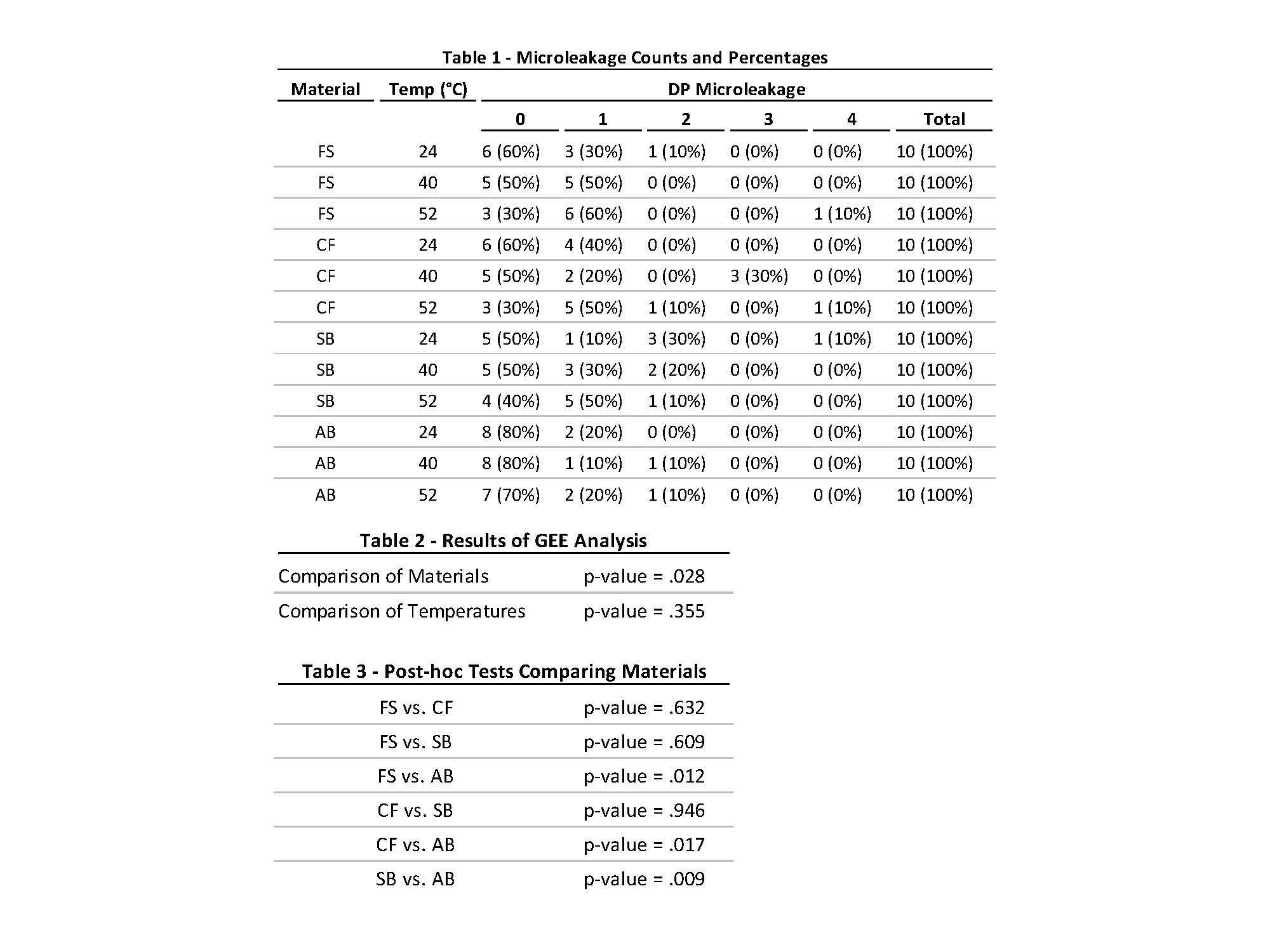
Results: Table 1 displays counts and percentages of microleakage scores. Table 2 displays GEE analysis showing statistically significant difference (p<0.05) between materials. Table 3 displays post-hoc tests using Bonferroni correction to adjust for multiple comparisons (p<0.008). All comparisons with AB would have been significant at p<0.05, but no comparisons were found significant using Bonferroni correction.
Conclusions: Results suggest that there are differences in microleakage between adhesive systems, but no definitive conclusions could be drawn from gathered data.
Methods: Standard Class II slot preparations (120) were performed on non-carious human molars with approximately 3mm depth at gingival floor and 4mm width bucco-lingually. Samples were randomly assigned into 12 groups (n=10). Three bonding agents were tested: ExciTE® F Ivoclar Vivadent (EF), CLEARFILTM SE Bond Kurary Dental (CF), and ScotchbondTM Universal Adhesive 3M ESPE (SB). ACTIVATM BioACTIVE Restorative Pulpdent (AB), was tested for additional comparisons. Materials were placed in an incubator (Thermo ScientificTM, ELED265) and heated for 120 hours at either 24°C, 40°C, or 52°C. All materials were applied according to manufacturer’s instructions. FiltekTM Supreme Ultra composite 3M ESPE was placed on bonding agents. Completed restorations were thermocycled for 5,000 cycles with dwell time of 15 seconds between 5°C and 55°C. Samples were immersed in 2% methylene blue dye for 8 hours, embedded in acrylic resin, sectioned mesio-distally, and evaluated under stereomicroscope (Olympus, SZX16). A dye-penetration-to-axial-wall (DP) score was used on gingival floor: 0=0% DP, 1=1-25% DP, 2=26-50% DP, 3=51-75% DP, and 4=76-100% DP. Counts and percentages were calculated, and statistical significance was assessed via generalized estimating equations (GEE) for separate comparisons of materials and temperatures.
Results: Table 1 displays counts and percentages of microleakage scores. Table 2 displays GEE analysis showing statistically significant difference (p<0.05) between materials. Table 3 displays post-hoc tests using Bonferroni correction to adjust for multiple comparisons (p<0.008). All comparisons with AB would have been significant at p<0.05, but no comparisons were found significant using Bonferroni correction.
Conclusions: Results suggest that there are differences in microleakage between adhesive systems, but no definitive conclusions could be drawn from gathered data.
IMAGES
2408308_File000000.jpg
2408308_File000000.jpg