IADR Abstract Archives
Engineering Nanopatterned Hybrid Surfaces by Biomimetic Mineralization of Elastin-like Recombinamer
Objectives: The ability to fabricate micro- and nano-patterned surfaces for controlling cell-material interactions has allowed the fundamental study of those interactions and also guided the design of new biomaterials. It is now known that a phenomenon such as “contact guidance” of cells by aligned surface grooves is based on a combination of the physical, chemical, and mechanical cues provided by the substrate. The fabrication of patterned organic-inorganic hybrid surfaces down to the nanolevel, which would confer bone-like and dentin-like cues, has been scarcely reported. This is because methods that lack a biomimetic approach for mineralization of the polymeric matrix have not been used. Our objective was to micropattern elastin-like recombinamers (ELRs) that will template hydroxyapatite nanocrystal mineralization by selectively infiltrating the ELRs.
Methods: Nanopatterned ELR surfaces were fabricated by lyophilization onto patterned polydimethylsiloxane hydrogels, which had been cured on a custom silicon carbide wafer. Four patterns were used: grooves, small-scale holes, large-scale holes, and pegs. After crosslinking and washing, the ELR matrices were mineralized for a week using the polymer-induced liquid precursor method (PILP). Mineralization was confirmed using scanning electron microscopy (SEM), Energy Dispersive X-Ray Spectroscopy (EDS), X-Ray diffractometry (XRD), and Attenuated Total-Reflectance Infrared Spectroscopy (ATR-FTIR).
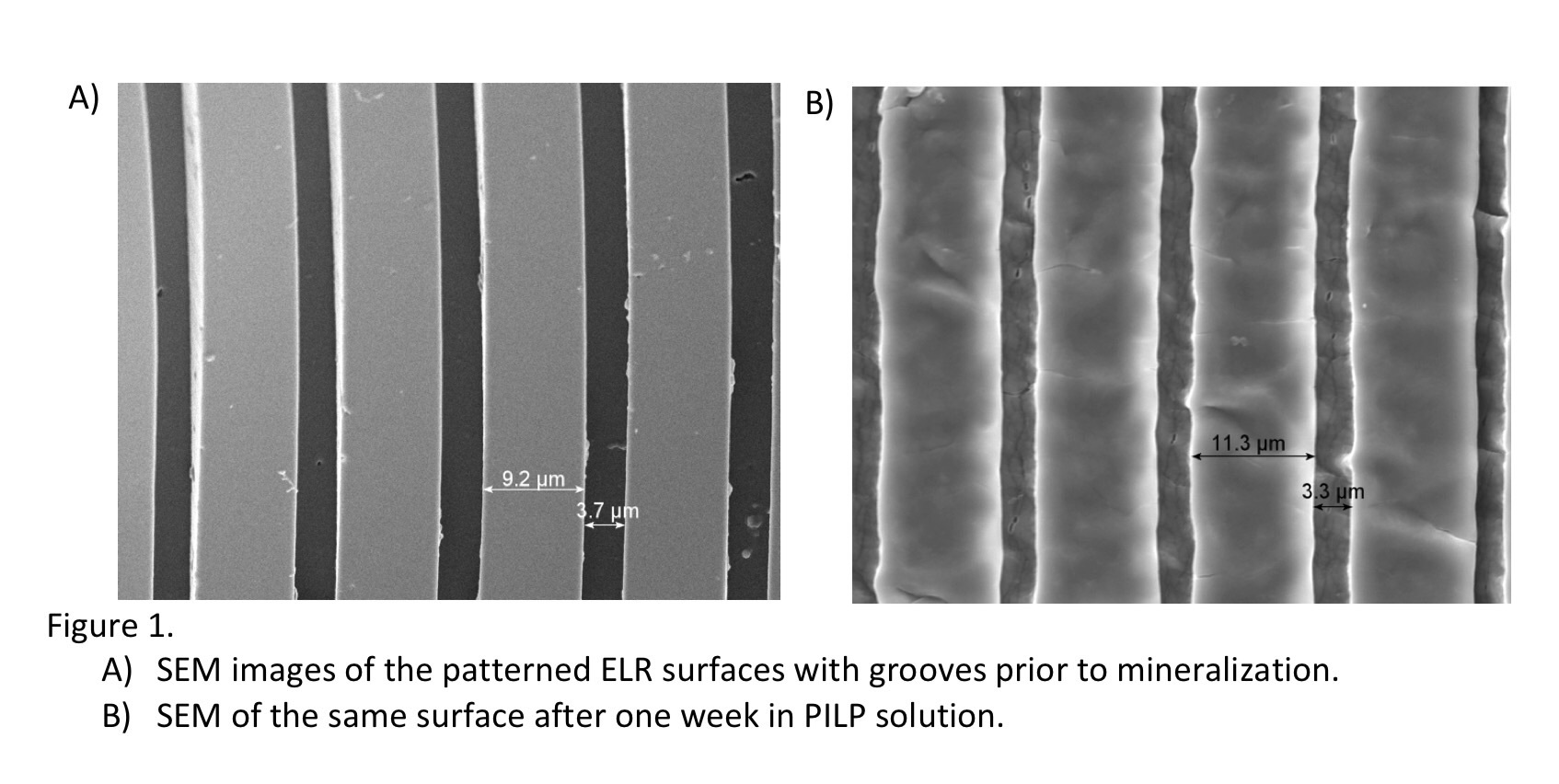
Results: We successfully fabricated micropatterned ELR surfaces (Figure 1A). After 7 days in the PILP solution the ELRs were mineralized with minimal dimensional change of the pattern (Figure 1B). The Ca/P=1.65 ratio obtained by EDS in combination with the positioning of the peaks in the XRD spectra confirmed that minerals formed were hydroxyapatite. Further analysis with FTIR confirmed that we obtained carbonated hydroxyapatite in the hybrid nanopatterned surfaces.
Conclusions: We controlled biomineralization of patterned surfaces of ELRs by using the PILP method. This structured hybrid surfaces can control and enhance osteoblast and odontoblast response.
Methods: Nanopatterned ELR surfaces were fabricated by lyophilization onto patterned polydimethylsiloxane hydrogels, which had been cured on a custom silicon carbide wafer. Four patterns were used: grooves, small-scale holes, large-scale holes, and pegs. After crosslinking and washing, the ELR matrices were mineralized for a week using the polymer-induced liquid precursor method (PILP). Mineralization was confirmed using scanning electron microscopy (SEM), Energy Dispersive X-Ray Spectroscopy (EDS), X-Ray diffractometry (XRD), and Attenuated Total-Reflectance Infrared Spectroscopy (ATR-FTIR).
Results: We successfully fabricated micropatterned ELR surfaces (Figure 1A). After 7 days in the PILP solution the ELRs were mineralized with minimal dimensional change of the pattern (Figure 1B). The Ca/P=1.65 ratio obtained by EDS in combination with the positioning of the peaks in the XRD spectra confirmed that minerals formed were hydroxyapatite. Further analysis with FTIR confirmed that we obtained carbonated hydroxyapatite in the hybrid nanopatterned surfaces.
Conclusions: We controlled biomineralization of patterned surfaces of ELRs by using the PILP method. This structured hybrid surfaces can control and enhance osteoblast and odontoblast response.
IMAGES
2408248_File000000.jpg
2408248_File000000.jpg