IADR Abstract Archives
Primary Stability: Influence of Bone and Insertional Torque on Micromotion
Objectives: The importance of the primary stability is widely acknowledged defined as the absence of micromovements larger than 75-100 µm. Unfortunately, there are no means to detect accurately micromotions in the clinical field, whereas ex vivo samples allow the precise detection through mechanical instrumentation. The success of the adaptation (osteointegration) depends on several factors, including the density and dimension of the host bone, the implant geometry, the surgical technique and peak insertion torque. Thus, in clinical practice, estimates of the primary stability come from detections of bone properties and insertional torque. The statistical relevance of these indirect measurements is still under debate.
Methods: More than 50 implants (BTK bt safe Bone level) were inserted in fresh pig-bone ribs from the same animal; insertional torque was recorded by a digital dynamometric wrench. Each rib was previously examined radiographically through the use of CBCT-TAC to assess cortical and medullary thickness and to evaluate bone density through the attenuation of gray (Hounsfield units).
The implants were subjected to five repeated cycles of lateral load up to 5 N using a Zwick-Roell machine and for each implant an average displacement was detected.
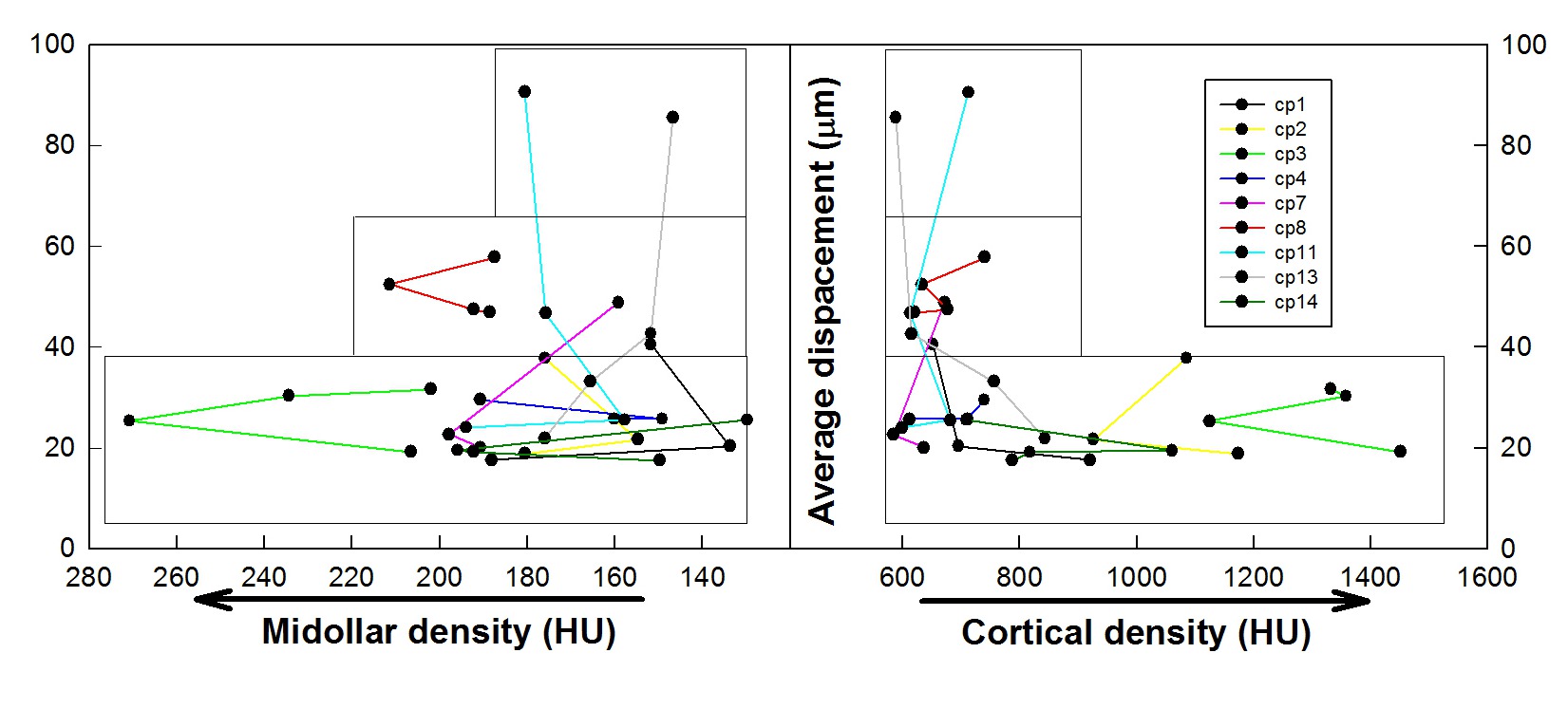
Results: In each ribs, the cortical and medullary bone densities around the implant and the torque and micromotions under 5 N load were measured. The micromovements observed under uniform applied load are investigated as function of the cortical and medullary densities as reported below.
These results are in close agreement with the scientific literature knowledge on the firm influence of cortical bone density in ensuring better implant fixity.
Concerning the insertional torque, strong correlation of insertional torque above 80 Ncm with micromovements demonstrates that excessively high insertional torque increase micromovements depletes primary stability.
Conclusions: Primary stability is shown to depend essentially on cortical density; high insertional torque depletes implant fixity increasing micromovements. The possible routes to overcome present instrumentation limitations are discussed.
Methods: More than 50 implants (BTK bt safe Bone level) were inserted in fresh pig-bone ribs from the same animal; insertional torque was recorded by a digital dynamometric wrench. Each rib was previously examined radiographically through the use of CBCT-TAC to assess cortical and medullary thickness and to evaluate bone density through the attenuation of gray (Hounsfield units).
The implants were subjected to five repeated cycles of lateral load up to 5 N using a Zwick-Roell machine and for each implant an average displacement was detected.
Results: In each ribs, the cortical and medullary bone densities around the implant and the torque and micromotions under 5 N load were measured. The micromovements observed under uniform applied load are investigated as function of the cortical and medullary densities as reported below.
These results are in close agreement with the scientific literature knowledge on the firm influence of cortical bone density in ensuring better implant fixity.
Concerning the insertional torque, strong correlation of insertional torque above 80 Ncm with micromovements demonstrates that excessively high insertional torque increase micromovements depletes primary stability.
Conclusions: Primary stability is shown to depend essentially on cortical density; high insertional torque depletes implant fixity increasing micromovements. The possible routes to overcome present instrumentation limitations are discussed.
IMAGES
2407510_File000001.jpg
2407510_File000001.jpg