IADR Abstract Archives
Validation of a Constitutive Model for Dental Composites during Curing
Objectives: Research was conducted to evaluate a constitutive model that uses shrinkage stress and shrinkage strain to derive changes in Young’s modulus of dental composites during the curing process. When the modulus increases quickly compared to the shrinkage strain, more shrinkage stress is expected to develop, leading possibly to fractures and debonding. The model can be used in conjunction with finite element analysis to predict stresses and deflections produced in restored teeth during the curing process.
Methods: Published shrinkage stress and shrinkage strain data for Z250 [1] were extracted. The stress and strain data were plotted against each other, and a curve was fitted to the data by nonlinear least squares. The derivative of the curve was calculated, and the time-history data for Young’s modulus was computed using the newly developed constitutive model. The data calculated by the constitutive equation were validated by looking at the cuspal deflection of a model restored tooth using the finite element model, which was compared to published experimental results [2].
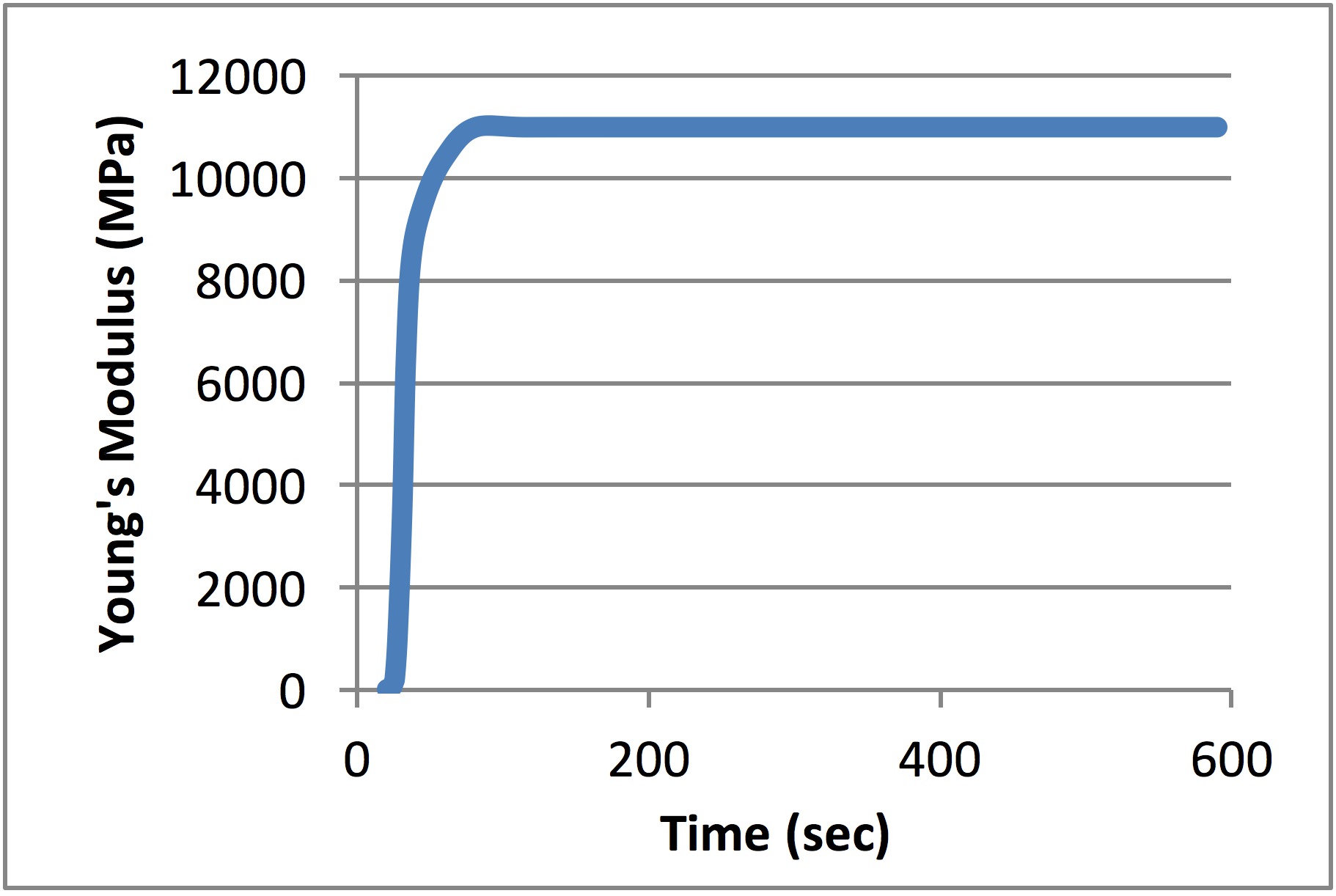
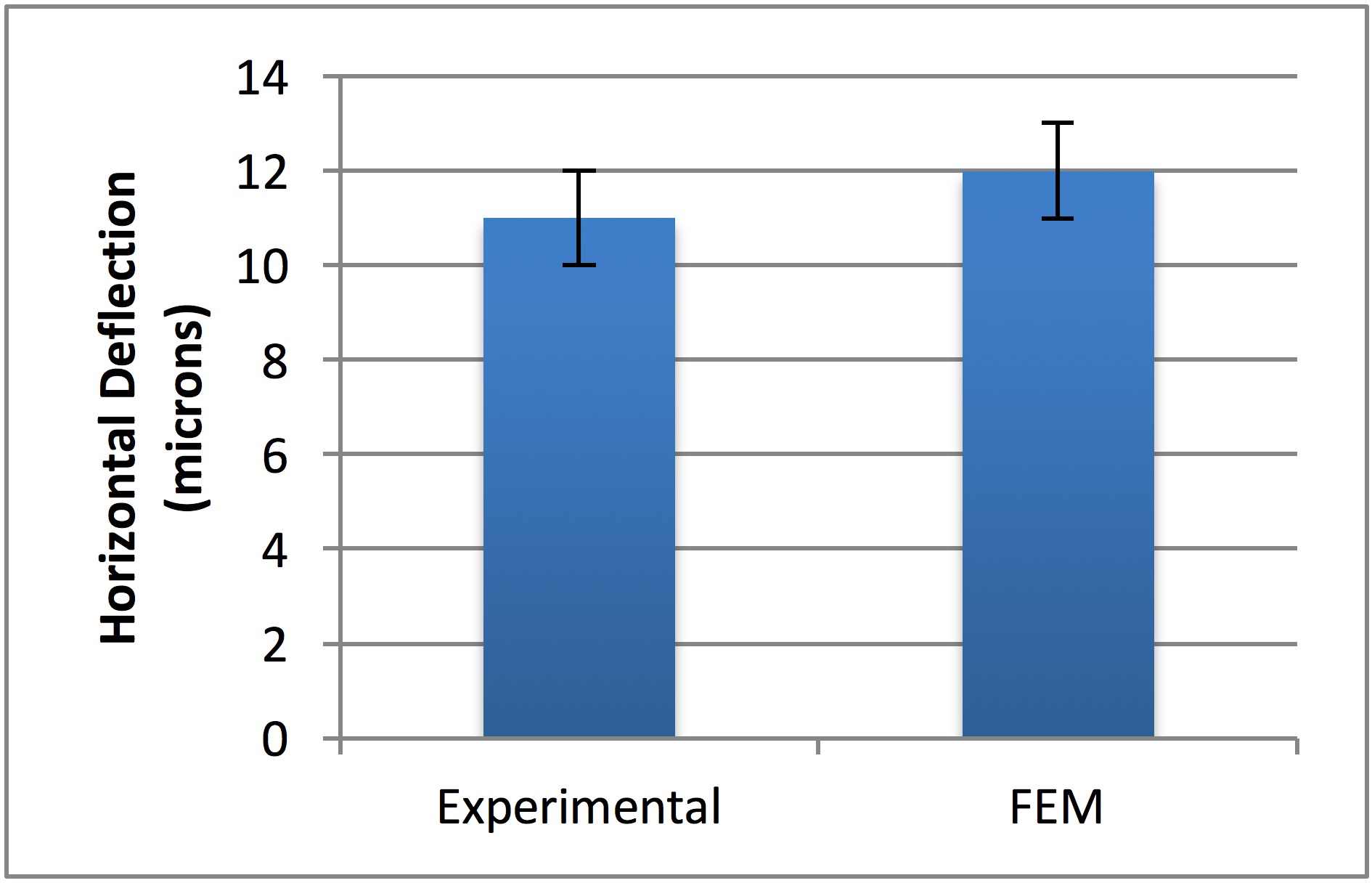
Results: The Young’s modulus time history for Z250 given by the constitutive law is shown in Figure 1. The horizontal cuspal deflection was predicted to be ~12 microns, which compared favorably with the published experimental value of ~11 microns [2]; see Figure 2.
Conclusions: The model properly predicts time-history data of Young’s modulus for a dental composite (Z250). Analytical prediction for the cuspal deflection of a model restored tooth closely matched experimental data. The constitutive law would allow prediction of temporal development of shrinkage stress in teeth, something that is difficult to measure due to the complex geometry.
References
1. Min, S., J. Ferracane and I. Lee. "Effect of shrinkage strain, modulus, and instrument compliance on polymerization shrinkage stress of light-cured composites during the initial curing stage." Dental Materials 26.10 (2010): 1024-33.
2. Park, J., J. Chang and J. et al. Ferracane. "How should composite be layered to reduce shrinkage stress: incremental or bulk filling?" Dental Materials 24.11 (2008): 1501-5.
Methods: Published shrinkage stress and shrinkage strain data for Z250 [1] were extracted. The stress and strain data were plotted against each other, and a curve was fitted to the data by nonlinear least squares. The derivative of the curve was calculated, and the time-history data for Young’s modulus was computed using the newly developed constitutive model. The data calculated by the constitutive equation were validated by looking at the cuspal deflection of a model restored tooth using the finite element model, which was compared to published experimental results [2].
Results: The Young’s modulus time history for Z250 given by the constitutive law is shown in Figure 1. The horizontal cuspal deflection was predicted to be ~12 microns, which compared favorably with the published experimental value of ~11 microns [2]; see Figure 2.
Conclusions: The model properly predicts time-history data of Young’s modulus for a dental composite (Z250). Analytical prediction for the cuspal deflection of a model restored tooth closely matched experimental data. The constitutive law would allow prediction of temporal development of shrinkage stress in teeth, something that is difficult to measure due to the complex geometry.
References
1. Min, S., J. Ferracane and I. Lee. "Effect of shrinkage strain, modulus, and instrument compliance on polymerization shrinkage stress of light-cured composites during the initial curing stage." Dental Materials 26.10 (2010): 1024-33.
2. Park, J., J. Chang and J. et al. Ferracane. "How should composite be layered to reduce shrinkage stress: incremental or bulk filling?" Dental Materials 24.11 (2008): 1501-5.
IMAGES
2406403_File000000.jpg
2406403_File000001.jpg
2406403_File000000.jpg
2406403_File000001.jpg