IADR Abstract Archives
Characterization and Optimization of Composite Scaffolds for Guided Bone Regeneration
Objectives: Collagen scaffolds for guided bone regeneration have poor mechanical properties and fail due to lack of rigidity and rapid degradation by collagenases. The objectives of this study were to reinforce collagen with elastin-like polypeptide (ELP) and optimize composite mechanical properties using novel response surface methodology (RSM).
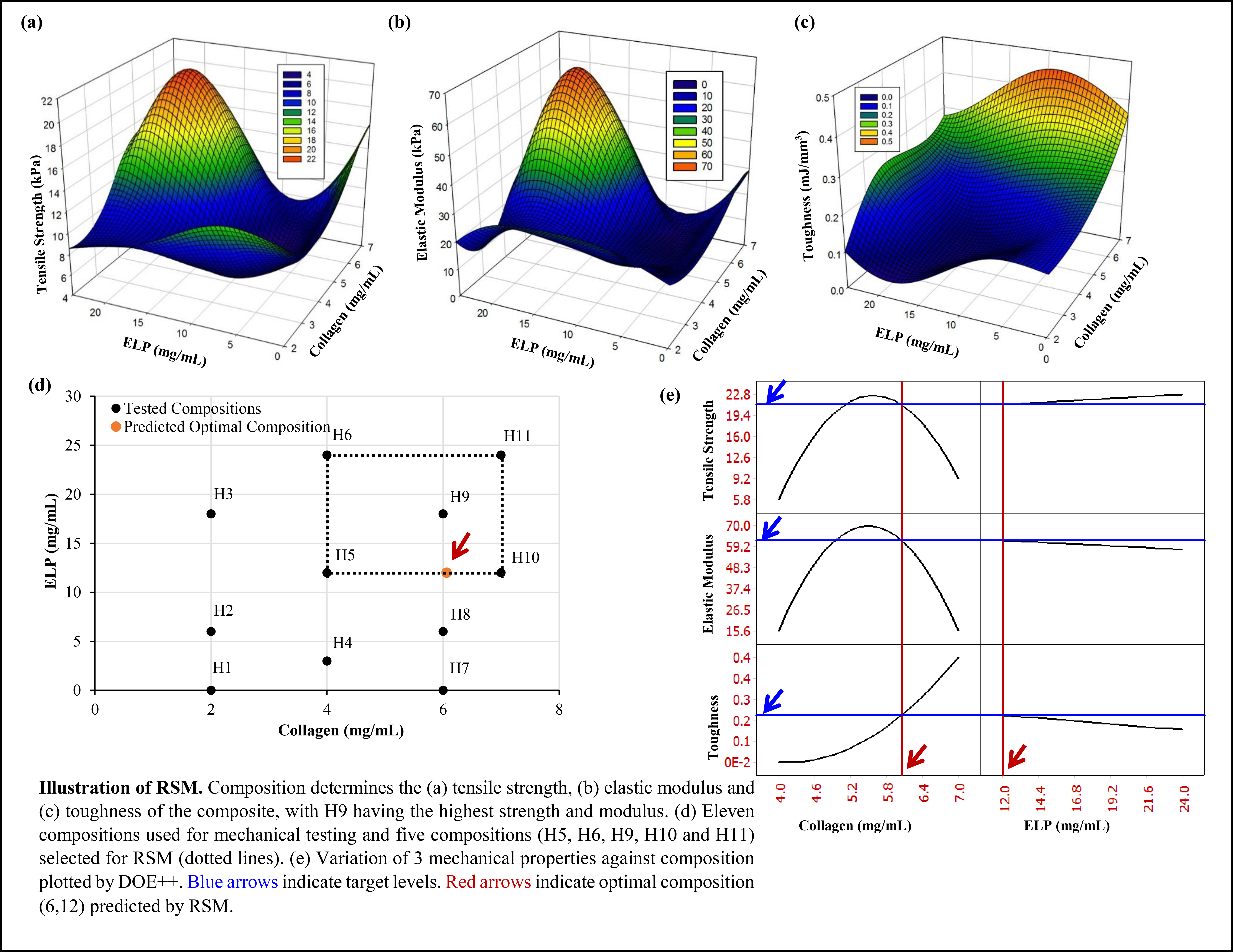
Methods: 2-7mg/mL collagen and 0-24mg/mL ELP were used in 11 different proportions to form the composites (Fig.1). Tensile strength, elastic modulus and toughness of hydrated composites were determined by uniaxial tensile testing (n=6) and optimized by two factor (collagen/ELP concentration) analysis with RSM (DOE++ software). Composites (n=3) were characterized by swelling ratio, differential scanning calorimetry (DSC), scanning electron microscopy (SEM) and FTIR spectroscopy.
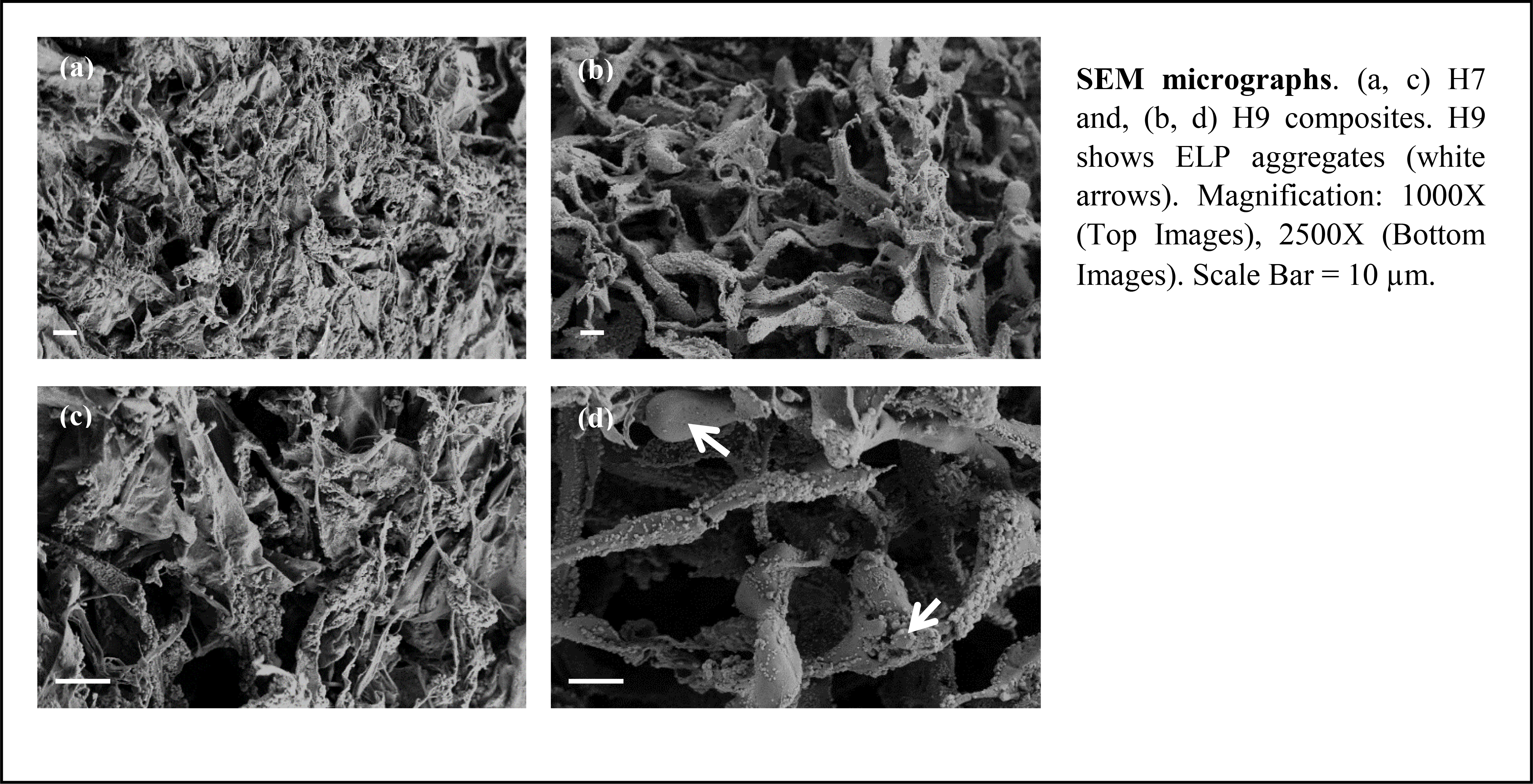
Results: Mechanical properties varied with composition (Fig.1a,b,c). H9 composite had the maximum strength (20.2±11.3kPa) and modulus (61.8±22.7kPa), but had lower toughness (0.20±0.04mJ/mm3) than many other composites. The efficient RSM technique performed equally weighted two-factor, three-objective optimization using just 5 compositions (versus the 11 we had to prepare for Fig.1a,b,c) and directed us to 6:12mg/mL collagen:ELP composition that may have high toughness without negatively impacting strength and modulus (Fig.1d,e). Physical characterization of freeze-dried H9 composite against its control (H7) by swelling ratio, DSC, and FTIR revealed that the addition of ELP in composites reduced the residual water content (swelling ratio for H7=53.8±3.7 versus H9=30.8±2.1). SEM images of both H7 (Fig.2a,c) and H9 (Fig.2b,d) composites showed porous fibrillar and afibrillar collagenous microstructure. Additionally, H9 composite showed dense microstructure with characteristic ELP aggregates.
Conclusions: A biomaterial with suboptimal properties should be optimized by a compromise between the minimal requirements, target level, and relative importance of each property. RSM efficiently performed such optimization for ELP-collagen composites and predicted a new composition for future testing. Our study demonstrated that ELP-Collagen composites have the capability to form good quality, rigid porous structures required for guided bone regeneration.
Methods: 2-7mg/mL collagen and 0-24mg/mL ELP were used in 11 different proportions to form the composites (Fig.1). Tensile strength, elastic modulus and toughness of hydrated composites were determined by uniaxial tensile testing (n=6) and optimized by two factor (collagen/ELP concentration) analysis with RSM (DOE++ software). Composites (n=3) were characterized by swelling ratio, differential scanning calorimetry (DSC), scanning electron microscopy (SEM) and FTIR spectroscopy.
Results: Mechanical properties varied with composition (Fig.1a,b,c). H9 composite had the maximum strength (20.2±11.3kPa) and modulus (61.8±22.7kPa), but had lower toughness (0.20±0.04mJ/mm3) than many other composites. The efficient RSM technique performed equally weighted two-factor, three-objective optimization using just 5 compositions (versus the 11 we had to prepare for Fig.1a,b,c) and directed us to 6:12mg/mL collagen:ELP composition that may have high toughness without negatively impacting strength and modulus (Fig.1d,e). Physical characterization of freeze-dried H9 composite against its control (H7) by swelling ratio, DSC, and FTIR revealed that the addition of ELP in composites reduced the residual water content (swelling ratio for H7=53.8±3.7 versus H9=30.8±2.1). SEM images of both H7 (Fig.2a,c) and H9 (Fig.2b,d) composites showed porous fibrillar and afibrillar collagenous microstructure. Additionally, H9 composite showed dense microstructure with characteristic ELP aggregates.
Conclusions: A biomaterial with suboptimal properties should be optimized by a compromise between the minimal requirements, target level, and relative importance of each property. RSM efficiently performed such optimization for ELP-collagen composites and predicted a new composition for future testing. Our study demonstrated that ELP-Collagen composites have the capability to form good quality, rigid porous structures required for guided bone regeneration.
IMAGES
2401496_File000000.jpg
2401496_File000001.jpg
2401496_File000000.jpg
2401496_File000001.jpg