IADR Abstract Archives
Overestimation of Dental Caries in Children: A Case Series Analysis
Objectives: The traditional decayed, missing, and filled surfaces (dmfs) system for counting dental caries assumes all surfaces of crowned and missing teeth are affected. The current study used a case series to compare the traditional counting mechanism with modified dmfs scores based on actual counts of dental caries from pretreatment study visits and treatment records to determine if disease overestimation exists in observational research.
Methods: Infants in this longitudinal IRB-approved study were recruited from Perry County, Alabama, a high-caries risk community because of their low socioeconomic status and minority (African American) population. Descriptive characteristics were determined from baseline questionnaires. Dental caries data were collected via visual oral exams every twelve months for sixty months. Children with complete follow-up and at least one crown or extraction due to dental caries were eligible to be included in this case series (N = 45). Records of dental care of treating dentists were reviewed to quantify the actual number of tooth surfaces affected by dental caries before treatment; 19 charts were chart-reviewable. Actual dental caries counts for 54 teeth were used to create two modified dmfs score outcomes: chart review (i.e., treatment records) and study pretreatment exam (i.e., study visit immediately preceding treatment). Differences between traditional and two modified dmfs scores were evaluated by Wilcoxon Signed Rank Tests, using a Bonferroni-corrected α = 0.017.
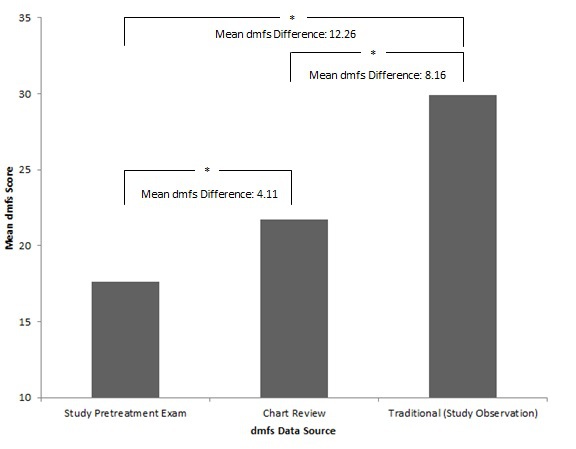
Results: While traditional dmfs scores significantly overestimated the actual measure (i.e. chart review) of disease (p < 0.0001), pretreatment data significantly underestimated actual (p = 0.0005) and traditional (p < 0.0001) methodologies of dental caries counts at sixty months (Figure 1).
Conclusions: This case series provided evidence contradicting the assumption that all five surfaces of crowned or extracted primary teeth are affected. Traditional scoring overemphasized caries while pretreatment values were too conservative, suggesting the need for the development of a chart review-based, modified score.
Methods: Infants in this longitudinal IRB-approved study were recruited from Perry County, Alabama, a high-caries risk community because of their low socioeconomic status and minority (African American) population. Descriptive characteristics were determined from baseline questionnaires. Dental caries data were collected via visual oral exams every twelve months for sixty months. Children with complete follow-up and at least one crown or extraction due to dental caries were eligible to be included in this case series (N = 45). Records of dental care of treating dentists were reviewed to quantify the actual number of tooth surfaces affected by dental caries before treatment; 19 charts were chart-reviewable. Actual dental caries counts for 54 teeth were used to create two modified dmfs score outcomes: chart review (i.e., treatment records) and study pretreatment exam (i.e., study visit immediately preceding treatment). Differences between traditional and two modified dmfs scores were evaluated by Wilcoxon Signed Rank Tests, using a Bonferroni-corrected α = 0.017.
Results: While traditional dmfs scores significantly overestimated the actual measure (i.e. chart review) of disease (p < 0.0001), pretreatment data significantly underestimated actual (p = 0.0005) and traditional (p < 0.0001) methodologies of dental caries counts at sixty months (Figure 1).
Conclusions: This case series provided evidence contradicting the assumption that all five surfaces of crowned or extracted primary teeth are affected. Traditional scoring overemphasized caries while pretreatment values were too conservative, suggesting the need for the development of a chart review-based, modified score.
IMAGES
2400549_File000000.jpg
2400549_File000000.jpg