IADR Abstract Archives
Bioactive Gradient Tissue Engineering Scaffolds: Fabrication and In Vitro Study
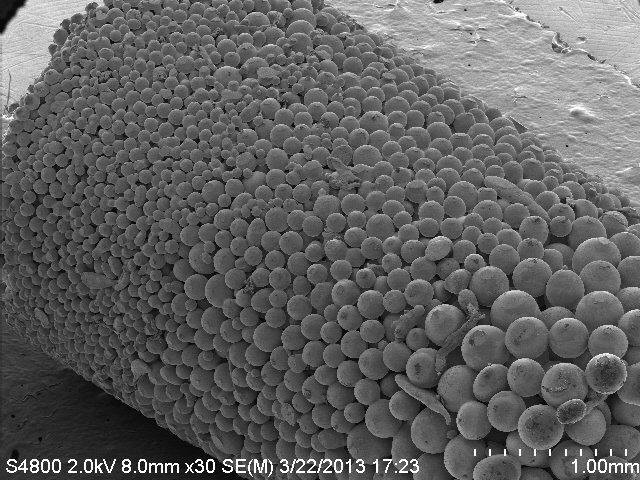
Objectives: The aim of this study was to fabricate highly bioactive scaffolds with precision control over the pore size distribution for tissue engineering applications. We designed a novel solvent-free microsphere sintering technique to produce gradient scaffolds as the best model for controlling pore size distribution.
Methods: TiO2 nanoparticles were employed both as particulate emulsifier in the preparation procedure and as surface modification agent to improve bioactivity of the scaffolds. Scanning Electron Microscopy (SEM) and Energy-Dispersive X-ray spectroscopy (EDX) were used to study the morphology of microspheres and scaffold and surface composition, respectively. Osteoblasts were cultured using standard aseptic cell culture techniques and seeded into the scaffolds. Alizarin Red and Von Kossa histochemical staining was used to estimate the amount of calcium phosphate secreted by cells after attachment. The morphology of osteoblasts on scaffolds was observed using SEM.
Results: The presence of TiO2 nanoparticles on the surface of microspheres was confirmed by both SEM and EDX analysis. An excellent pore size gradient was achieved with a pore volume of 30±2.6%. Examination of the scaffolds seeded with osteoblasts and cultured up to 21 days showed progressive activity of the osteoblasts on the scaffold with evidence of increase in its mineral content. Interestingly, the osteoblasts grew within the pores of the scaffold with multiple cell processes observed branching from one microsphere to another forming an adherent plexus across the scaffold microspheres.
Conclusions: The bioactive gradient scaffold developed in this study has the potential to be used as a suitable biomaterial for bone tissue engineering and dental hard tissue regeneration.
Methods: TiO2 nanoparticles were employed both as particulate emulsifier in the preparation procedure and as surface modification agent to improve bioactivity of the scaffolds. Scanning Electron Microscopy (SEM) and Energy-Dispersive X-ray spectroscopy (EDX) were used to study the morphology of microspheres and scaffold and surface composition, respectively. Osteoblasts were cultured using standard aseptic cell culture techniques and seeded into the scaffolds. Alizarin Red and Von Kossa histochemical staining was used to estimate the amount of calcium phosphate secreted by cells after attachment. The morphology of osteoblasts on scaffolds was observed using SEM.
Results: The presence of TiO2 nanoparticles on the surface of microspheres was confirmed by both SEM and EDX analysis. An excellent pore size gradient was achieved with a pore volume of 30±2.6%. Examination of the scaffolds seeded with osteoblasts and cultured up to 21 days showed progressive activity of the osteoblasts on the scaffold with evidence of increase in its mineral content. Interestingly, the osteoblasts grew within the pores of the scaffold with multiple cell processes observed branching from one microsphere to another forming an adherent plexus across the scaffold microspheres.
Conclusions: The bioactive gradient scaffold developed in this study has the potential to be used as a suitable biomaterial for bone tissue engineering and dental hard tissue regeneration.
IMAGES
2400116_File000000.jpg
2400116_File000000.jpg