IADR Abstract Archives
Growth Inhibitory Effects of Plant-derived Essential Oils on Oral Pathogens
Objectives: Tooth decay is the most common chronic childhood disease. Prevention and treatment of oral disease is proven to enhance quality of life for children and adults. Due to rising concerns about side-effects of chemically based products, the use of plant-derived essential oils may be an alternative to conventional oral hygiene product ingredients.
We studied growth inhibitory effects of Lemongrass (Lm), Tea tree (Tt), Turmeric (Tu), and Cedarwood (Ced) essential oils on Aggregatibacter actinomycetemcomitans (AA), Streptococcus mutans (SM), and Enterococcus faecalis (EF) and compared their anti-bacterial action with chlorhexidine (CHX).
Methods: Using the agar disk diffusion method, AA, SM, and EF were tested for their susceptibility to undiluted quantities of the oils each one alone and in combination. CHX served as the positive control. Amounts of oil(s) per disk ranged from 2-10 microliters. Sixteen trials were conducted and average zones of inhibition in millimeters were determined. Additionaly, the effects of these oils will be evaluated in bacteria biofilms using dead/live staining and confocal microscopy.
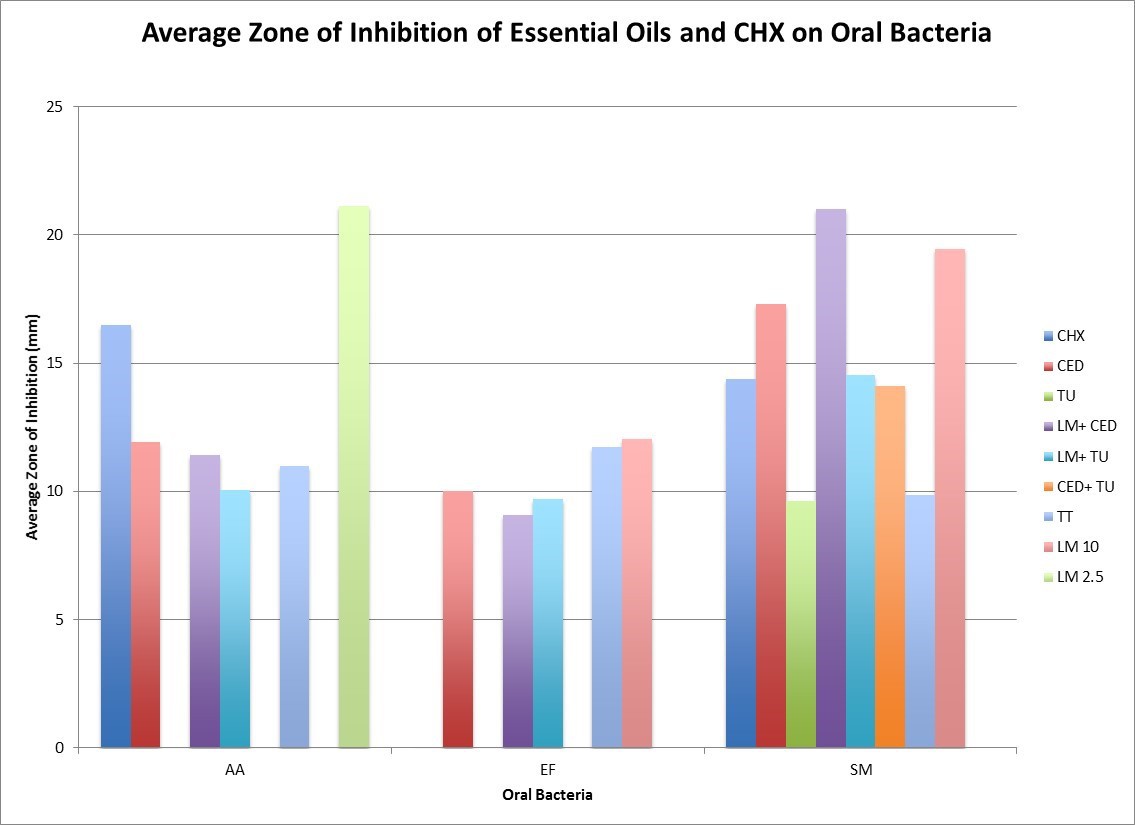
Results: Lm inhibited the growth of AA the greatest (21mm of inhibition zone), followed by CHX (16.5mm), Ced (11.9mm), Lm+Ced (11.4mm), Tt (11mm), Lm+Tu (10.1mm), and Tu (0mm). EF was most sensitive to LM (12.1mm), followed by Tt (11.8mm), Lm+Tu (9.7mm), Lm+Ced (9.1mm). CHX, Tu, and Ced+Tu all demonstrated no inhibitory effect on EF. SM was the most sensitive to Lm+Ced (21mm), followed by Lm (19.4mm), Ced (17.3mm), Lm+Tu ( 14.5mm), CHX (14.3mm), Ced+Tu (14.1mm), Tt ( 9.9mm), and Tu (9.6mm). Overall, Lm was found to be more effective than CHX (p<.05). The essential oils showing the greatest bacteria inhibition are also being tested for efficay in more complex bacteria biofilms.
Conclusions: Lemongrass, Tea Tree, and Cedarwood essential oils demonstrated statistically significant growth inhibition greater than or comparable to the effect of CHX against all tested pathogens. This study presents a basis for further research and development of oral products using essential oils as active ingredients.
We studied growth inhibitory effects of Lemongrass (Lm), Tea tree (Tt), Turmeric (Tu), and Cedarwood (Ced) essential oils on Aggregatibacter actinomycetemcomitans (AA), Streptococcus mutans (SM), and Enterococcus faecalis (EF) and compared their anti-bacterial action with chlorhexidine (CHX).
Methods: Using the agar disk diffusion method, AA, SM, and EF were tested for their susceptibility to undiluted quantities of the oils each one alone and in combination. CHX served as the positive control. Amounts of oil(s) per disk ranged from 2-10 microliters. Sixteen trials were conducted and average zones of inhibition in millimeters were determined. Additionaly, the effects of these oils will be evaluated in bacteria biofilms using dead/live staining and confocal microscopy.
Results: Lm inhibited the growth of AA the greatest (21mm of inhibition zone), followed by CHX (16.5mm), Ced (11.9mm), Lm+Ced (11.4mm), Tt (11mm), Lm+Tu (10.1mm), and Tu (0mm). EF was most sensitive to LM (12.1mm), followed by Tt (11.8mm), Lm+Tu (9.7mm), Lm+Ced (9.1mm). CHX, Tu, and Ced+Tu all demonstrated no inhibitory effect on EF. SM was the most sensitive to Lm+Ced (21mm), followed by Lm (19.4mm), Ced (17.3mm), Lm+Tu ( 14.5mm), CHX (14.3mm), Ced+Tu (14.1mm), Tt ( 9.9mm), and Tu (9.6mm). Overall, Lm was found to be more effective than CHX (p<.05). The essential oils showing the greatest bacteria inhibition are also being tested for efficay in more complex bacteria biofilms.
Conclusions: Lemongrass, Tea Tree, and Cedarwood essential oils demonstrated statistically significant growth inhibition greater than or comparable to the effect of CHX against all tested pathogens. This study presents a basis for further research and development of oral products using essential oils as active ingredients.
IMAGES
2394681_File000000.jpg
2394681_File000000.jpg