IADR Abstract Archives
Laminate Veneers Cementation – Polymerization Volumetric Shrinkage and Film Thickness of Various Cementation Materials - A Micro-CT Analysis
Objectives: The present study evaluated and quantified the volumetric polymerization shrinkage (VS) and film thickness (FT) of - two veneer cements; two flowable composite resins; and two pre-heated conventional composites; two room-temperature composites were also tested to serve as a control for the pre-heated composite groups - over a laminate veneer model through 3D micro-computed tomography (μCT).
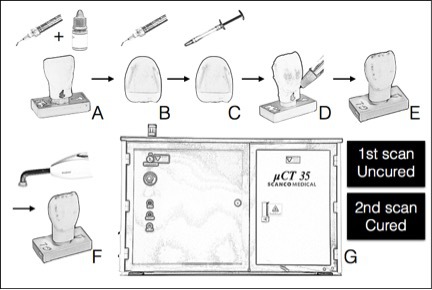
Methods: 48 standardized prepared typodont maxillary central incisor models and correspondent laminate veneers were divided in 8 groups (n=6): G1 - RelyX Veneer + Scotchbond Universal (RV); G2 - Variolink Esthetic LC + Adhese Universal (VE); G3 - Filtek Supreme Ultra Flowable + Scotchbond Universal (FF); G4 - IPS Empress Direct Flow + Adhese Universal (EF); G5 - Filtek Supreme Ultra Universal + Scotchbond Universal (FS); G6 - IPS Empress Direct + Adhese Universal (ED); G7 - Pre-heated Filtek Supreme Ultra Universal + Scotchbond Universal (HFS); G8 - Pre-heated IPS Empress Direct + Adhese Universal (HED). Samples were scanned before and after polymerization using a μCT apparatus and the resulting files were imported and analyzed using a 3D rendering software to calculate VS and FT (Figure 1). The collected data was submitted to analysis of variance.
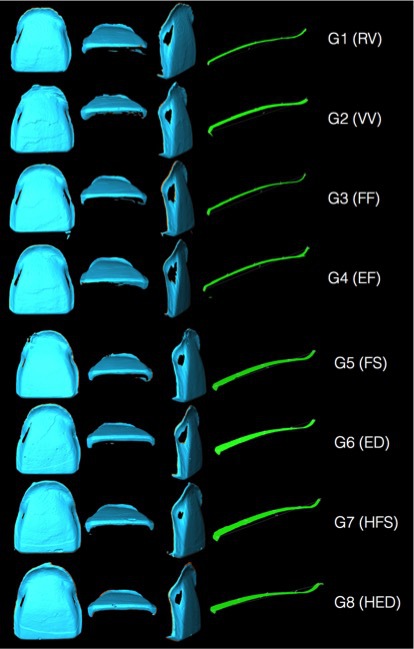
Results: G2 (VE) showed the smallest percentual shrinkage, with no statistically significant difference when compared to G1 (RV), G3 (FF) and G4 (EF). The highest percentual shrinkage was observed in G5 (FS), not reaching statistically significant difference in comparison to G1 (RV), G6 (ED), G7 (HFS) and G8 (HED). G1 (RV) did not differ statistically from the remaining groups. FT evaluation reveled the lowest values for G1 (RV), G2 (VE), G3 (FF) and G4 (EF), which were significantly different from G5 (FS), G6 (ED), G7 (HFS) and G8 (HED) (Figure 2).
Conclusions: Both VS and FT of pre-heated conventional composites is higher than the ones of veneer cements and flowable composites, suggesting the utilization of the last for laminate veneer cementation.
Methods: 48 standardized prepared typodont maxillary central incisor models and correspondent laminate veneers were divided in 8 groups (n=6): G1 - RelyX Veneer + Scotchbond Universal (RV); G2 - Variolink Esthetic LC + Adhese Universal (VE); G3 - Filtek Supreme Ultra Flowable + Scotchbond Universal (FF); G4 - IPS Empress Direct Flow + Adhese Universal (EF); G5 - Filtek Supreme Ultra Universal + Scotchbond Universal (FS); G6 - IPS Empress Direct + Adhese Universal (ED); G7 - Pre-heated Filtek Supreme Ultra Universal + Scotchbond Universal (HFS); G8 - Pre-heated IPS Empress Direct + Adhese Universal (HED). Samples were scanned before and after polymerization using a μCT apparatus and the resulting files were imported and analyzed using a 3D rendering software to calculate VS and FT (Figure 1). The collected data was submitted to analysis of variance.
Results: G2 (VE) showed the smallest percentual shrinkage, with no statistically significant difference when compared to G1 (RV), G3 (FF) and G4 (EF). The highest percentual shrinkage was observed in G5 (FS), not reaching statistically significant difference in comparison to G1 (RV), G6 (ED), G7 (HFS) and G8 (HED). G1 (RV) did not differ statistically from the remaining groups. FT evaluation reveled the lowest values for G1 (RV), G2 (VE), G3 (FF) and G4 (EF), which were significantly different from G5 (FS), G6 (ED), G7 (HFS) and G8 (HED) (Figure 2).
Conclusions: Both VS and FT of pre-heated conventional composites is higher than the ones of veneer cements and flowable composites, suggesting the utilization of the last for laminate veneer cementation.
IMAGES
2386916_File000000.jpg
2386916_File000002.jpg
2386916_File000000.jpg
2386916_File000002.jpg