IADR Abstract Archives
Posterior Cantilever RBFDP: Case Report Supported by FEA
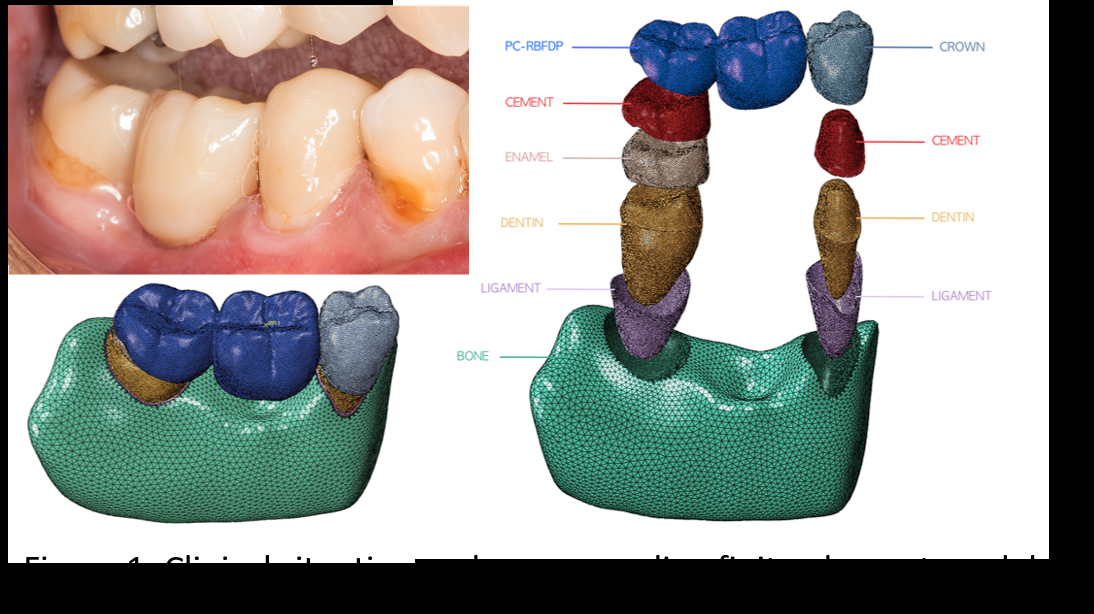
Objectives: Posterior cantilevered all-ceramic resin-bonded fixed dental prostheses (PC-RBFDPs) could represent a minimal-invasive, aesthetic, economic and quick solution for tooth replacement. This approach is a suitable alternative for patients non eligible to implants and requires less preparation than 3-unit RBFDPs (3U-RBFDPs). This study presents a clinical case in which a missing right mandibular first molar was replaced with a PC-RBFDP. Finite element models (FEM) were created to analyze mechanical behaviors of areas of interest and compare this new therapeutic to a 3U-RBFDP to anticipate complications (Fig.1).
Methods: The right first mandibular molar of a 60-year-old female patient was restored using a PC-RBFDP in zirconia with a 16mm2 connector section. A 3D FEM of the clinical situation was created from the CBCT scan of the patient. A PC-RBFDP and a 3U-RBFDP were built from the actual prosthetic design using Mimics (Materialize) software and imported into the FEM software (Abaqus, Dassault System). All materials were assumed to be linearly elastic, isotropic and homogenous and interfaces were considered perfectly bonded (except for a frictional contact between the premolar and the PC-RBFDP). Linear static simulation of a 600N uniaxial force was run under small displacement assumption.
Results: After 1.5 year, the patient is satisfied and regained masticatory function. No secondary caries or partial debonding were observed. Model was found very sensitive to periodontal ligament stiffness. Compared to 3U-RBFDP, PC-RBFDP showed higher stress level in the connector region but still lower than zirconia mechanical strength as well as increased stress in the cement and in the root of the abutment tooth. PC-RBFDP relieved pressure on the premolar root.
Conclusions: PC-RBFDP is a recent and promising therapeutic approach. FEM emphasizes the critical importance of connector dimensions, the risk of adhesive failure and the increased solicitation of the abutment tooth root.
Methods: The right first mandibular molar of a 60-year-old female patient was restored using a PC-RBFDP in zirconia with a 16mm2 connector section. A 3D FEM of the clinical situation was created from the CBCT scan of the patient. A PC-RBFDP and a 3U-RBFDP were built from the actual prosthetic design using Mimics (Materialize) software and imported into the FEM software (Abaqus, Dassault System). All materials were assumed to be linearly elastic, isotropic and homogenous and interfaces were considered perfectly bonded (except for a frictional contact between the premolar and the PC-RBFDP). Linear static simulation of a 600N uniaxial force was run under small displacement assumption.
Results: After 1.5 year, the patient is satisfied and regained masticatory function. No secondary caries or partial debonding were observed. Model was found very sensitive to periodontal ligament stiffness. Compared to 3U-RBFDP, PC-RBFDP showed higher stress level in the connector region but still lower than zirconia mechanical strength as well as increased stress in the cement and in the root of the abutment tooth. PC-RBFDP relieved pressure on the premolar root.
Conclusions: PC-RBFDP is a recent and promising therapeutic approach. FEM emphasizes the critical importance of connector dimensions, the risk of adhesive failure and the increased solicitation of the abutment tooth root.
IMAGES
4289050_File000000.jpg
4289050_File000000.jpg