IADR Abstract Archives
Fatigue Resistance and Fracture Strength of Injectable Ultrathin Occlusal Veneers
Objectives: This study investigated the restoration thickness and material impact on the fatigue resistance and fracture strength (FS) of injectable resin occlusal veneers (OV).
Methods: 1.0-mm and 0.5-mm occlusal veneer preparations were performed on molar typodont teeth and then duplicated to fabricate 64 resin replicas. Replicas from each preparation depth group were divided into four subgroups (n=8) according to the restoration type: either CAD/CAM-milled (Cerasmart blocks - GC) as a control, or using the injection molding technique with two injectable resin composites (Beautifil Injectable X - Shofu, G-ænial Universal Injectable - GC) or a bulk-fill composite (SonicFill 2 – Kerr).
Specimens were subjected to 500,000 mutual thermal and mechanical cycles with 5kg load and 10,000 Thermal cycles (5 - 55°C). Subsequently, the failure type was investigated using a stereomicroscope. FS of partially and completely survived samples was tested using load-to-failure. The fatigue failure results were analyzed using chi-square and Fisher's exact tests. Two-way ANOVA and post-hoc tests were applied to FS results (p<0.05).
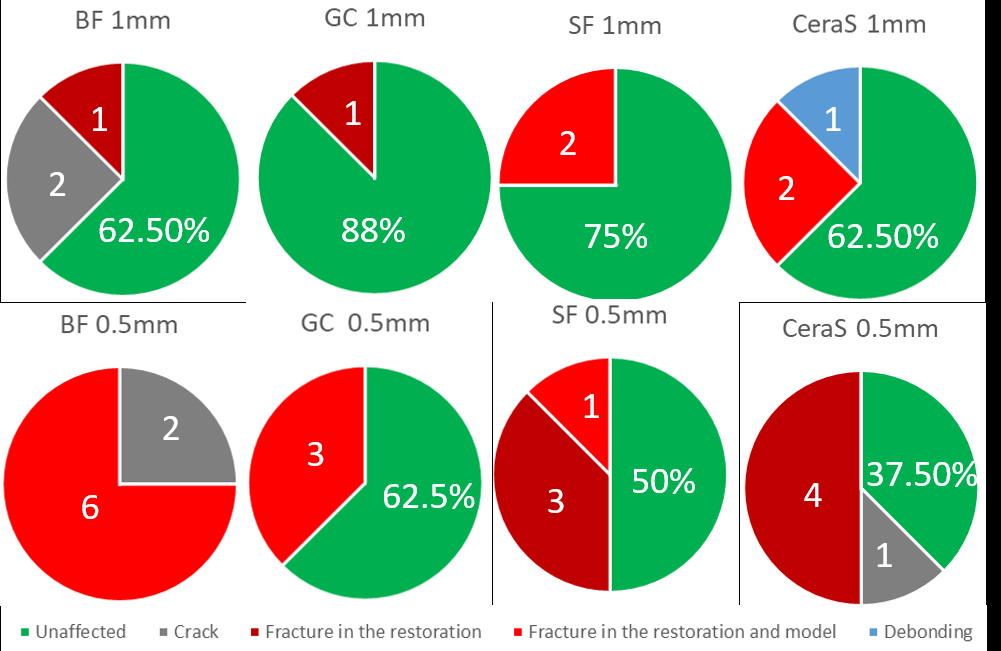
Results: Following TMC, statistical analysis revealed no significant effect of OV’s material on their FS (p = 0.093). However, the OV’s thickness and the interaction between OV material and thickness significantly affected FS (p<0 .001, p = 0.006, respectively). Cracks didn’t negatively impact FS. There was no significant difference between the survival rate or FS of 1mm groups (p>0.05). Meanwhile, at 0.5mm thickness, the Cerasmart group recorded the lowest FS (p<0.05). The decrease in OV thickness increased the failure rate of the four tested materials, especially in the Beautifil Injectable X group, but did not affect FS of G-ænial group.
Conclusions: Injectable OVs represent reliable alternatives to CAD/CAM resin-based restorations. All tested materials exhibited clinically acceptable fracture strength at a thickness of 1 mm. However, at a reduced thickness of 0.5 mm, careful selection of OV's material is mandatory.
Methods: 1.0-mm and 0.5-mm occlusal veneer preparations were performed on molar typodont teeth and then duplicated to fabricate 64 resin replicas. Replicas from each preparation depth group were divided into four subgroups (n=8) according to the restoration type: either CAD/CAM-milled (Cerasmart blocks - GC) as a control, or using the injection molding technique with two injectable resin composites (Beautifil Injectable X - Shofu, G-ænial Universal Injectable - GC) or a bulk-fill composite (SonicFill 2 – Kerr).
Specimens were subjected to 500,000 mutual thermal and mechanical cycles with 5kg load and 10,000 Thermal cycles (5 - 55°C). Subsequently, the failure type was investigated using a stereomicroscope. FS of partially and completely survived samples was tested using load-to-failure. The fatigue failure results were analyzed using chi-square and Fisher's exact tests. Two-way ANOVA and post-hoc tests were applied to FS results (p<0.05).
Results: Following TMC, statistical analysis revealed no significant effect of OV’s material on their FS (p = 0.093). However, the OV’s thickness and the interaction between OV material and thickness significantly affected FS (p<0 .001, p = 0.006, respectively). Cracks didn’t negatively impact FS. There was no significant difference between the survival rate or FS of 1mm groups (p>0.05). Meanwhile, at 0.5mm thickness, the Cerasmart group recorded the lowest FS (p<0.05). The decrease in OV thickness increased the failure rate of the four tested materials, especially in the Beautifil Injectable X group, but did not affect FS of G-ænial group.
Conclusions: Injectable OVs represent reliable alternatives to CAD/CAM resin-based restorations. All tested materials exhibited clinically acceptable fracture strength at a thickness of 1 mm. However, at a reduced thickness of 0.5 mm, careful selection of OV's material is mandatory.
IMAGES
4287992_File000000.jpg
4287992_File000000.jpg