IADR Abstract Archives
Impact of Nanodiamond and S-Glass Fiber on Dental Composite Performance
Objectives: Despite advancements in dental resin composites, challenges such as bulk fracture and secondary caries remain, driving efforts to enhance their performance and durability through various micro/nanofillers. This study evaluates a novel dental composite incorporating nanodiamonds and short S-glass fibers to improve mechanical and antibacterial properties while ensuring a natural aesthetic for dental restorations.
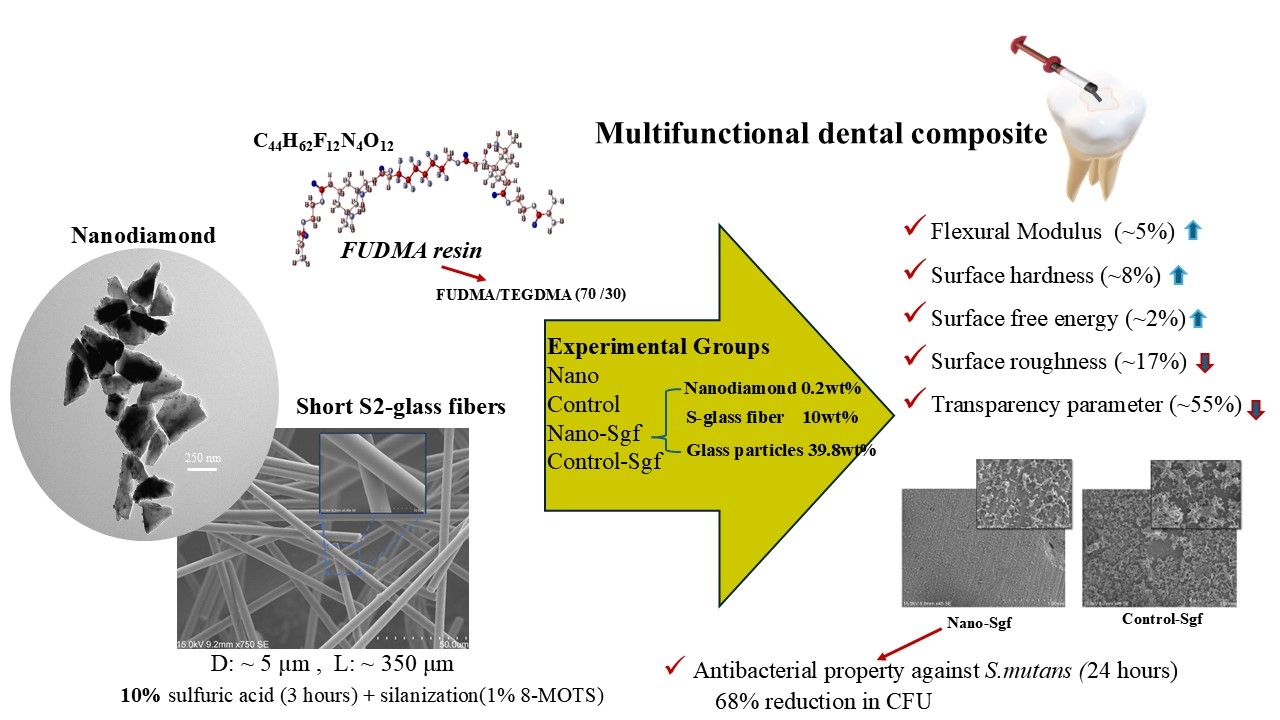
Methods: Four composite groups were prepared. The first experimental group contained 50 wt% resin(FUDMA/TEGDMA, 70/30wt%), 10wt% S-glass fibers(D: ~ 5µm and L: ~ 350 μm, etched 10% sulfuric acid for 3 hours and silanized),40 wt% glass particles(D:~ 0.7µm), 0.2wt% nanodiamonds, and 1wt% photoinitiators. The second experimental group had the same ingredients without S-glass fibers. The third group excluded nanodiamonds, while the control group was without S-glass fibers and nanodiamonds. Various mechanical, physical, and biological properties were assessed. Statistical analysis was performed using SPSS software (α=0.05).
Results: The nanodiamond composites demonstrated significantly higher flexural modulus (7.27±0.33GPa) and Vickers hardness(32.66±0.99VH) compared to the control group (p=0.021). The nanodiamond group also showed better color matching to the white point and standard tooth(deltaEW=19.85±0.47, delta ET=19.54±0.15) compared to the control group (p < 0.001). The nanodiamond composite exhibited lower surface roughness(Ra=0.14±0.02 nm) and higher surface free energy(47.13±0.47mJ/m2) than the control group. After 24 hours of incubation with Streptococcus mutants, the nanodiamond group showed significantly lower bacterial adhesion (122±46.92×10⁴CFU/ml) compared to the control (386.6±115.16×10⁴CFU/ml, p=0.013). No significant differences were found in MC3T3-E1 cell viability between the nanodiamond and control groups after one day(p=0.507) and seven days(p=0.176).
Conclusions: Dental resin composites reinforced with surface-modified S-glass fibers and nanodiamonds were developed, enhancing mechanical strength, hardness, antibacterial properties, and aesthetics for dental restorations
Methods: Four composite groups were prepared. The first experimental group contained 50 wt% resin(FUDMA/TEGDMA, 70/30wt%), 10wt% S-glass fibers(D: ~ 5µm and L: ~ 350 μm, etched 10% sulfuric acid for 3 hours and silanized),40 wt% glass particles(D:~ 0.7µm), 0.2wt% nanodiamonds, and 1wt% photoinitiators. The second experimental group had the same ingredients without S-glass fibers. The third group excluded nanodiamonds, while the control group was without S-glass fibers and nanodiamonds. Various mechanical, physical, and biological properties were assessed. Statistical analysis was performed using SPSS software (α=0.05).
Results: The nanodiamond composites demonstrated significantly higher flexural modulus (7.27±0.33GPa) and Vickers hardness(32.66±0.99VH) compared to the control group (p=0.021). The nanodiamond group also showed better color matching to the white point and standard tooth(deltaEW=19.85±0.47, delta ET=19.54±0.15) compared to the control group (p < 0.001). The nanodiamond composite exhibited lower surface roughness(Ra=0.14±0.02 nm) and higher surface free energy(47.13±0.47mJ/m2) than the control group. After 24 hours of incubation with Streptococcus mutants, the nanodiamond group showed significantly lower bacterial adhesion (122±46.92×10⁴CFU/ml) compared to the control (386.6±115.16×10⁴CFU/ml, p=0.013). No significant differences were found in MC3T3-E1 cell viability between the nanodiamond and control groups after one day(p=0.507) and seven days(p=0.176).
Conclusions: Dental resin composites reinforced with surface-modified S-glass fibers and nanodiamonds were developed, enhancing mechanical strength, hardness, antibacterial properties, and aesthetics for dental restorations
IMAGES
4287755_File000000.jpg
4287755_File000000.jpg