IADR Abstract Archives
Accuracy of CBCT-Based Impressions Compared to Intraoral Scanning - Dental Revolution?
Objectives: This study aims to compare the accuracy of intraoral scanning (IOS) and Cone Beam Computed Tomography (CBCT) for documenting subgingival tooth preparations, specifically focusing on scanning accuracy in a partially edentulous model. We hypothesize that the IOS will exhibit limitations in spatial accuracy when fewer teeth remain, and that CBCT will provide superior visualization of the tooth position and preparation margins.
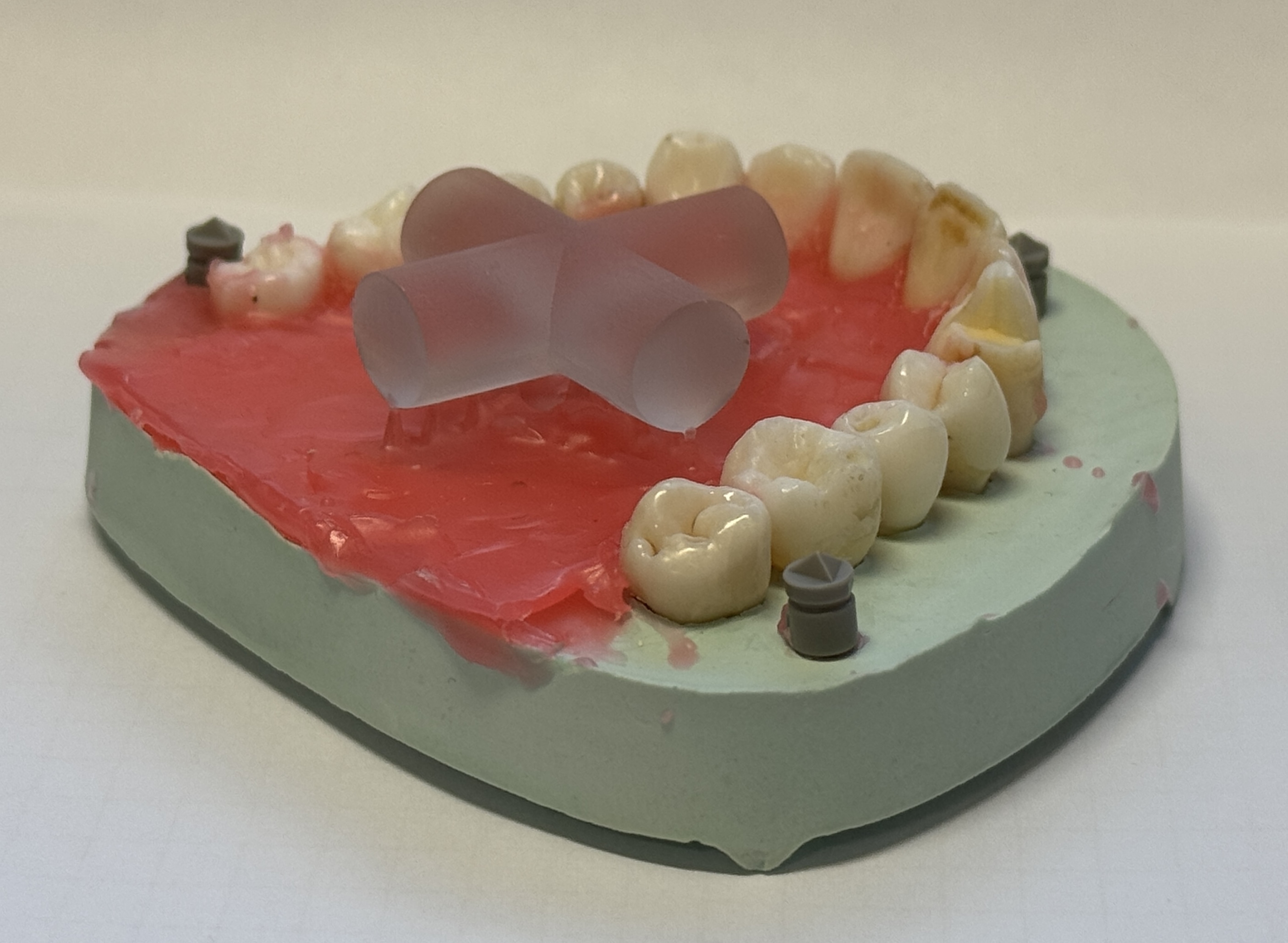
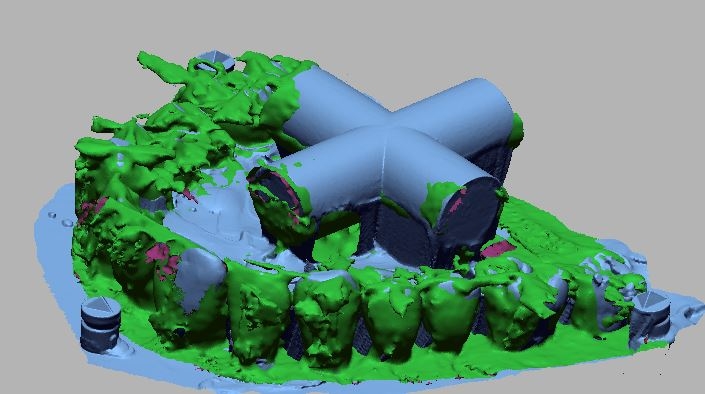
Methods: A total of 14 human, unrestored teeth were embedded in a gypsum model, simulating a realistic maxillary dental arch. The model, equipped with reference structures (Straumann 3D scan bodies, Dentsply Sirona Primeprint Guide material), was scanned 13 times using a Dentsply Sirona Primescan IOS, with a tooth being extracted after each scan, progressively increasing the edentulous gap. The scans were analyzed for matching errors and spatial deviations, particularly in the occlusal and marginal areas. A reference scan using a coordinate measuring machine (CMM) was performed to capture the "true" position. Additionally, CBCT scans (Planmeca Viso) were conducted in parallel, simulating a clinical case with subgingival preparations below the gingival margin. The CMM data were used as a reference for comparison.
Results: The RMS (Root Mean Square) deviation analysis revealed that the IOS provided higher precision in capturing the tooth surface, but struggled with spatial accuracy when only two teeth remained. In contrast, CBCT offered better visualization of subgingival margins and more accurate 3D positioning of the remaining teeth. A 37% deviation was noted between the IOS and CBCT data, with the latter providing more consistent results for subgingival areas.
Conclusions: This study demonstrates that CBCT is more reliable for assessing subgingival tooth preparations in a partially edentulous arch, especially for cases with minimal remaining teeth. While the IOS excels in surface accuracy, particularly for the tooth crowns, CBCT provides superior precision in capturing the precise 3D positioning and spatial relationship of the remaining teeth. A hybrid approach combining both technologies may offer the most accurate results for comprehensive dental scanning. Further research should investigate patient cases to validate these findings in clinical settings
Methods: A total of 14 human, unrestored teeth were embedded in a gypsum model, simulating a realistic maxillary dental arch. The model, equipped with reference structures (Straumann 3D scan bodies, Dentsply Sirona Primeprint Guide material), was scanned 13 times using a Dentsply Sirona Primescan IOS, with a tooth being extracted after each scan, progressively increasing the edentulous gap. The scans were analyzed for matching errors and spatial deviations, particularly in the occlusal and marginal areas. A reference scan using a coordinate measuring machine (CMM) was performed to capture the "true" position. Additionally, CBCT scans (Planmeca Viso) were conducted in parallel, simulating a clinical case with subgingival preparations below the gingival margin. The CMM data were used as a reference for comparison.
Results: The RMS (Root Mean Square) deviation analysis revealed that the IOS provided higher precision in capturing the tooth surface, but struggled with spatial accuracy when only two teeth remained. In contrast, CBCT offered better visualization of subgingival margins and more accurate 3D positioning of the remaining teeth. A 37% deviation was noted between the IOS and CBCT data, with the latter providing more consistent results for subgingival areas.
Conclusions: This study demonstrates that CBCT is more reliable for assessing subgingival tooth preparations in a partially edentulous arch, especially for cases with minimal remaining teeth. While the IOS excels in surface accuracy, particularly for the tooth crowns, CBCT provides superior precision in capturing the precise 3D positioning and spatial relationship of the remaining teeth. A hybrid approach combining both technologies may offer the most accurate results for comprehensive dental scanning. Further research should investigate patient cases to validate these findings in clinical settings
IMAGES
4285816_File000000.jpg
4285816_File000001.JPG
4285816_File000000.jpg
4285816_File000001.JPG