
IADR Abstract Archives
Mechanical Properties of in Vitro Subgingival Biofilms: Insights Into Periodontal Disease
Objectives: Periodontitis is characterized by microbial dysbiosis and increased biofilm resilience, presenting challenges for effective mechanical removal. This study investigates the rheological properties of symbiotic and dysbiotic biofilms composed of 14 key oral bacterial species, providing first insights into the mechanical properties of subgingival biofilms.
Methods: Subgingival biofilms were cultivated using a controlled Leuven in vitro model, under conditions promoting either symbiosis (commensal-dominated) or dysbiosis (pathobionts-dominated). Rheological properties were assessed using different rheological methods (amplitude sweeps, frequency sweeps, and viscosity curves) to characterize viscoelastic behaviour of biofilms. The extracellular polymeric substance (EPS) matrix was isolated and analysed for major components, including extracellular DNA, proteins, polysaccharides, and lipids, using biochemical assays. Microbial composition was quantified using quantitative PCR, and a linear mix model was employed to identify microbial taxa and EPS components contributing to biofilm mechanics.
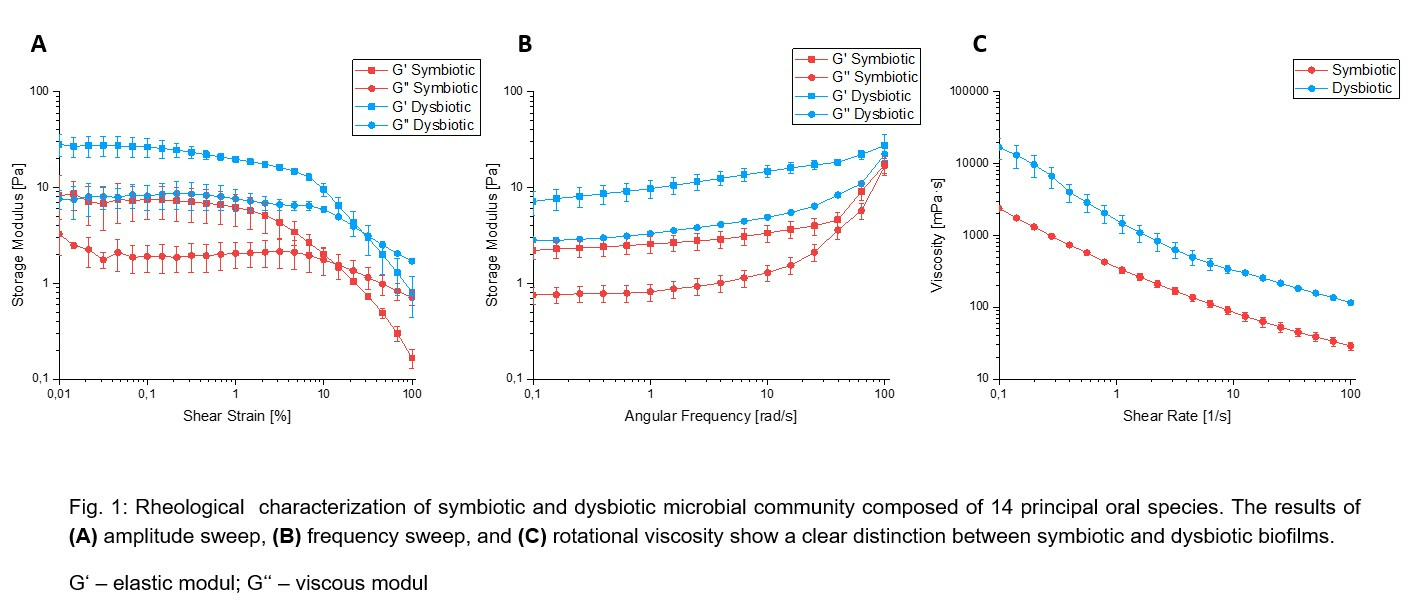
Results: Dysbiotic biofilms demonstrated notably higher viscoelasticity - resistance to deformation, in both elastic (measure of the energy stored in a material and can be reused) and viscous (measure of energy lost in a material with deformation) moduli than their symbiotic counterparts, correlating with shifts in microbial composition and EPS matrix compositions. These biofilms exhibited a more rigid structure, enhancing their mechanical robustness.
Conclusions: This study highlights the rheological differences between health- and disease-associated biofilms, linking biofilm mechanics –final biofilm phenotype– to microbial composition and EPS matrix characteristics. Distinct rheological profiles indicate that dysbiosis involves mechanical adaptations, potentially contributing to their greater resistance to mechanical forces encountered during oral hygiene practices.
Methods: Subgingival biofilms were cultivated using a controlled Leuven in vitro model, under conditions promoting either symbiosis (commensal-dominated) or dysbiosis (pathobionts-dominated). Rheological properties were assessed using different rheological methods (amplitude sweeps, frequency sweeps, and viscosity curves) to characterize viscoelastic behaviour of biofilms. The extracellular polymeric substance (EPS) matrix was isolated and analysed for major components, including extracellular DNA, proteins, polysaccharides, and lipids, using biochemical assays. Microbial composition was quantified using quantitative PCR, and a linear mix model was employed to identify microbial taxa and EPS components contributing to biofilm mechanics.
Results: Dysbiotic biofilms demonstrated notably higher viscoelasticity - resistance to deformation, in both elastic (measure of the energy stored in a material and can be reused) and viscous (measure of energy lost in a material with deformation) moduli than their symbiotic counterparts, correlating with shifts in microbial composition and EPS matrix compositions. These biofilms exhibited a more rigid structure, enhancing their mechanical robustness.
Conclusions: This study highlights the rheological differences between health- and disease-associated biofilms, linking biofilm mechanics –final biofilm phenotype– to microbial composition and EPS matrix characteristics. Distinct rheological profiles indicate that dysbiosis involves mechanical adaptations, potentially contributing to their greater resistance to mechanical forces encountered during oral hygiene practices.
4285668_File000000.jpg