IADR Abstract Archives
Evaluation of Polishing Methods on CAD/CAM Lithium Disilicate Ceramics
Objectives: Lithium disilicate (LDS) glass ceramic is a material with high mechanical strength and aesthetics. Clinically, the prosthesis made of LDS is applied to polishing instruments or glaze materials. Initial LiSi Block (LS; GC) is a CAD/CAM LDS glass ceramic designed for prosthesis fabrication with only polishing and finishing. Therefore, the polishing method after processing is important. In this study, the gloss after each polishing method for LDS was evaluated.
Methods: LS specimens (1.0×1.0×0.5mm plate) were fabricated by CEREC MC XL (Dentsply Sirona). DIAPOL RA (EVE) and GRADIA DIAPOLISHER (GC) were used as polishing instruments. The polishing load was 1.5 to 2.0N. The fabricated specimens were polished under conditions shown in Table 1. The gloss (Gs60) was measured with a gloss meter (VG7000, NIPPON DENSHOKU) (n=3). The gloss results were statistically analyzed by Tukey’s test. SEM (SU-70, HITACHI) observation of LS was also carried out.
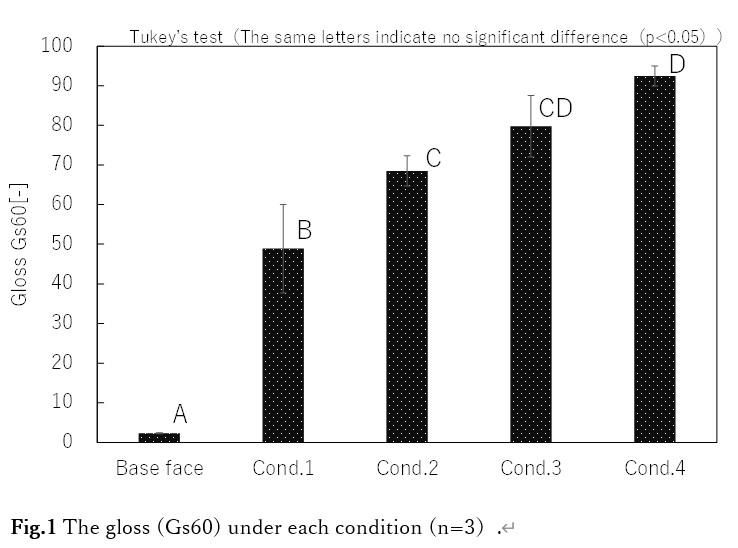
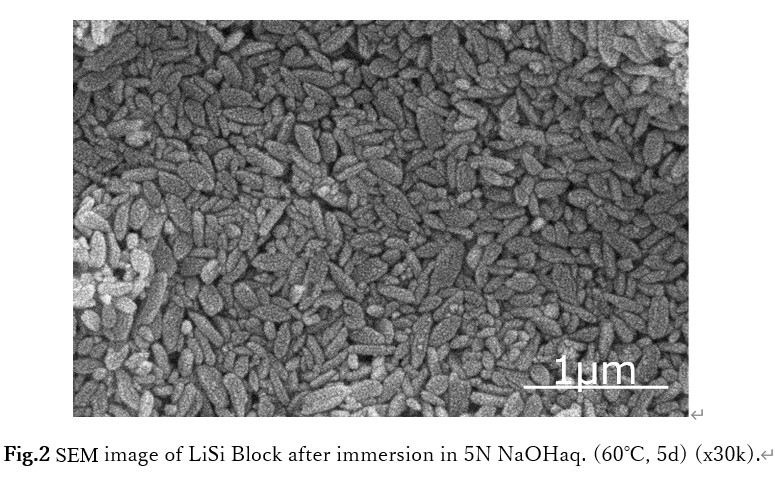
Results: Figure 1 shows the gloss (Gs60) under each polishing condition. It was confirmed that the gloss improved as the number polishing steps increased. In particular, conditions 3 and 4 created a clear gloss observed by visual inspection. Figure 2 showed that LS has densely dispersed small crystal grains (0.3–0.5µm). Therefore, it is considered that the surface was less prone to unevenness due to the impact and force during polishing, increasing the effectiveness of polishing.
Conclusions: It was suggested that Initial LiSi Block is possible to obtain gloss by using the recommended polishing procedure. In particular, it was obvious that optimal gloss can be obtained by polishing using four types of polishing instruments as in conditions 4.
Methods: LS specimens (1.0×1.0×0.5mm plate) were fabricated by CEREC MC XL (Dentsply Sirona). DIAPOL RA (EVE) and GRADIA DIAPOLISHER (GC) were used as polishing instruments. The polishing load was 1.5 to 2.0N. The fabricated specimens were polished under conditions shown in Table 1. The gloss (Gs60) was measured with a gloss meter (VG7000, NIPPON DENSHOKU) (n=3). The gloss results were statistically analyzed by Tukey’s test. SEM (SU-70, HITACHI) observation of LS was also carried out.
Results: Figure 1 shows the gloss (Gs60) under each polishing condition. It was confirmed that the gloss improved as the number polishing steps increased. In particular, conditions 3 and 4 created a clear gloss observed by visual inspection. Figure 2 showed that LS has densely dispersed small crystal grains (0.3–0.5µm). Therefore, it is considered that the surface was less prone to unevenness due to the impact and force during polishing, increasing the effectiveness of polishing.
Conclusions: It was suggested that Initial LiSi Block is possible to obtain gloss by using the recommended polishing procedure. In particular, it was obvious that optimal gloss can be obtained by polishing using four types of polishing instruments as in conditions 4.
IMAGES
4285541_File000000.jpg
4285541_File000001.jpg
4285541_File000000.jpg
4285541_File000001.jpg