IADR Abstract Archives
Mechanical Enhancement and Microstructure of BNNSs Light-Curable Dental Resin Composites
Objectives: This study aimed to investigate the reinforcing mechanism of boron nitride nanosheets (BNNSs) in improving mechanical properties and light curability of dental resin composites.
Methods: Experimental resin composites formulated with varying BNNSs loadings (0-10.0 wt%) and glass fillers (40 wt%) were prepared by ultrasonication, SpeedMixing and vacuum degassing. The particle size distribution and aspect ratio of BNNSs were characterised using Zetasizer Nano and atomic force microscopy (AFM). Scanning electron microscopy (SEM) was employed to investigate its microstructure and fracture surface morphology. Light transmittance and degree of conversion (DC), Vickers microhardness (HVN), flexural modulus (FM), flexural strength (FS), and fracture toughness (KIC) were evaluated. Statistical analysis was performed using one-way ANOVA with Tukey’s post hoc tests (α = 0.05).
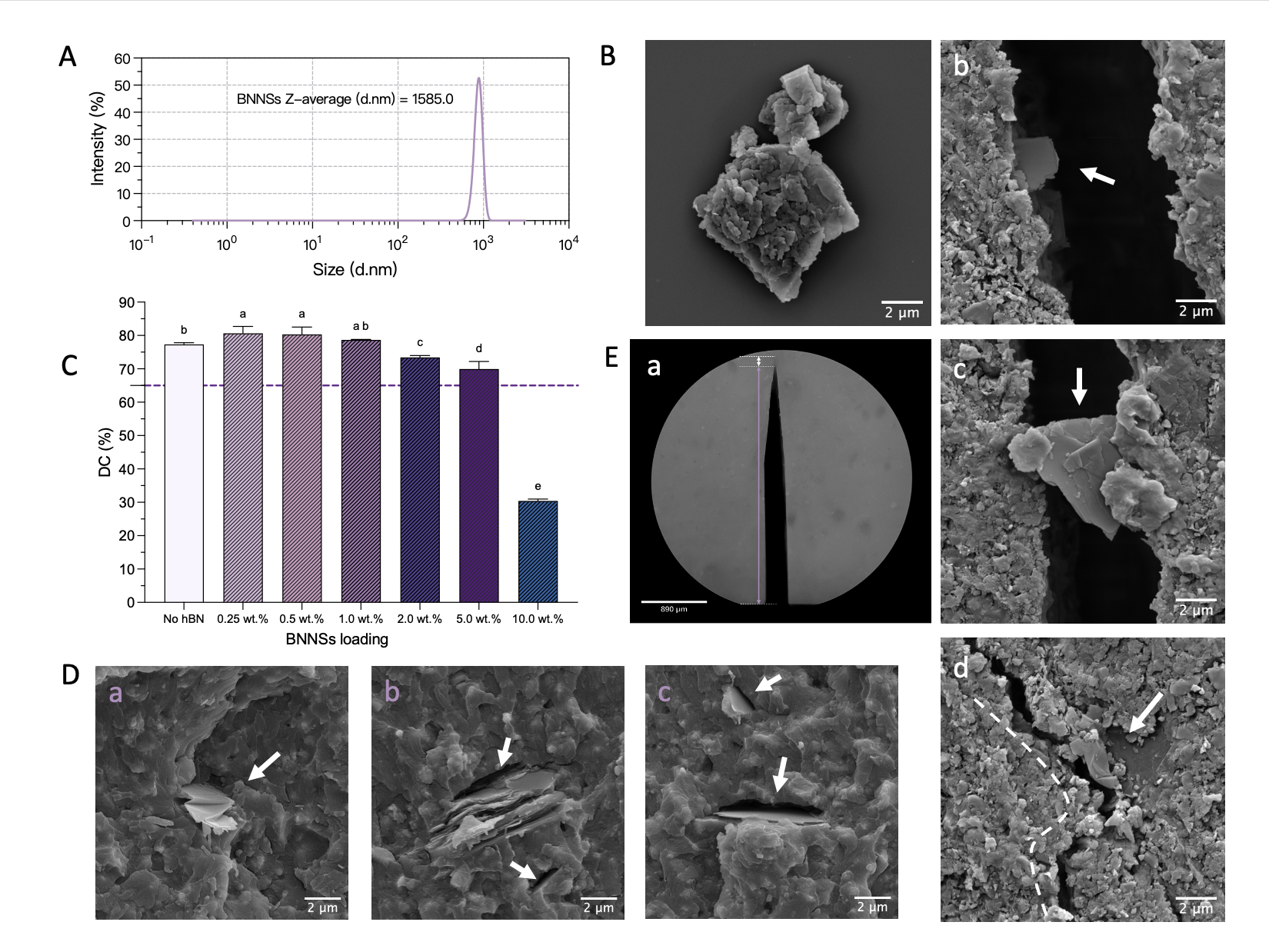
Results: BNNSs (Z-average = 1585.0 nm) exhibited a platelet-like 2D structure with significant stacking. Increasing BNNSs loading reduced maximum irradiance (Imax), light transmittance (%), and prolonged curing time. The 24-hour post-curing DC (2mm specimen thickness) peaked at 1.0 wt%, remained clinically acceptable (>65%) up to 5.0 wt% but dropped detrimentally at 10.0 wt% (30.4%). BNNSs enhanced the top surface HVN while reduced bottom surface HVN at higher loadings. FM improved significantly with BNNSs incorporation, whereas FS declined noticeably above 5.0 wt%. KIC increased significantly from the 0.5 to 5.0 wt% groups but decreased at 10.0 wt%. SEM revealed uniform BNNSs dispersion up to 0.5 wt% groups while all higher loadings resulted in local agglomerations of multi-layered BNNSs. BNNSs pull-out and debonding were identified as defects and gaps at BNNSs-polymer matrix interface. Crack deflection, bridging, pinning and fractured BNNSs were observed along the growing pre-crack of fracture toughness specimens, contributing to enhanced crack resistance.
Conclusions: Incorporating BNNSs enhanced the mechanical performance of dental resin composites but adversely impacted light transmittance and DC at higher loadings. Local agglomerations may contribute to stress concentration, negatively affecting mechanical properties. Further optimisation is required to improve BNNSs dispersion and maximise its reinforcement potential.
Methods: Experimental resin composites formulated with varying BNNSs loadings (0-10.0 wt%) and glass fillers (40 wt%) were prepared by ultrasonication, SpeedMixing and vacuum degassing. The particle size distribution and aspect ratio of BNNSs were characterised using Zetasizer Nano and atomic force microscopy (AFM). Scanning electron microscopy (SEM) was employed to investigate its microstructure and fracture surface morphology. Light transmittance and degree of conversion (DC), Vickers microhardness (HVN), flexural modulus (FM), flexural strength (FS), and fracture toughness (KIC) were evaluated. Statistical analysis was performed using one-way ANOVA with Tukey’s post hoc tests (α = 0.05).
Results: BNNSs (Z-average = 1585.0 nm) exhibited a platelet-like 2D structure with significant stacking. Increasing BNNSs loading reduced maximum irradiance (Imax), light transmittance (%), and prolonged curing time. The 24-hour post-curing DC (2mm specimen thickness) peaked at 1.0 wt%, remained clinically acceptable (>65%) up to 5.0 wt% but dropped detrimentally at 10.0 wt% (30.4%). BNNSs enhanced the top surface HVN while reduced bottom surface HVN at higher loadings. FM improved significantly with BNNSs incorporation, whereas FS declined noticeably above 5.0 wt%. KIC increased significantly from the 0.5 to 5.0 wt% groups but decreased at 10.0 wt%. SEM revealed uniform BNNSs dispersion up to 0.5 wt% groups while all higher loadings resulted in local agglomerations of multi-layered BNNSs. BNNSs pull-out and debonding were identified as defects and gaps at BNNSs-polymer matrix interface. Crack deflection, bridging, pinning and fractured BNNSs were observed along the growing pre-crack of fracture toughness specimens, contributing to enhanced crack resistance.
Conclusions: Incorporating BNNSs enhanced the mechanical performance of dental resin composites but adversely impacted light transmittance and DC at higher loadings. Local agglomerations may contribute to stress concentration, negatively affecting mechanical properties. Further optimisation is required to improve BNNSs dispersion and maximise its reinforcement potential.
IMAGES
4285418_File000000.jpg
4285418_File000000.jpg