IADR Abstract Archives
Portable Microwave-Plasma Device Promotes Rapid Extraction Socket Healing in Minipigs
Objectives: Tooth extraction often results in complications such as bleeding and dry sockets, emphasizing the need for novel healing strategies. Current methods, such as collagen sponges, can delay healing, while antibiotics pose risks, including allergic reactions and resistance. Microwave plasma (MP) generates reactive oxygen and nitrogen species (RONS) that promote hemostasis and wound healing. However, existing MP devices are too bulky for oral use. This study develops a portable MP device designed to accelerate the healing of extraction sockets in minipigs by enhancing hemostasis and improving both soft tissue and bone healing.
Methods: A compact, portable MP device was developed for efficient use in irregular and hard-to-reach areas, such as post-extraction sockets. With a 6 mm diameter, the device is well-suited for tooth extraction wounds and operates efficiently at a low microwave power of 15 W. Its biological effects were investigated in three key areas: hemostasis, macrophage differentiation, and fibroblast activity. The efficacy of the device in promoting socket healing was evaluated in both rat and preclinical minipig tooth extraction models.
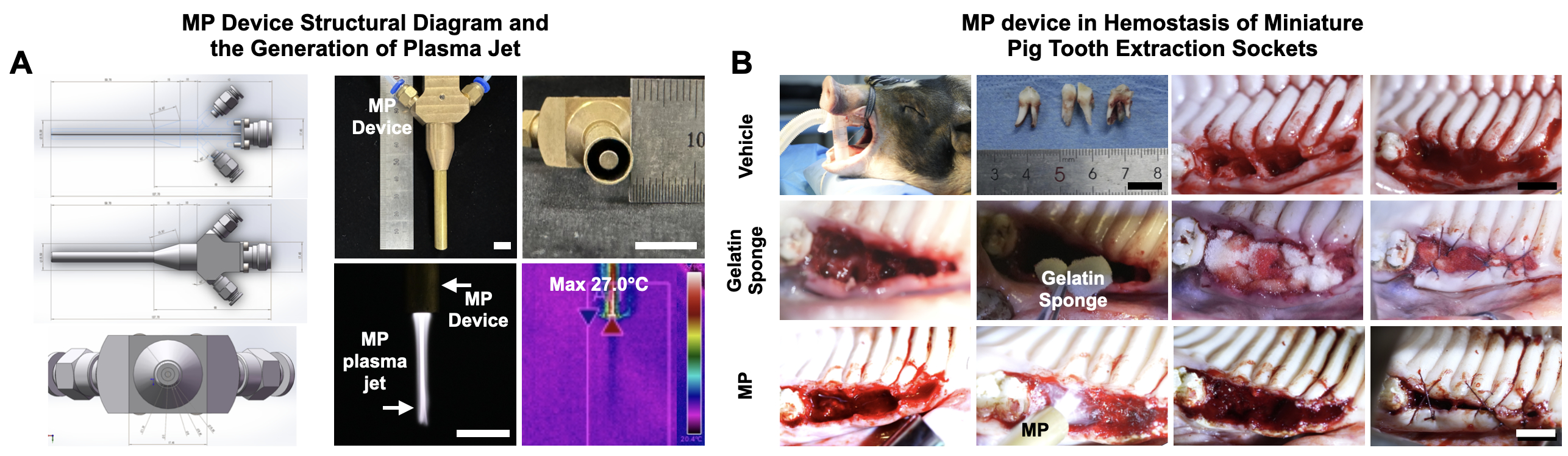
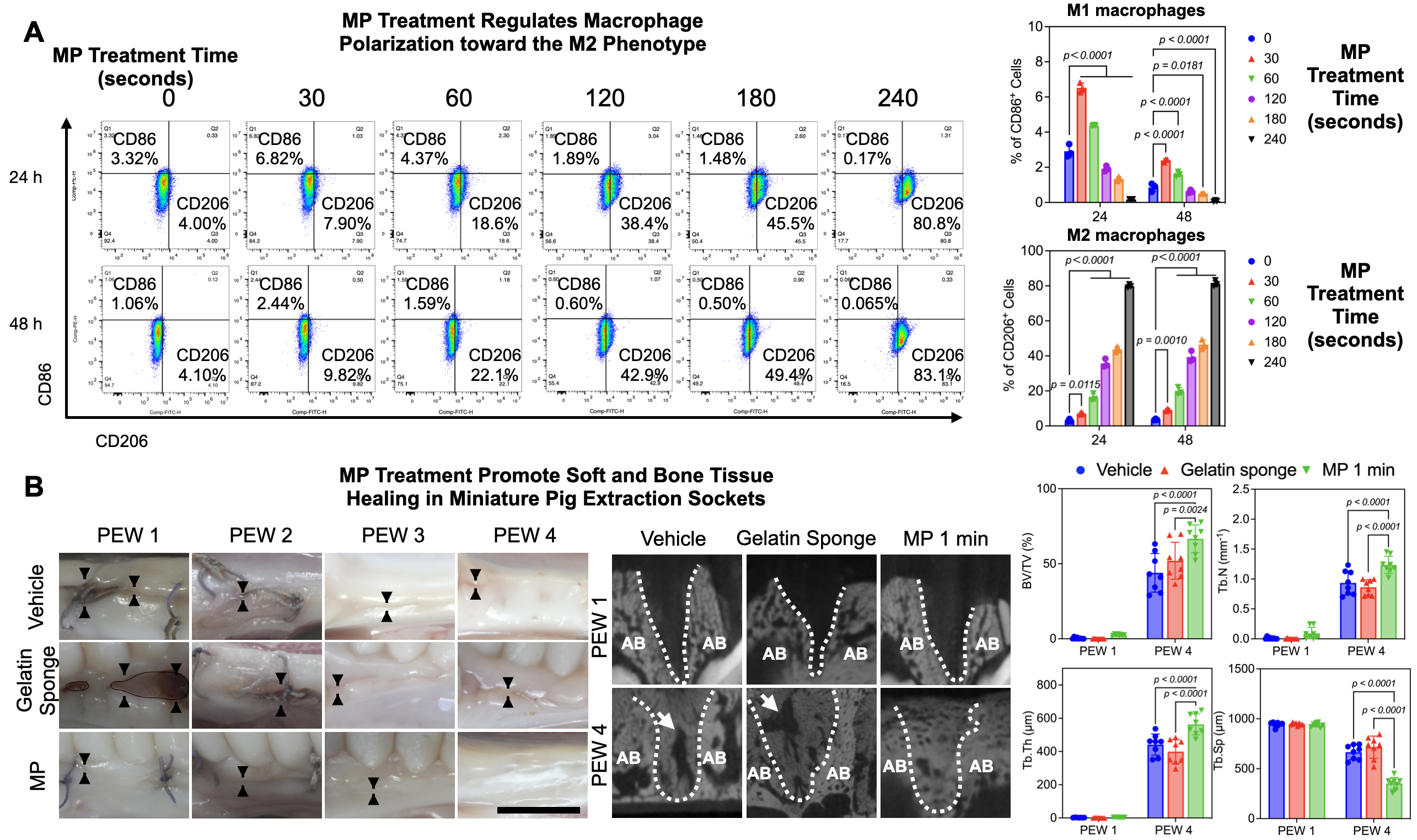
Results: The portable MP device, designed for oral applications, generated a stable plasma jet (Figure 1A) and produced long-lasting RONS within 1 minute, with effects sustained for at least 24 hours. In rat and minipig extraction sockets, MP treatment for 1 minute significantly reduced both hemostasis time and blood loss compared to commercial hemostatic materials (Figure 1B). MP also promoted M2 macrophage polarization and stimulated gingival fibroblast activity, enhancing soft tissue healing (Figure 2A). In both rat and minipig models, MP treatment improved soft tissue sealing and promoted complete bone healing, outperforming traditional hemostatic agents, such as gelatin sponges (Figure 2B). The MP device has been granted patents and has successfully passed third-party safety evaluations. It is currently undergoing regulatory approval to become a Class III medical device.
Conclusions: This newly designed MP device generates long-lasting RONS, effectively promoting hemostasis and tissue repair. It outperforms commercial alternatives in tooth extraction sockets. This approach offers a promising solution with significant potential for clinical applications.
Methods: A compact, portable MP device was developed for efficient use in irregular and hard-to-reach areas, such as post-extraction sockets. With a 6 mm diameter, the device is well-suited for tooth extraction wounds and operates efficiently at a low microwave power of 15 W. Its biological effects were investigated in three key areas: hemostasis, macrophage differentiation, and fibroblast activity. The efficacy of the device in promoting socket healing was evaluated in both rat and preclinical minipig tooth extraction models.
Results: The portable MP device, designed for oral applications, generated a stable plasma jet (Figure 1A) and produced long-lasting RONS within 1 minute, with effects sustained for at least 24 hours. In rat and minipig extraction sockets, MP treatment for 1 minute significantly reduced both hemostasis time and blood loss compared to commercial hemostatic materials (Figure 1B). MP also promoted M2 macrophage polarization and stimulated gingival fibroblast activity, enhancing soft tissue healing (Figure 2A). In both rat and minipig models, MP treatment improved soft tissue sealing and promoted complete bone healing, outperforming traditional hemostatic agents, such as gelatin sponges (Figure 2B). The MP device has been granted patents and has successfully passed third-party safety evaluations. It is currently undergoing regulatory approval to become a Class III medical device.
Conclusions: This newly designed MP device generates long-lasting RONS, effectively promoting hemostasis and tissue repair. It outperforms commercial alternatives in tooth extraction sockets. This approach offers a promising solution with significant potential for clinical applications.
IMAGES
4272691_File000000.jpg
4272691_File000001.jpg
4272691_File000000.jpg
4272691_File000001.jpg