IADR Abstract Archives
Assessing the Educational Effectiveness of Multi-Texture 3D-Printed Models for Teaching Clinical Skills in Restorative Dentistry
Objectives:
Over the last decade, the dental industry has significantly advanced with the integration of 3D printing technology. However, while advancements have been made in the restoration of teeth, the simulation of teeth for training purposes still fails to accurately replicate the mechanical properties and key structural layers of enamel and dentine. This study aims to analyse commercially available resins to create more effective and realistic models via the development of multi-layered 3D-printed teeth using Formlabs SLA and Stratasys J5 3D printers.
Methods: Twelve commercially available resins (seven from Formlabs and five from Stratasys J5) were evaluated. Resin samples (30 mm diameter, 2 mm thickness) were printed and assessed for mechanical properties via Vickers and Mohs hardness tests. Surface characteristics were analysed using Scanning Electron Microscopy (SEM) and profilometry. Additionally, root canal models were printed using the Formlabs SLA printer, with different orientations to optimize resin drainage and canal patency.
Results:
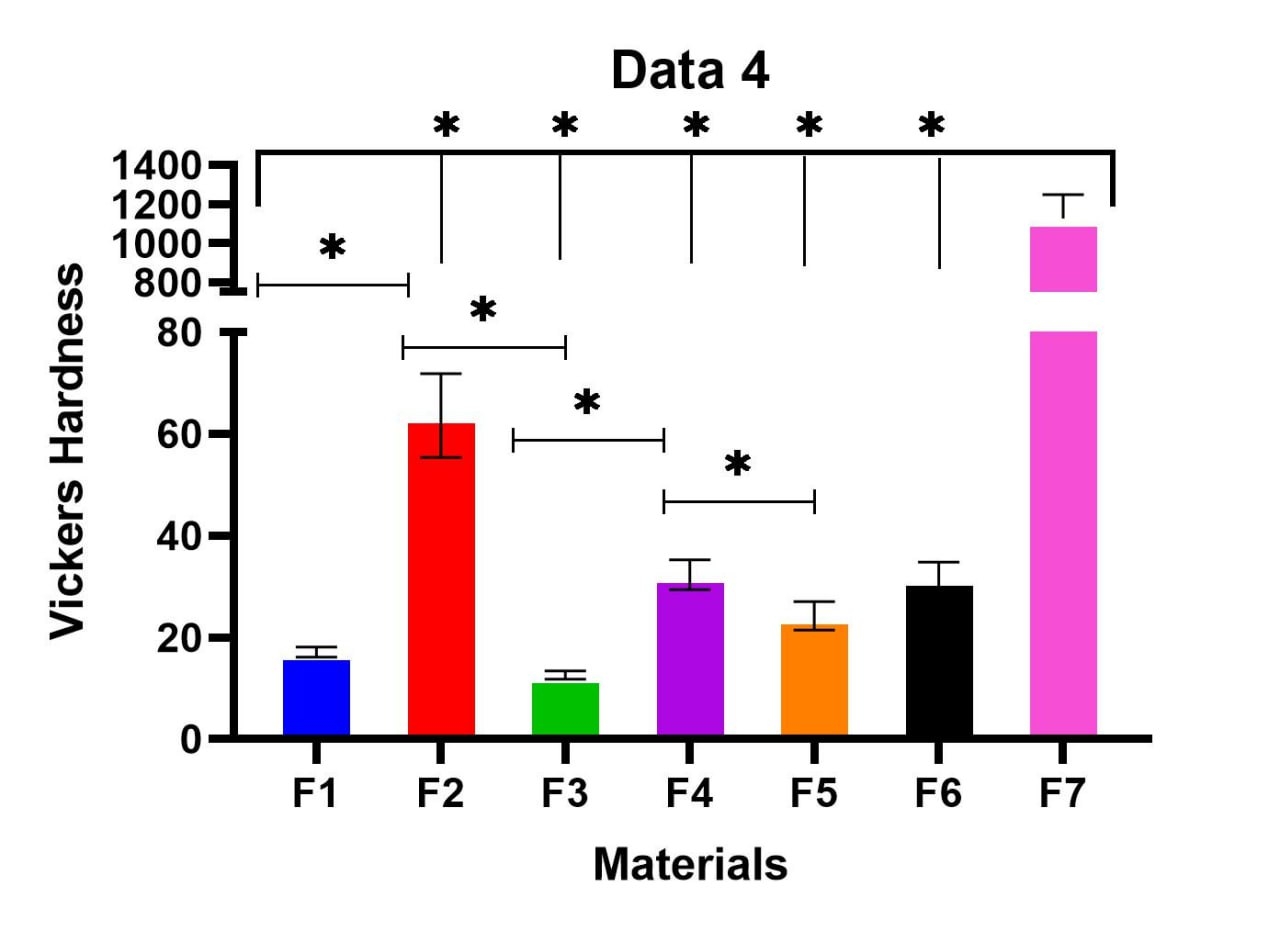
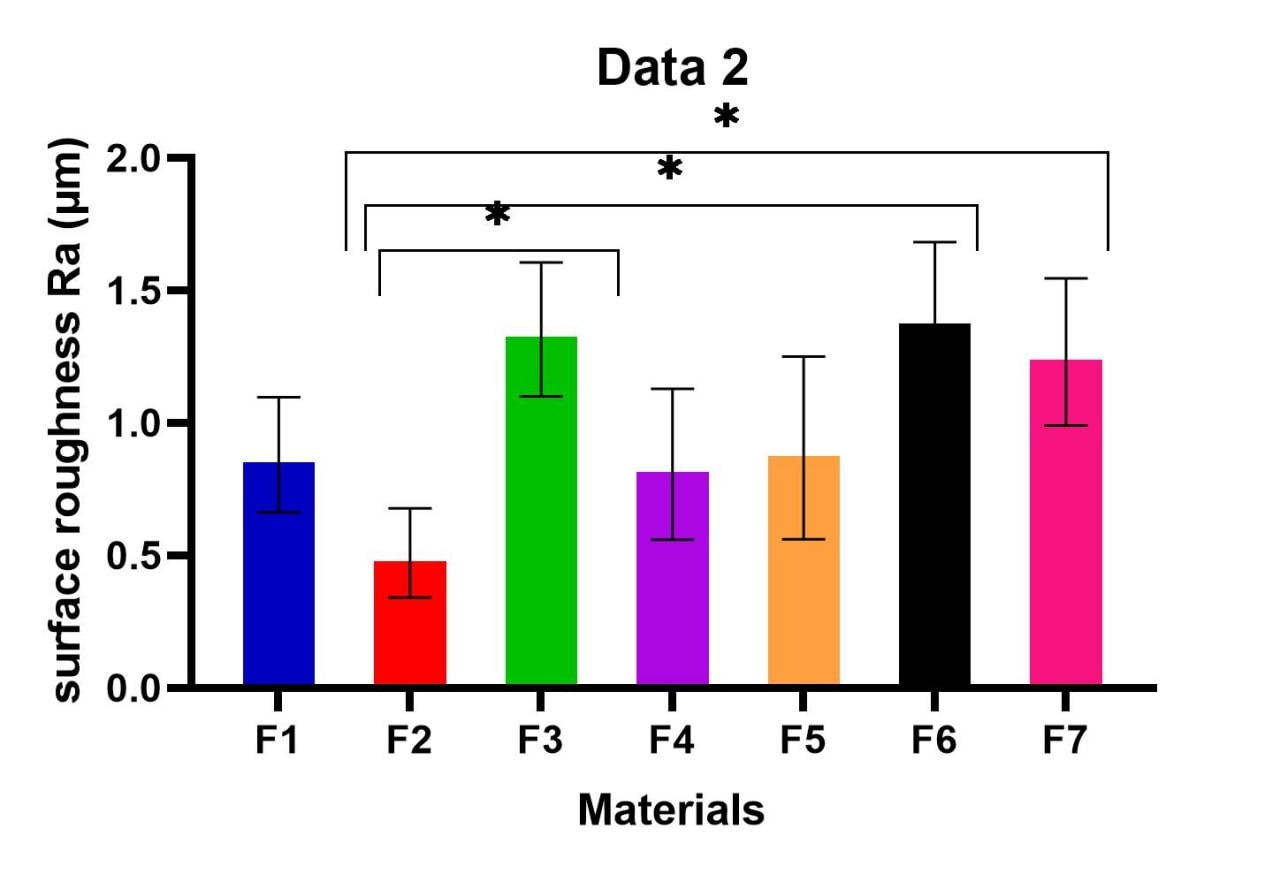
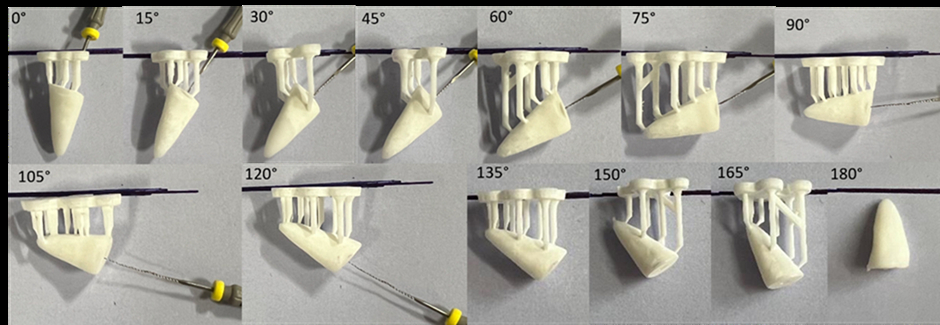
The Formlabs Rigid 10K resin demonstrated mechanical properties closely matching natural dentine, with a Vickers hardness of 50-70 HV as shown in Figure 1, and a Mohs hardness of 3. Scanning Electron Microscopy (SEM) and profilometry as shown in Figure 2 confirmed the models' smooth surfaces and accurate canal structures, with minimal dimensional irregularities. The printing orientation had a significant impact on canal patency, with the 0° orientation proving optimal for maintaining open canals (figure 3).
Conclusions:
This study demonstrates the potential of using 3D printing to create more realistic and functional tooth models that better replicate the mechanical properties of natural teeth. The development of 3D-printed root canal models using the Formlabs SLA printer and Rigid 10K resin showed promising results. The Rigid 10K resin was found to closely match the mechanical properties of dentin, making it an ideal candidate for use in dental training models, specifically root canal models.
Over the last decade, the dental industry has significantly advanced with the integration of 3D printing technology. However, while advancements have been made in the restoration of teeth, the simulation of teeth for training purposes still fails to accurately replicate the mechanical properties and key structural layers of enamel and dentine. This study aims to analyse commercially available resins to create more effective and realistic models via the development of multi-layered 3D-printed teeth using Formlabs SLA and Stratasys J5 3D printers.
Methods: Twelve commercially available resins (seven from Formlabs and five from Stratasys J5) were evaluated. Resin samples (30 mm diameter, 2 mm thickness) were printed and assessed for mechanical properties via Vickers and Mohs hardness tests. Surface characteristics were analysed using Scanning Electron Microscopy (SEM) and profilometry. Additionally, root canal models were printed using the Formlabs SLA printer, with different orientations to optimize resin drainage and canal patency.
Results:
The Formlabs Rigid 10K resin demonstrated mechanical properties closely matching natural dentine, with a Vickers hardness of 50-70 HV as shown in Figure 1, and a Mohs hardness of 3. Scanning Electron Microscopy (SEM) and profilometry as shown in Figure 2 confirmed the models' smooth surfaces and accurate canal structures, with minimal dimensional irregularities. The printing orientation had a significant impact on canal patency, with the 0° orientation proving optimal for maintaining open canals (figure 3).
Conclusions:
This study demonstrates the potential of using 3D printing to create more realistic and functional tooth models that better replicate the mechanical properties of natural teeth. The development of 3D-printed root canal models using the Formlabs SLA printer and Rigid 10K resin showed promising results. The Rigid 10K resin was found to closely match the mechanical properties of dentin, making it an ideal candidate for use in dental training models, specifically root canal models.
IMAGES
4256654_File000000.jpg
4256654_File000003.jpg
4256654_File000004.jpg
4256654_File000000.jpg
4256654_File000003.jpg
4256654_File000004.jpg