IADR Abstract Archives
Mechanistic Study of the Antibiofilm Effect of QAM-Based Materials
Objectives: The theory that, in positively charged molecules, longer side chains act as a lancet leading to bacterial disruption remains unproved. Giventhe flexibility and size of the chain compared with the thickness of the bacterial cell wall, the aim of this study was to elucidate the mechanism through which the combination of chain-length and charge in QAM-containing materials affects biofilm inhibition.
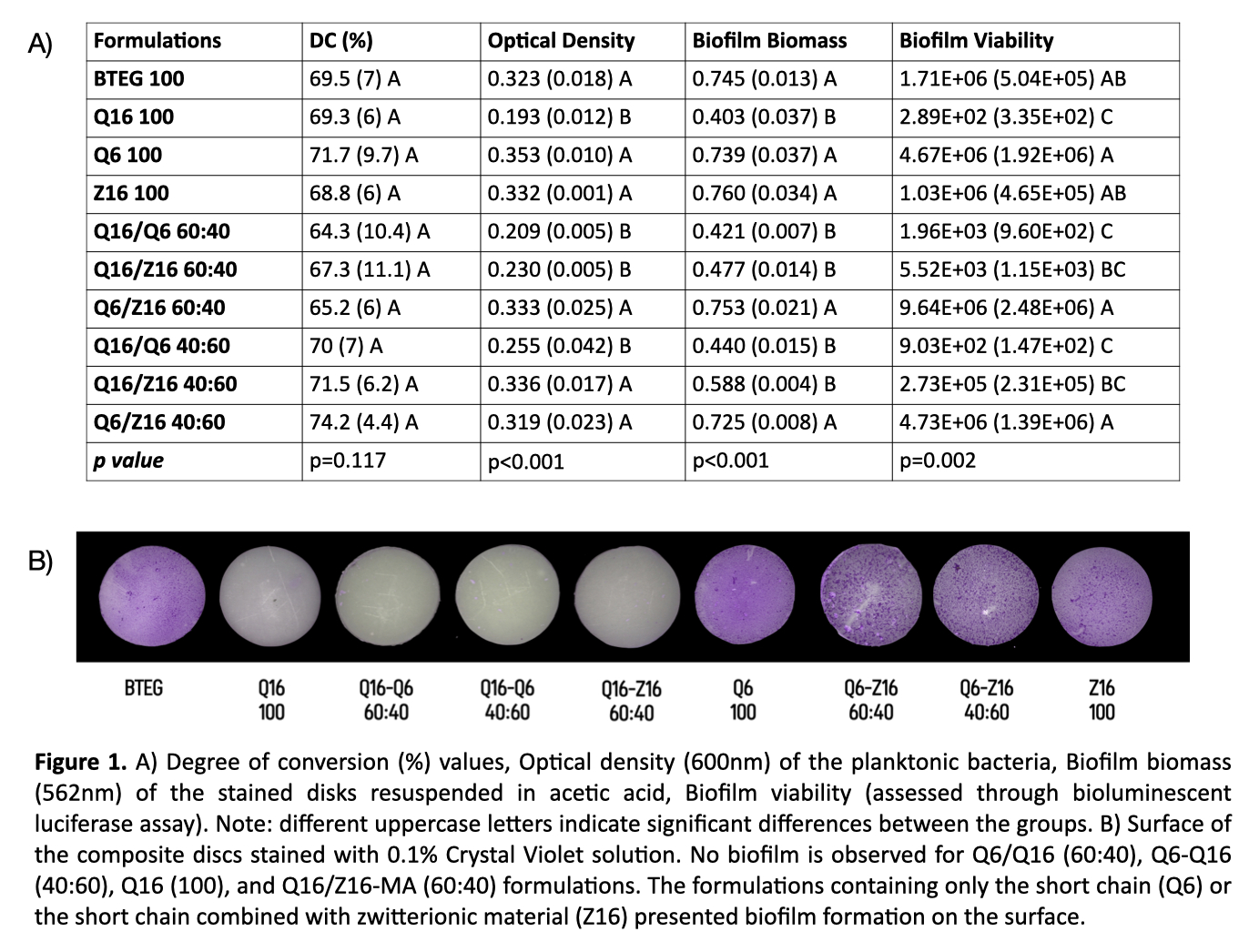
Methods: BisGMA/TEGDMA (50/50wt%), 0.1wt% DMPA, 70wt% filler were combined with 0 (control) or 10wt%: quaternary-ammonium methacrylate (QAM, positive charge) with 6- or 16-carbon side chain length (Q6 or Q16), or a zwitterion molecule (Z16, neutral) at several mol ratios (Figure 1A). Discs were photocured (700 mWcm2, 1 min/side), stored for 24 h, and the degree of conversion (DC) was measured (near-IR). Discs were sanded to 0.2-0.5µm surface roughness, then incubated with S. mutans (1% sucrose, TH media, 24 h, 37°C/5%CO2). Optical density of planktonic bacteria (OD), biofilm viability and biomass were assessed with crystal violet and luciferase assays. Data were analyzed with one-way ANOVA/Tukey’s test (α=0.05).
Results: DC was statistically similar for all groups (p=0.117). Groups containing the long chain (Q16) presented overall lower values of OD (p<0.001), suggesting that potential leachates were affecting planktonic bacteria. In general, biofilm biomass and viability decreased with the increase of Q16 concentration. One interesting observation is that the combination Q16/Q6 led to statistically similar biofilm disruption than Q16/Z16 at the 60/40, and both were statistically similar to Q16 alone. Considering that Q6 alone has no antimicrobial effect, that indicates that charge concentration is the main driver of antibiofilm activity.
Conclusions: The results demonstrate that the side chain length is not the main factor in biofilm disruption with positively-charged molecules, since at the same charge concentration, a mixture of long and short-chains led to the same antibiofilm effect than the long-chain alone.
Methods: BisGMA/TEGDMA (50/50wt%), 0.1wt% DMPA, 70wt% filler were combined with 0 (control) or 10wt%: quaternary-ammonium methacrylate (QAM, positive charge) with 6- or 16-carbon side chain length (Q6 or Q16), or a zwitterion molecule (Z16, neutral) at several mol ratios (Figure 1A). Discs were photocured (700 mWcm2, 1 min/side), stored for 24 h, and the degree of conversion (DC) was measured (near-IR). Discs were sanded to 0.2-0.5µm surface roughness, then incubated with S. mutans (1% sucrose, TH media, 24 h, 37°C/5%CO2). Optical density of planktonic bacteria (OD), biofilm viability and biomass were assessed with crystal violet and luciferase assays. Data were analyzed with one-way ANOVA/Tukey’s test (α=0.05).
Results: DC was statistically similar for all groups (p=0.117). Groups containing the long chain (Q16) presented overall lower values of OD (p<0.001), suggesting that potential leachates were affecting planktonic bacteria. In general, biofilm biomass and viability decreased with the increase of Q16 concentration. One interesting observation is that the combination Q16/Q6 led to statistically similar biofilm disruption than Q16/Z16 at the 60/40, and both were statistically similar to Q16 alone. Considering that Q6 alone has no antimicrobial effect, that indicates that charge concentration is the main driver of antibiofilm activity.
Conclusions: The results demonstrate that the side chain length is not the main factor in biofilm disruption with positively-charged molecules, since at the same charge concentration, a mixture of long and short-chains led to the same antibiofilm effect than the long-chain alone.
IMAGES
4011273_File000000.jpg
4011273_File000000.jpg