IADR Abstract Archives
Comparative Analysis of Test Method Configurations on Flexural-Strength of 5Y-Partially-Stabilized-Zirconia
Objectives: ISO 6872 “Dentistry-Ceramic Materials” allows the minimum values for the mean flexural-strength requirements for the different classes of ceramics to be met using one of the following methods: 3-point bending, 4-point bending, or biaxial-flexure. Furthermore, it permits a range of specimen span-lengths for the two bending methods. The purpose of this study is to compare the effects of ISO 6872 allowable bending methods and span-lengths on the resulting mean flexural-strength values of one brand of 5 mol%-yttria (5Y) partially-stabilized-zirconia (PSZ).
Methods: Sample preparation and testing methodology were performed according to ISO 6872. Rectangular beam-specimens were milled from 5Y-PSZ milling-blanks (BruxZir Anterior, Lot #BZ0027336) using a 5-axis dental-mill (vhf K5). Specimens were sintered according to the manufacturer’s instructions to a final dimension of 3x4x45 mm with four longitudinal 45° chamfers, measuring 0.12 mm.
Four-point bending was performed with two support rollers, utilizing short (20 mm) and long (40 mm) support-spans (L) with the load equally applied from two rollers located either 5 or 10 mm inside the support rollers, creating a loading-span (L/2) of 10 or 20 mm. Additionally, 3-point bending was performed with two support rollers using a span of 20 mm, with the load applied by an individual loading roller at the midpoint of the supports. All rollers had a diameter of 4.5 mm. A crosshead speed of 0.5 mm/min was employed until failure using an Instron Universal-Test-Machine. The peak-load at fracture was recorded for each test, and flexural-strength values were calculated according to ISO 6872, and Weibull plots were generated. One-way ANOVA and Tukey-Kramer post-hoc tests were performed, along with Weibull analysis.
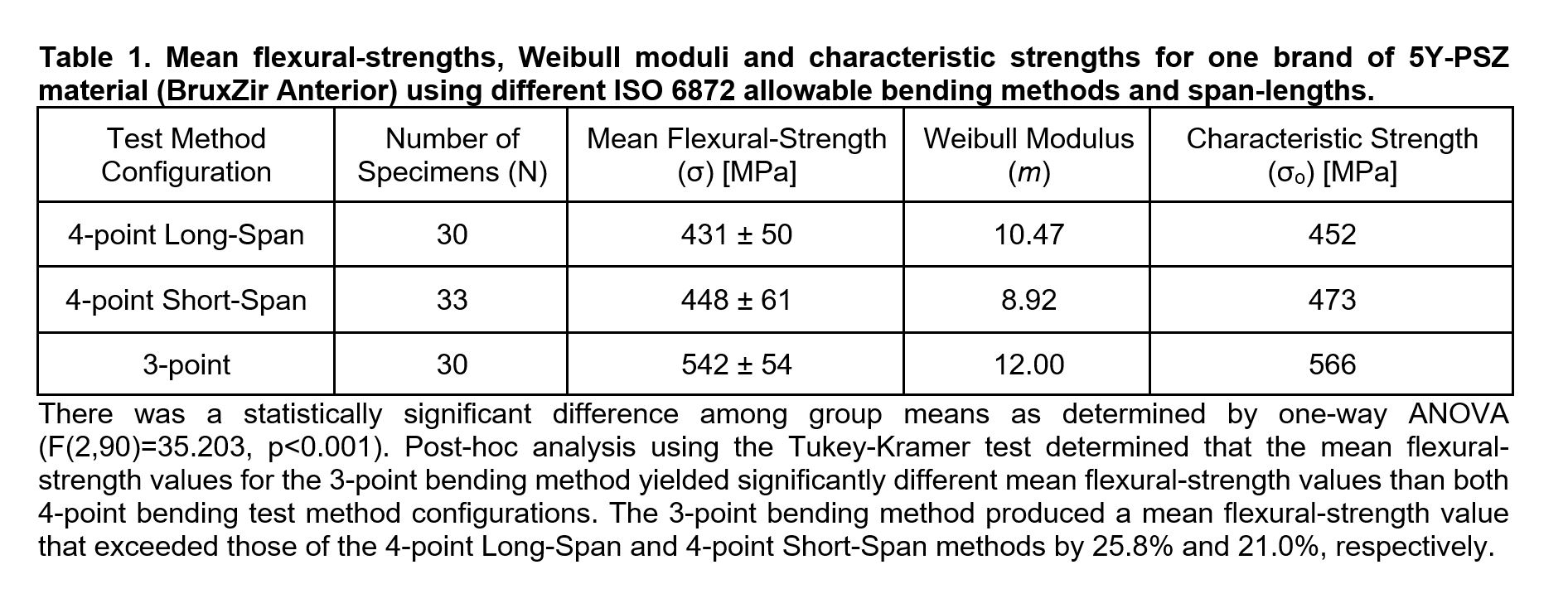
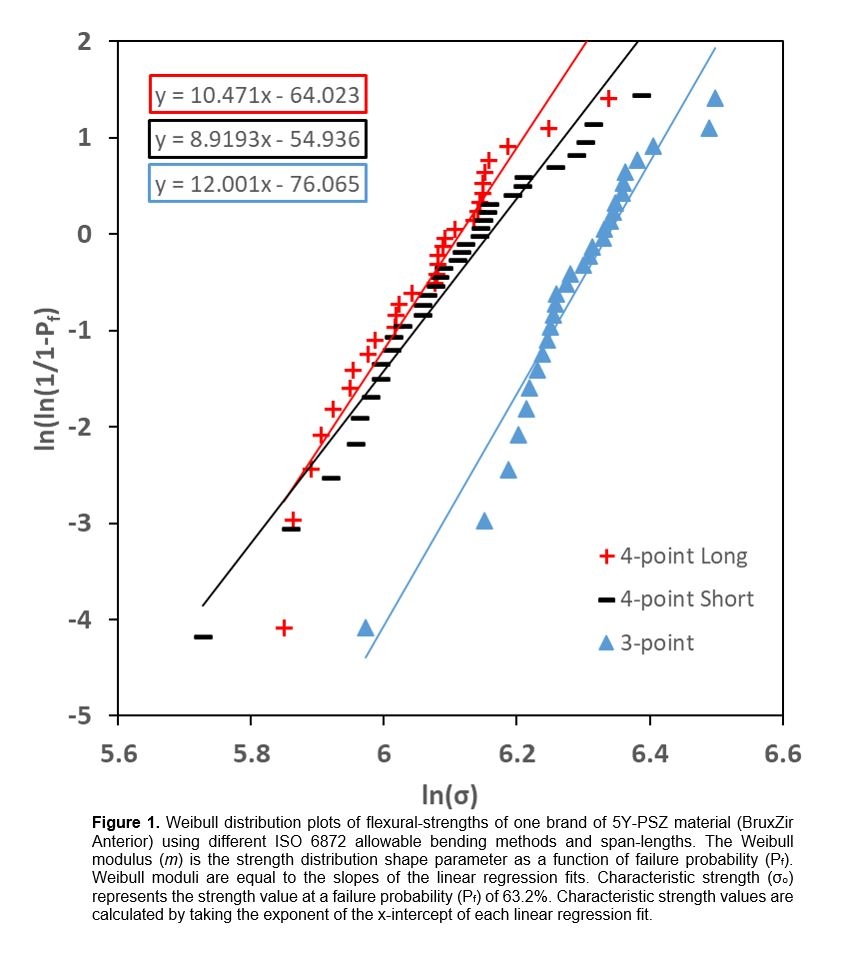
Results: Table 1 and Figure 1 show the data summary and Weibull plots, respectively.
Conclusions: This study revealed that a statistically significant difference in mean flexural-strength results can be obtained for the same lot of 5Y-PSZ material using the ISO 6872 allowable bending methods and span-lengths, suggesting that the standard may need to be revised to limit the allowable variability in methodologies.
Methods: Sample preparation and testing methodology were performed according to ISO 6872. Rectangular beam-specimens were milled from 5Y-PSZ milling-blanks (BruxZir Anterior, Lot #BZ0027336) using a 5-axis dental-mill (vhf K5). Specimens were sintered according to the manufacturer’s instructions to a final dimension of 3x4x45 mm with four longitudinal 45° chamfers, measuring 0.12 mm.
Four-point bending was performed with two support rollers, utilizing short (20 mm) and long (40 mm) support-spans (L) with the load equally applied from two rollers located either 5 or 10 mm inside the support rollers, creating a loading-span (L/2) of 10 or 20 mm. Additionally, 3-point bending was performed with two support rollers using a span of 20 mm, with the load applied by an individual loading roller at the midpoint of the supports. All rollers had a diameter of 4.5 mm. A crosshead speed of 0.5 mm/min was employed until failure using an Instron Universal-Test-Machine. The peak-load at fracture was recorded for each test, and flexural-strength values were calculated according to ISO 6872, and Weibull plots were generated. One-way ANOVA and Tukey-Kramer post-hoc tests were performed, along with Weibull analysis.
Results: Table 1 and Figure 1 show the data summary and Weibull plots, respectively.
Conclusions: This study revealed that a statistically significant difference in mean flexural-strength results can be obtained for the same lot of 5Y-PSZ material using the ISO 6872 allowable bending methods and span-lengths, suggesting that the standard may need to be revised to limit the allowable variability in methodologies.
IMAGES
4011192_File000000.JPG
4011192_File000001.JPG
4011192_File000000.JPG
4011192_File000001.JPG