IADR Abstract Archives
Strength of Crown Materials Printed on a $135 Hobby 3D-Printer
Objectives: 3D-printing in professional and hobby contexts is increasingly popular. Multiple permanent, restorative resins have recently received FDA-approval. These are typically marketed for use with professional print systems which may be prohibitively expensive for community or low-cost dental practices. This study tested whether material properties of permanent restorations printed on a low-cost hobby printer (HP) were commensurate with those produced on two different professional printers (PP): Formlabs 3B+ or Sprintray Pro 55S.
Methods: Three permanent crown materials were included in this study: Formlabs Permanent (Somerville, MA), Sprintray Ceramic Crown and Sprintray Bego Crown (Los Angeles, CA). Seventy-two 2x2x25mm test bars (n=12/group) were printed of each resin using either the manufacturer’s print system or a UV SLA hobby printer (HP) purchased through an online retailer. Ideal HP cure times were identified using open-source calibration models. Slice parameters were identical between groups and all sample post-print processing followed manufacturer directions. After 24hrs storage in 37°C/100% humidity, each sample underwent 3-point bend testing on an Instron E3000 in 37°C water circulation with a crosshead speed of 0.5mm/min until failure. Differences in flexural strength and flexural modulus were compared via two-way ANOVA with post-hoc pairwise Tukey (α=0.05) using R statistical platform (version 4.3.1).
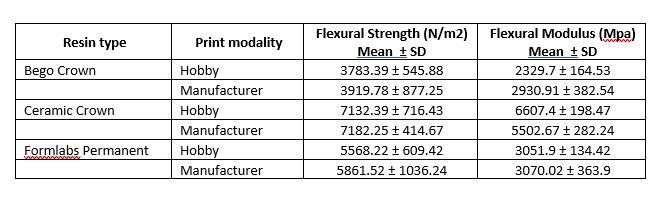
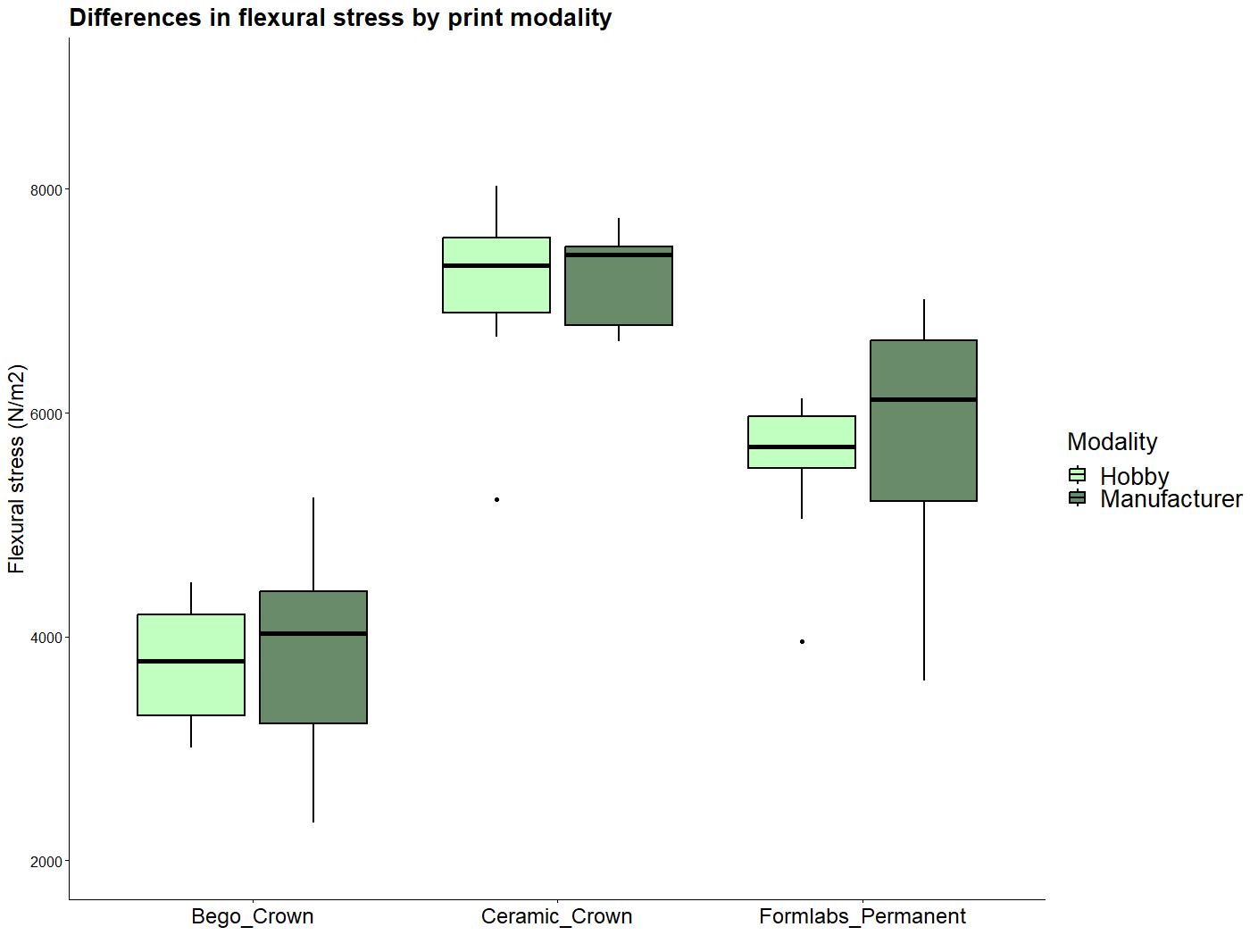
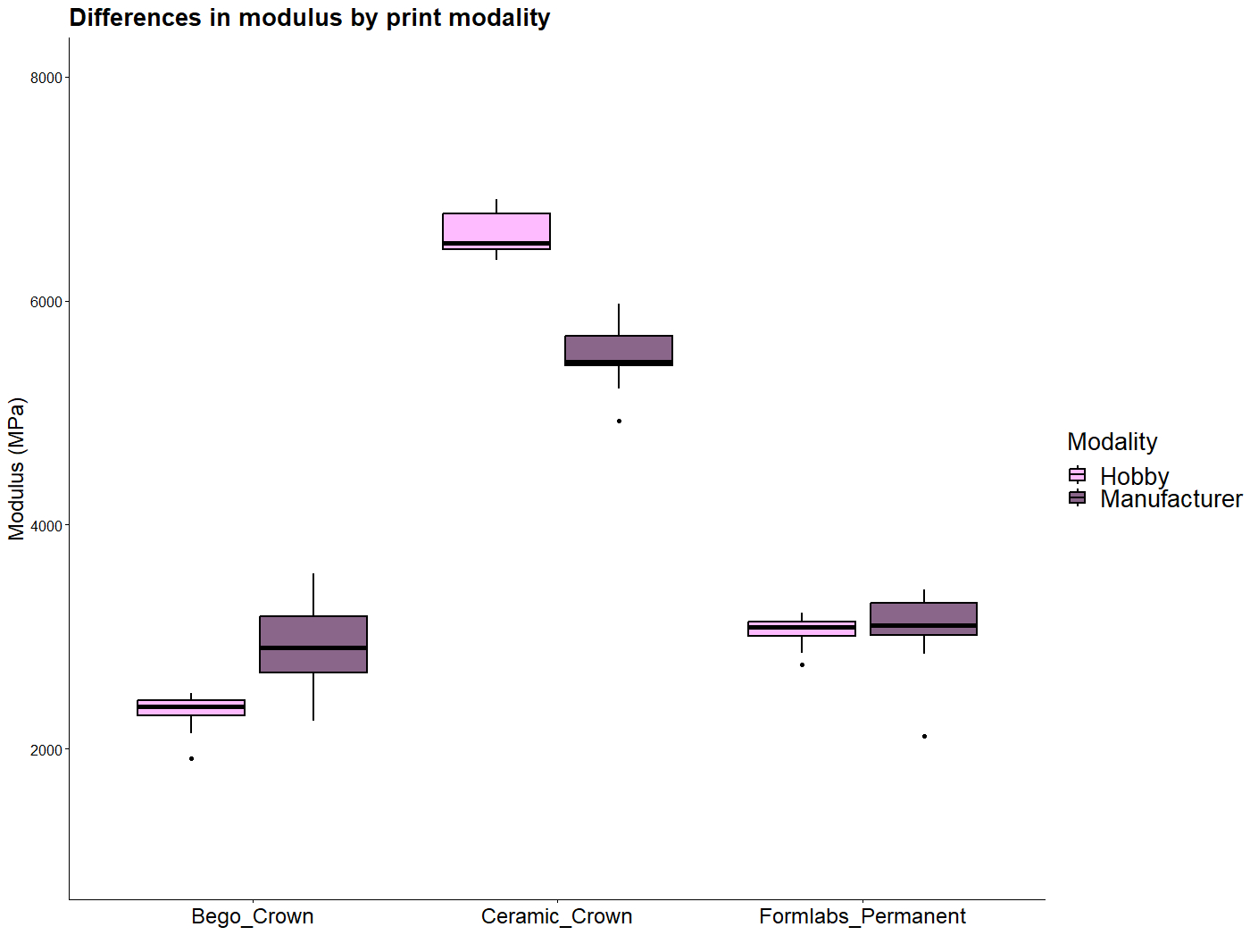
Results: Flexural strength significantly differed by resin type (p-value<0.001, F=121.795) but not printer type (Fig 1). A significant interaction between resin and printer type was detected for modulus (p-value<0.001, F=77.648), which was driven primarily by comparably higher values for the HP Ceramic Crown subgroup (Fig 2).
Conclusions: Hobby and professional 3D-printers produce permanent crown materials with commensurate flexural strength. Resin heterogeneity may explain differences in modulus between HP and PP Ceramic Crown prints. At the time of this abstract, HPs are $6000-20000 cheaper than the PP systems tested. These results indicate HPs may be a viable option to provide lower-cost restorations.
Methods: Three permanent crown materials were included in this study: Formlabs Permanent (Somerville, MA), Sprintray Ceramic Crown and Sprintray Bego Crown (Los Angeles, CA). Seventy-two 2x2x25mm test bars (n=12/group) were printed of each resin using either the manufacturer’s print system or a UV SLA hobby printer (HP) purchased through an online retailer. Ideal HP cure times were identified using open-source calibration models. Slice parameters were identical between groups and all sample post-print processing followed manufacturer directions. After 24hrs storage in 37°C/100% humidity, each sample underwent 3-point bend testing on an Instron E3000 in 37°C water circulation with a crosshead speed of 0.5mm/min until failure. Differences in flexural strength and flexural modulus were compared via two-way ANOVA with post-hoc pairwise Tukey (α=0.05) using R statistical platform (version 4.3.1).
Results: Flexural strength significantly differed by resin type (p-value<0.001, F=121.795) but not printer type (Fig 1). A significant interaction between resin and printer type was detected for modulus (p-value<0.001, F=77.648), which was driven primarily by comparably higher values for the HP Ceramic Crown subgroup (Fig 2).
Conclusions: Hobby and professional 3D-printers produce permanent crown materials with commensurate flexural strength. Resin heterogeneity may explain differences in modulus between HP and PP Ceramic Crown prints. At the time of this abstract, HPs are $6000-20000 cheaper than the PP systems tested. These results indicate HPs may be a viable option to provide lower-cost restorations.
IMAGES
4010932_File000000.JPG
4010932_File000001.jpg
4010932_File000002.jpg
4010932_File000000.JPG
4010932_File000001.jpg
4010932_File000002.jpg