IADR Abstract Archives
Assessments of Novel PVA-ACP Gel for Simulating White Spot Lesions
Objectives: Caries is the most common disease worldwide. Unlike dentine, enamel caries starts by subsurface demineralization, leaving a porous mineral surface covering the lesion body, which is called white spot lesion (WSL). Within the WSL, there are alternating periods of demineralization caused by bacteria acids and remineralization facilitated by saliva. Here we aimed to develop a novel artificial WSL model in vitro experiment using Polyvinyl Alcohol/ Amorphous Calcium Phosphate (PVA-ACP) synthetic hydrogel to simulate the progression of tooth decay for caries research.
Methods: The buccal surface of six human extracted teeth were subjected to demineralization with a PVA-ACP hydrogel at pH adjusted to between 2.3 – 2.5. The hydrogel was renewed 48-hourly for 14 days. 3D OCT scans were acquired at every other day. Human extracted teeth with stage ICDAS-I & -II naturally occurring caries (n=6 each) were also scanned with OCT. Average depth-resolved reflectance profile of the lesion and demineralization depth were measured. Secondary and backscattered electron scanning electron microscopy (SEM) and micro-computed tomography (micro-CT) scans were also performed.
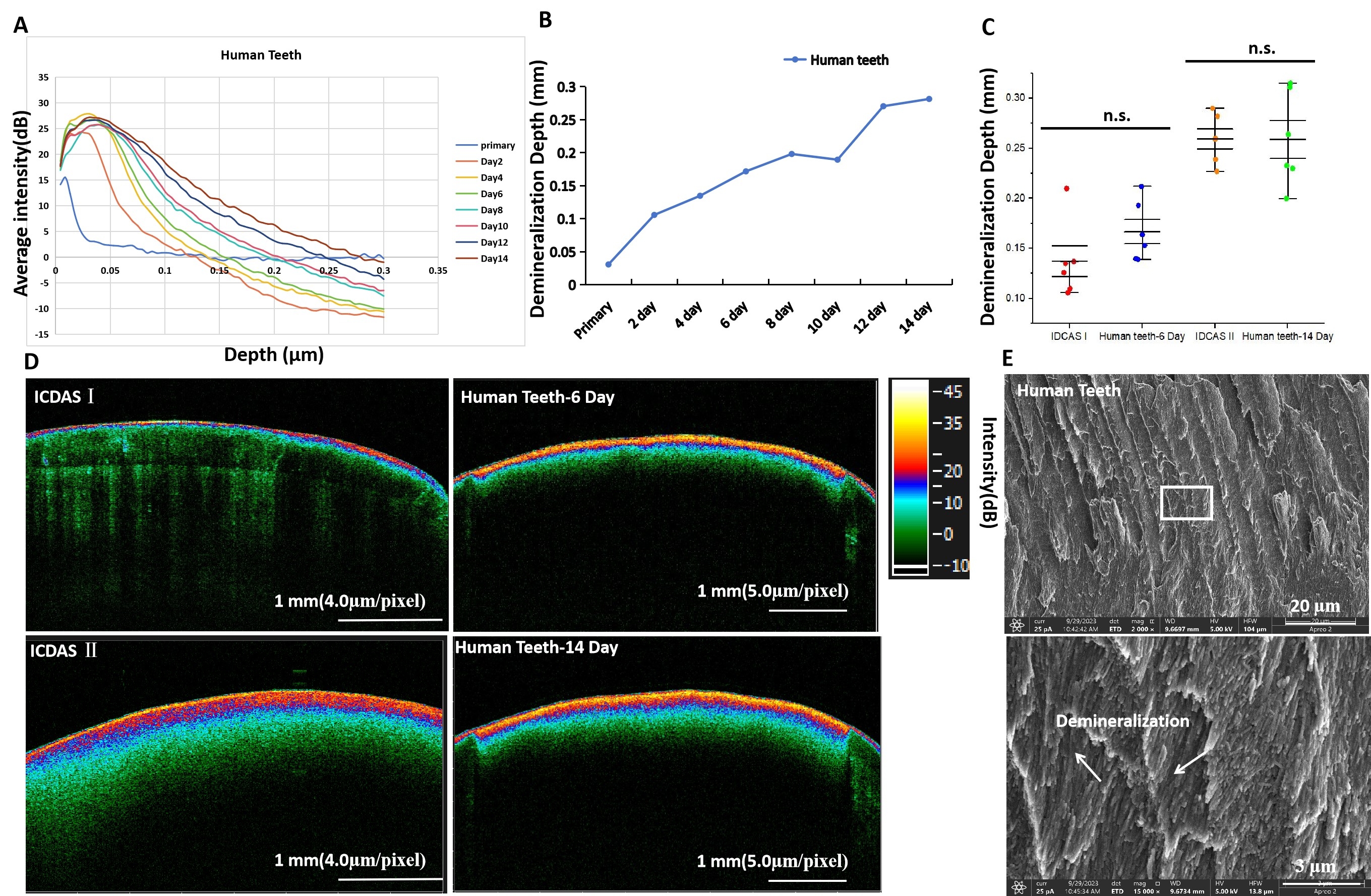
Results: The OCT integrated reflectance increased exponentially in the first 4 days but the increment rate plateaud thereafter (Fig A). The rate of demineralization depth increment however were similar throughout the 14 days (Fig B). No significant differences in demineralization depth were observed between Day-6 of the artificial caries and the ICDAS-I lesions and between Day-14 of the artificial caries and the ICDAS-II lesions (Fig C). At the 14th day, a surface layer resembling that in ICDAS-II lesions was observed (Fig D). SEM images of Day 14 of the artificial caries showed inter- and intraprismatic demineralized prisms (Fig E).
Conclusions: The acidic PVA-ACP hydrogel produced cyclic de-mineralization
and remineralization kinetics, producing artificial caries that mimics that of non-cavitated naturally occurring caries. We envisioned that this model simulate the progression of tooth decay, aiding in-depth research and advancements in the field of caries study.
Methods: The buccal surface of six human extracted teeth were subjected to demineralization with a PVA-ACP hydrogel at pH adjusted to between 2.3 – 2.5. The hydrogel was renewed 48-hourly for 14 days. 3D OCT scans were acquired at every other day. Human extracted teeth with stage ICDAS-I & -II naturally occurring caries (n=6 each) were also scanned with OCT. Average depth-resolved reflectance profile of the lesion and demineralization depth were measured. Secondary and backscattered electron scanning electron microscopy (SEM) and micro-computed tomography (micro-CT) scans were also performed.
Results: The OCT integrated reflectance increased exponentially in the first 4 days but the increment rate plateaud thereafter (Fig A). The rate of demineralization depth increment however were similar throughout the 14 days (Fig B). No significant differences in demineralization depth were observed between Day-6 of the artificial caries and the ICDAS-I lesions and between Day-14 of the artificial caries and the ICDAS-II lesions (Fig C). At the 14th day, a surface layer resembling that in ICDAS-II lesions was observed (Fig D). SEM images of Day 14 of the artificial caries showed inter- and intraprismatic demineralized prisms (Fig E).
Conclusions: The acidic PVA-ACP hydrogel produced cyclic de-mineralization
and remineralization kinetics, producing artificial caries that mimics that of non-cavitated naturally occurring caries. We envisioned that this model simulate the progression of tooth decay, aiding in-depth research and advancements in the field of caries study.
IMAGES
4010902_File000000.jpg
4010902_File000000.jpg