IADR Abstract Archives
Opioid-Analgesics Prescriptions After Invasive Surgical Procedures at Predoctoral Dental School
Objectives: We investigated the prevalence and evolving trend of opioid prescription and high-risk prescription across invasive surgical dental procedures between 2013-2023 within a predoctoral dental school.
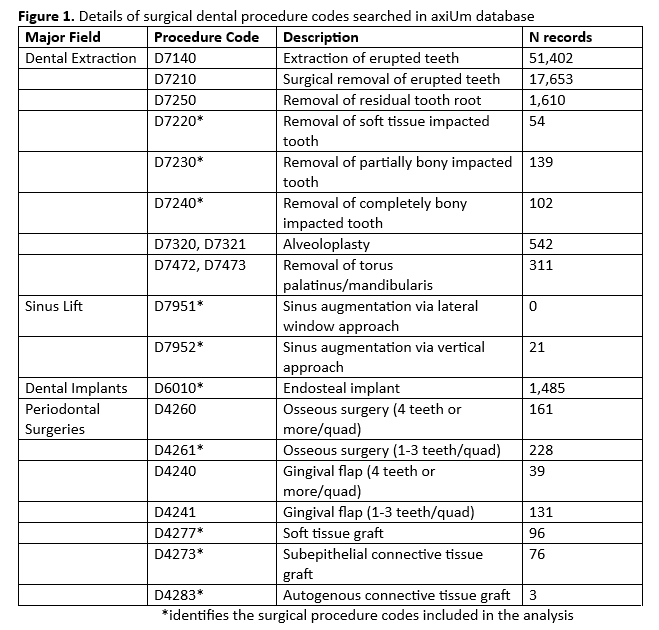
Methods: After IRB approval, the electronic health records (EHR, AxiUm database) of Midwestern University (College of Dental Medicine-Illinois) were searched for dental surgical procedure codes dated between July 2013-May 2023 (N=74,053). For this analysis, only invasive surgical procedures were considered (N=2,204 EHR, Figure 1). Difference in frequency of opioid prescriptions and high-risk prescriptions (opioids prescribed concurrently with benzodiazepine or within 30 days of another opioid prescription) across study observation-period and across dental procedures were compared using chi-square tests.
Results: Of N=2,204 EHR, N=147 records were excluded (N=31 dismissed patients, N=89 lacking availability for review, N=27 out-of-scope), which yielded a final N=2,057 EHR (age 56.3±15.7, 52.9% females). A total of N=121 (5.9%) procedures received opioid-analgesic prescriptions, with statistically significant difference across procedure types (p<.001). Impacted teeth extractions accounted for 86.0% of the prescriptions, while implants accounted for 14.0%. There was a significant difference in frequency of opioid-analgesic prescriptions across the study period (p<.001). The highest number of opioid-analgesic prescriptions occurred in 2016 (40.1%). A steep decline started in 2017, dropping from 14.6% in 2017 to 0.0% in 2022 and 2023. Out of 121 opioid analgesic prescriptions, 12.4% were considered at high-risk (4.1% concurrently with benzodiazepine; 8.3% within 30 days of another opioid). High-risk opioid-analgesic prescriptions exhibited a significant variation across the study period (p<.001), with the highest number dispensed in 2015 (5.9%), followed by no high-risk prescriptions from 2018 onward.
Conclusions: Within the selected invasive surgical procedures, only 5.9% of dental procedures received opioid-analgesic prescriptions in a predoctoral dental school, with 12.4% of these prescriptions considered high-risk. A steep decline in opioid-analgesic prescriptions was observed across the study observation period.
Methods: After IRB approval, the electronic health records (EHR, AxiUm database) of Midwestern University (College of Dental Medicine-Illinois) were searched for dental surgical procedure codes dated between July 2013-May 2023 (N=74,053). For this analysis, only invasive surgical procedures were considered (N=2,204 EHR, Figure 1). Difference in frequency of opioid prescriptions and high-risk prescriptions (opioids prescribed concurrently with benzodiazepine or within 30 days of another opioid prescription) across study observation-period and across dental procedures were compared using chi-square tests.
Results: Of N=2,204 EHR, N=147 records were excluded (N=31 dismissed patients, N=89 lacking availability for review, N=27 out-of-scope), which yielded a final N=2,057 EHR (age 56.3±15.7, 52.9% females). A total of N=121 (5.9%) procedures received opioid-analgesic prescriptions, with statistically significant difference across procedure types (p<.001). Impacted teeth extractions accounted for 86.0% of the prescriptions, while implants accounted for 14.0%. There was a significant difference in frequency of opioid-analgesic prescriptions across the study period (p<.001). The highest number of opioid-analgesic prescriptions occurred in 2016 (40.1%). A steep decline started in 2017, dropping from 14.6% in 2017 to 0.0% in 2022 and 2023. Out of 121 opioid analgesic prescriptions, 12.4% were considered at high-risk (4.1% concurrently with benzodiazepine; 8.3% within 30 days of another opioid). High-risk opioid-analgesic prescriptions exhibited a significant variation across the study period (p<.001), with the highest number dispensed in 2015 (5.9%), followed by no high-risk prescriptions from 2018 onward.
Conclusions: Within the selected invasive surgical procedures, only 5.9% of dental procedures received opioid-analgesic prescriptions in a predoctoral dental school, with 12.4% of these prescriptions considered high-risk. A steep decline in opioid-analgesic prescriptions was observed across the study observation period.
IMAGES
4010837_File000000.jpg
4010837_File000000.jpg