IADR Abstract Archives
3D-Printed Models Dimensional Accuracy: a Function of Printing Angulation
Objectives: 3D-printing technology allows clinicians to fabricate models for various purposes. During the printing process, varying printing angles could alter model accuracy. This study compared linear dimensions across diagnostic models printed at different angles. We hypothesized that varying print angulation affects models’ dimensional accuracy.
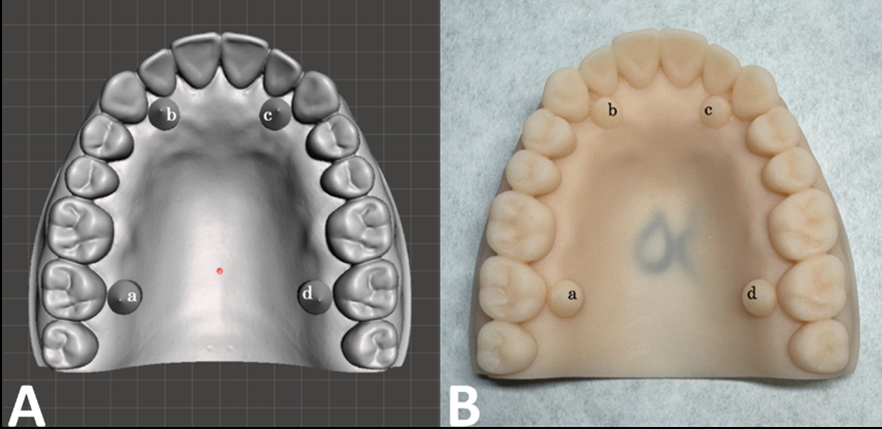
Methods: A stereolithography (STL) file of a standardized maxillary arch was created following a modification of ISO-WD-20896-1. The file was printed at six different angulations 15o , 30o , 45o , 60o , 75o , 90o (n=10/angulation), and compared to a 0o 3D-printed group (control). Measurements (a-b, b-c, c-d, a-d, a-c, b-d) were obtained by a trained investigator. Six linear measurements (Figure 1) across 10 3D-printed models were assessed for agreement with Kruskal-Wallis Test. One sample t-test was used to assess agreement between the reference 0o STL-file and measurements taken with different angulations for each linear measurement.
Results: Linear measurements of each print did not differ across the 10 prints (p=.437). For the a-b linear measurement, significant differences were found between 0o (32.30±0.1) and 45o (32.14±0.9, p<.001). No significant differences were observed between the b-c linear measurements taken at different angulations. For the c-d linear measurement, significant differences were found between 0o (32.29±0.1), 15o (32.37±0.1, p=.004) and 75o (32.42±0.1, p=.007). The a-d linear measurement showed significant differences between 0o (32.93±0.1) and 15o (32.86±0.1, p=.013), 30o (32.67±0.1, p<.001), 45o (32.64±0.1, p<.001), and 60o (32.73±0.1, p<.001). For the a-c linear measurement, significant differences were found between 0o (41.00±0.1), 30o (40.91±0.1, p=.001), 45o (40.81±0.1, p<.001), 60o (40.94±0.1, p=.026). For the b-d linear measurement, significant differences were found between 0o (40.98±0.1) and 45o (40.85±0.1, p=.004).
Conclusions: Within the limitations of the study, the most accurate printing angulation compared to the 0o group was the 90o group, whereas the least accurate was the 45o group. The linear measurement b-c was the most accurate among all groups.
Methods: A stereolithography (STL) file of a standardized maxillary arch was created following a modification of ISO-WD-20896-1. The file was printed at six different angulations 15o , 30o , 45o , 60o , 75o , 90o (n=10/angulation), and compared to a 0o 3D-printed group (control). Measurements (a-b, b-c, c-d, a-d, a-c, b-d) were obtained by a trained investigator. Six linear measurements (Figure 1) across 10 3D-printed models were assessed for agreement with Kruskal-Wallis Test. One sample t-test was used to assess agreement between the reference 0o STL-file and measurements taken with different angulations for each linear measurement.
Results: Linear measurements of each print did not differ across the 10 prints (p=.437). For the a-b linear measurement, significant differences were found between 0o (32.30±0.1) and 45o (32.14±0.9, p<.001). No significant differences were observed between the b-c linear measurements taken at different angulations. For the c-d linear measurement, significant differences were found between 0o (32.29±0.1), 15o (32.37±0.1, p=.004) and 75o (32.42±0.1, p=.007). The a-d linear measurement showed significant differences between 0o (32.93±0.1) and 15o (32.86±0.1, p=.013), 30o (32.67±0.1, p<.001), 45o (32.64±0.1, p<.001), and 60o (32.73±0.1, p<.001). For the a-c linear measurement, significant differences were found between 0o (41.00±0.1), 30o (40.91±0.1, p=.001), 45o (40.81±0.1, p<.001), 60o (40.94±0.1, p=.026). For the b-d linear measurement, significant differences were found between 0o (40.98±0.1) and 45o (40.85±0.1, p=.004).
Conclusions: Within the limitations of the study, the most accurate printing angulation compared to the 0o group was the 90o group, whereas the least accurate was the 45o group. The linear measurement b-c was the most accurate among all groups.
IMAGES
4010805_File000000.jpg
4010805_File000000.jpg