IADR Abstract Archives
3D Bioprinting of Complex Scaffold With α-Mangostin for Bone Regeneration
Objectives: α-Mangostin (MG) is known for its anti-inflammatory potential, suggesting its role in bone regeneration therapy. Therefore, this study aimed to develop an MG-infused bioink and evaluate its stability, cytocompatibility, and mineralization for bone regeneration using 3D bioprinting.
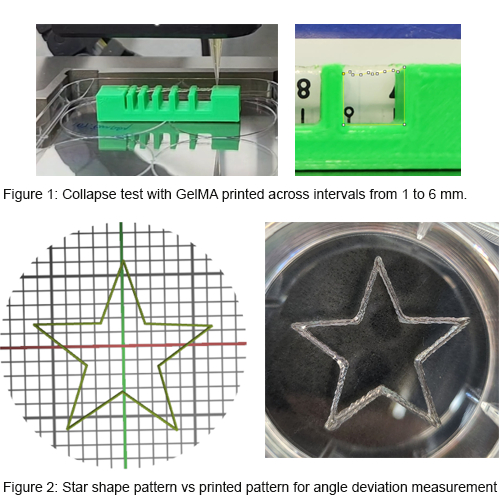
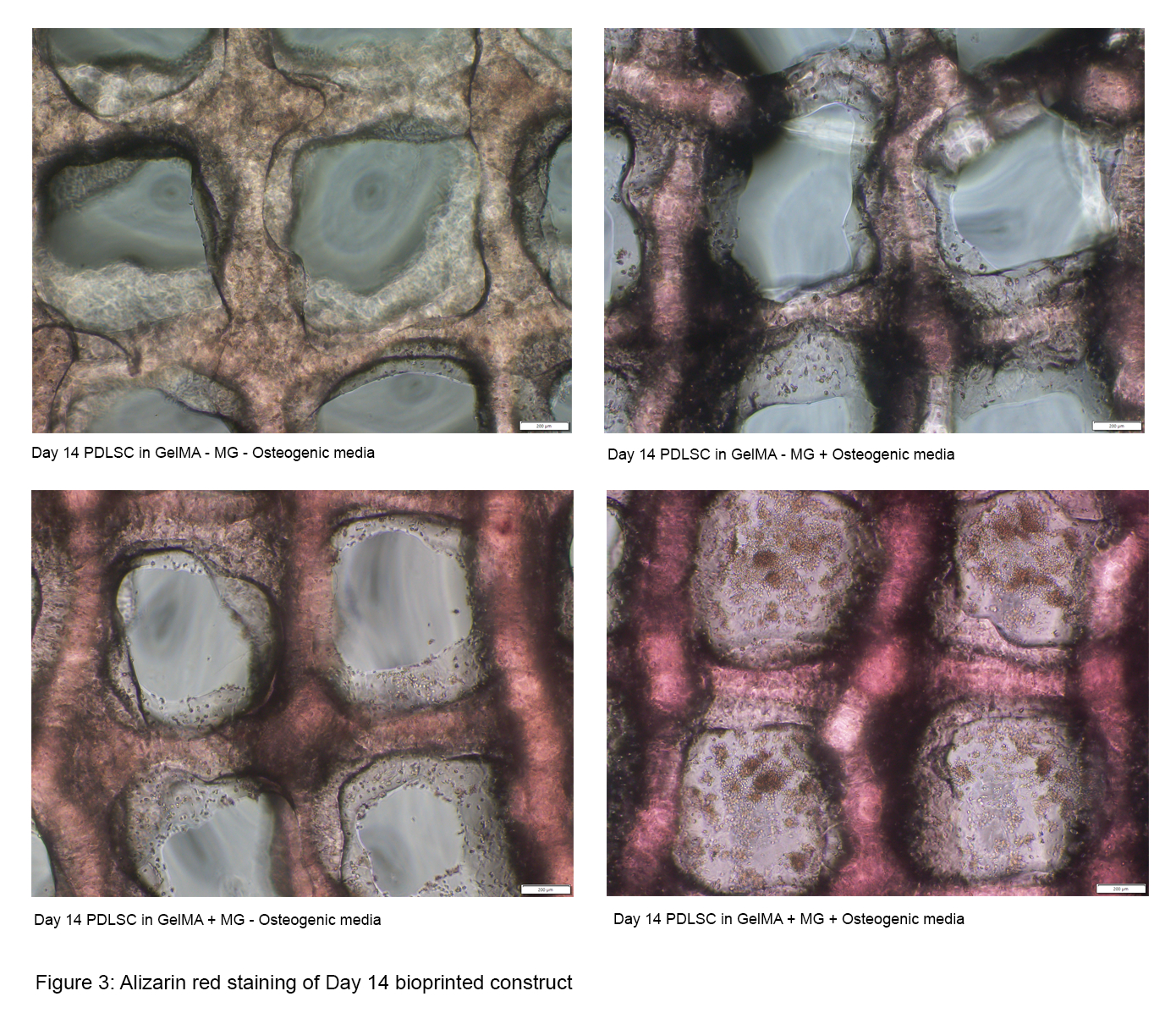
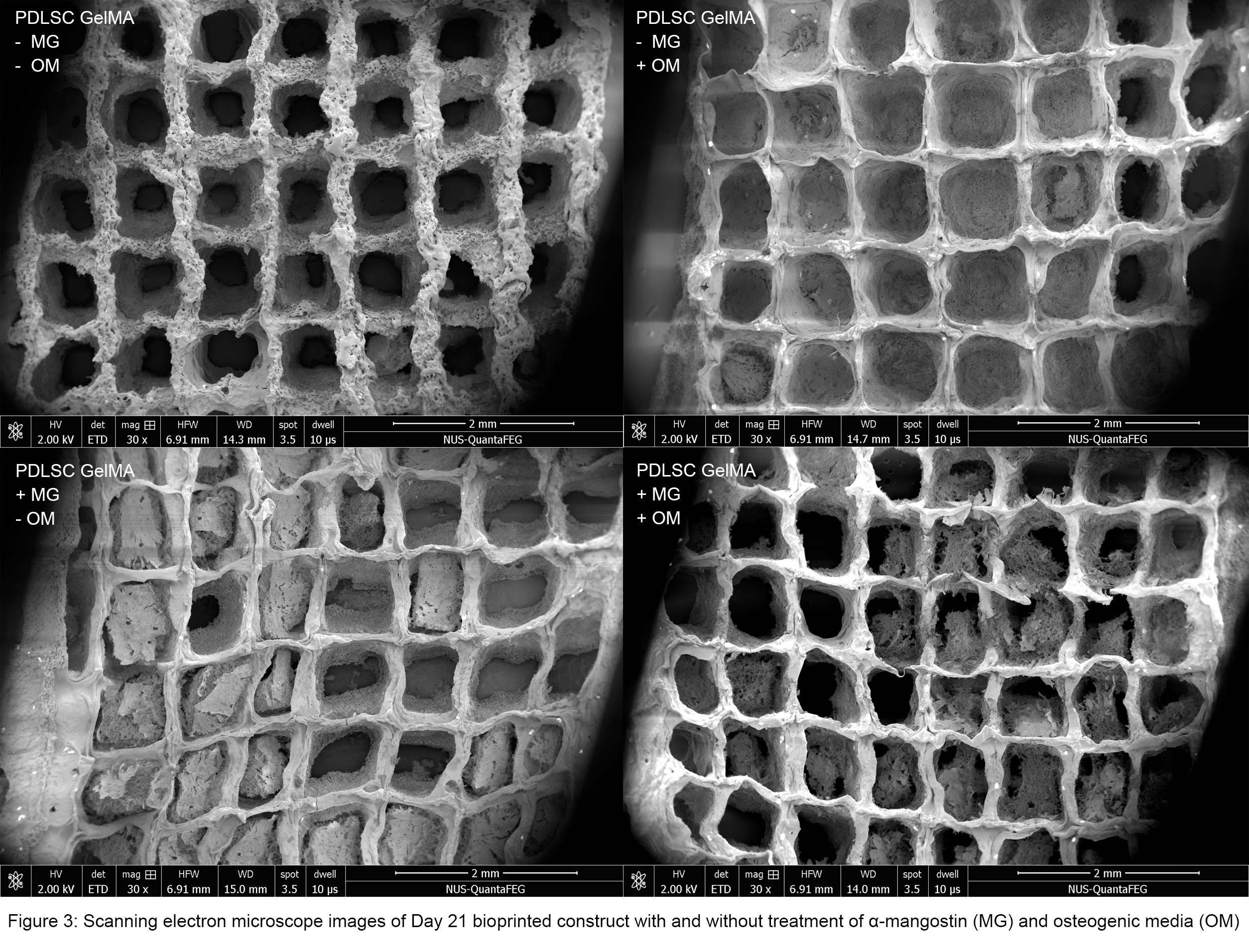
Methods: The bioink was formulated by mixing MG with 7% and 10% gelatin methacryloyl (GelMA). The effect of MG concentration (0 to 30μg/mL) on periodontal ligament stem cells (PDLSCs) was assessed via MTS assay. Based on cell viability, bioink with 5ug/mL MG was printed through extrusion-based bioprinter, GeSim Bioscaffolder, at 16°C, 90kPa and photopolymerized via dental curing light. Collapsing factor and shape fidelity were tested for bioink stability. With superior stability and biocompatibility, 7% GelMA with 5 ug/mL MG was bioprinted for biological assays using PDLSCs. ATP and MTS assay were performed for biocompatibility. Mineralization was tested via Alkaline phosphatase (ALP), Alizarin red staining (ARS) assay and SEM with statistical analysis (one-way ANOVA with Tukey HSD test; p-value=0.05).
Results: 5ug/mL MG demonstrated 140.12% viability, subsequent 10ug/mL MG reduced viability to 74.24%, leading to the selection of 5ug/mL. Furthermore, incorporation of MG improved the stability of bioink, as 7% GelMA had collapsing factor improved from 87.24% to 92.49%, and 10% GelMA, improved from 84.67% to 91.13%. Shape fidelity was measured by angular deviation using standard star-shaped pattern. MG-bioink demonstrated reduced deviation from 30.31% to 7.94% in 7% GelMA, while in 10% GelMA deviations were 15.54% for untreated and 17.91% with MG. PDLSC exhibited 40.19%±0.24% proliferation increment for 5ug/mL MG compared to untreated GelMA on day 5. Day 7 ALP concentration of MG-bioink was found 2.24 folds higher than untreated GelMA. Moreover, ARS and SEM results suggested more extensive calcification of bioink with MG.
Conclusions: In summary, the proposed bioink can function as a bioprintable and cytocompatible scaffold with osteogenic capacity, offering potential application in bone regeneration.
Methods: The bioink was formulated by mixing MG with 7% and 10% gelatin methacryloyl (GelMA). The effect of MG concentration (0 to 30μg/mL) on periodontal ligament stem cells (PDLSCs) was assessed via MTS assay. Based on cell viability, bioink with 5ug/mL MG was printed through extrusion-based bioprinter, GeSim Bioscaffolder, at 16°C, 90kPa and photopolymerized via dental curing light. Collapsing factor and shape fidelity were tested for bioink stability. With superior stability and biocompatibility, 7% GelMA with 5 ug/mL MG was bioprinted for biological assays using PDLSCs. ATP and MTS assay were performed for biocompatibility. Mineralization was tested via Alkaline phosphatase (ALP), Alizarin red staining (ARS) assay and SEM with statistical analysis (one-way ANOVA with Tukey HSD test; p-value=0.05).
Results: 5ug/mL MG demonstrated 140.12% viability, subsequent 10ug/mL MG reduced viability to 74.24%, leading to the selection of 5ug/mL. Furthermore, incorporation of MG improved the stability of bioink, as 7% GelMA had collapsing factor improved from 87.24% to 92.49%, and 10% GelMA, improved from 84.67% to 91.13%. Shape fidelity was measured by angular deviation using standard star-shaped pattern. MG-bioink demonstrated reduced deviation from 30.31% to 7.94% in 7% GelMA, while in 10% GelMA deviations were 15.54% for untreated and 17.91% with MG. PDLSC exhibited 40.19%±0.24% proliferation increment for 5ug/mL MG compared to untreated GelMA on day 5. Day 7 ALP concentration of MG-bioink was found 2.24 folds higher than untreated GelMA. Moreover, ARS and SEM results suggested more extensive calcification of bioink with MG.
Conclusions: In summary, the proposed bioink can function as a bioprintable and cytocompatible scaffold with osteogenic capacity, offering potential application in bone regeneration.
IMAGES
4010674_File000000.jpg
4010674_File000001.jpg
4010674_File000002.jpg
4010674_File000000.jpg
4010674_File000001.jpg
4010674_File000002.jpg