IADR Abstract Archives
Antibacterial Properties of Fluoride-Doped Calcium-Phosphate Reinforced Composites Against Streptococcus Gordonii
Objectives: Fluoride has been advocated to promote enamel remineralization and prevent caries via inhibition of bacterial growth. Moreover, the presence of specific ions such as Ca2+ and PO43− may enhance the deposition of apatite-like crystals. In this work, we evaluated the antibacterial properties of an experimental resin composite containing fluoride-doped calcium phosphate particles against Streptococcus gordonii, a primary oral colonizer of restored-tooth surfaces.
Methods: Calcium phosphate was doped with 10% and 20% of fluoride salts (SV10 and SV20 groups) by addition of NaF and CaF (1:1) to create experimental bioactive fillers. Such fillers were incorporated into a resin blend at 5wt%, 10 wt% and 20wt% (R5, R10 and R20, respectively). The resin bland without the bioactive fillers was used as control. Specimens were pre-conditioned for 48h in PBS. S. gordonii was seeded on samples at 1x10⁶ CFU/mL and incubated 24h at 37°C. ATP and CFU were assessed to determinate bacteria metabolic activity and viability, respectively. Bacteria colonization of surfaces was evaluated by live/dead assay. Levene's tests were performed to assess homogeneity of variances between groups. ANOVA tables with Tukey and Tamahane's T2 post-hoc tests were performed for assessing statistical significant differences between groups (p<0.05).
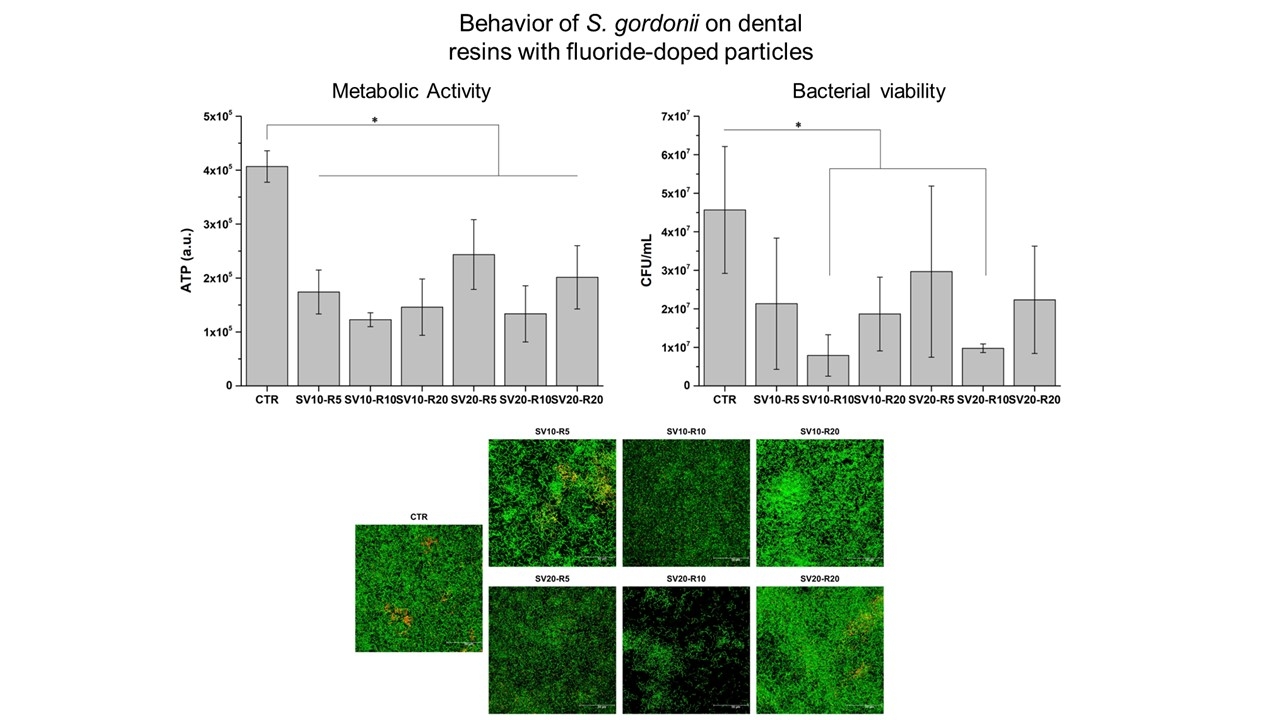
Results: ATP and CFU indicated clear antimicrobial activity in the composites containing the experimental bioactive fillers, especially when such filler were incorporated at a concentration of 10% (R10). No statistical differences between SV10 and SV20 groups were determined. The nonlinear correlation between the particles percentage and antimicrobial activity was likely due to low fluoride release in R5 groups and excessive fluoride release in R20 groups that caused the precipitation of non-antimicrobial fluoride salts. LIVE/DEAD indicated that biofilm formation was compromised in R10 groups, especially in SV20-R10.
Conclusions: Incorporation of fluoride-doped calcium phosphate filler in dental resin composites at 10%wt may be effective to inhibit bacterial growth on the surfaces of restored teeth.
Methods: Calcium phosphate was doped with 10% and 20% of fluoride salts (SV10 and SV20 groups) by addition of NaF and CaF (1:1) to create experimental bioactive fillers. Such fillers were incorporated into a resin blend at 5wt%, 10 wt% and 20wt% (R5, R10 and R20, respectively). The resin bland without the bioactive fillers was used as control. Specimens were pre-conditioned for 48h in PBS. S. gordonii was seeded on samples at 1x10⁶ CFU/mL and incubated 24h at 37°C. ATP and CFU were assessed to determinate bacteria metabolic activity and viability, respectively. Bacteria colonization of surfaces was evaluated by live/dead assay. Levene's tests were performed to assess homogeneity of variances between groups. ANOVA tables with Tukey and Tamahane's T2 post-hoc tests were performed for assessing statistical significant differences between groups (p<0.05).
Results: ATP and CFU indicated clear antimicrobial activity in the composites containing the experimental bioactive fillers, especially when such filler were incorporated at a concentration of 10% (R10). No statistical differences between SV10 and SV20 groups were determined. The nonlinear correlation between the particles percentage and antimicrobial activity was likely due to low fluoride release in R5 groups and excessive fluoride release in R20 groups that caused the precipitation of non-antimicrobial fluoride salts. LIVE/DEAD indicated that biofilm formation was compromised in R10 groups, especially in SV20-R10.
Conclusions: Incorporation of fluoride-doped calcium phosphate filler in dental resin composites at 10%wt may be effective to inhibit bacterial growth on the surfaces of restored teeth.
IMAGES
4008214_File000000.jpg
4008214_File000000.jpg