IADR Abstract Archives
Effect of Saliva on Mechanical Properties of 3D-Printed Occlusal Guard
Objectives: This study aimed to investigate the effect of saliva on the ultimate flexural strength and Young’s modulus of 3D-printed occlusal guard materials.
Methods: Four 3D-printed materials (SprintRay Nightguard Firm, SprintRay Nightguard Flex, NextDent Ortho Clear, and Keyprint KeySplint Soft™) were stored in two different solutions (distilled water (control) and artificial saliva (BZ 323, Biochemazone, Canada)), creating 8 groups (n=9). The specimens were printed at 90° (3.5x12x64mm) at a layer height of 100mm and polished to 3.3x10x64mm. The control group was stored in distilled water for 50±2 hours at 37±1°C. The experimental group was stored in artificial saliva with pH of 6.8 (BZ323, Biochemazone, Canada) for 50±2 hours at 37±1°C. After storage, ultimate flexural strength and Young’s modulus were determined by a three-point bending test, according to ISO 20795-2:2013. Data were statistically analyzed with the independent-samples t-test and Mann-Whitney U test to compare the two different storage solutions in terms of ultimate flexural strength and Young’s modulus (p<0.05).
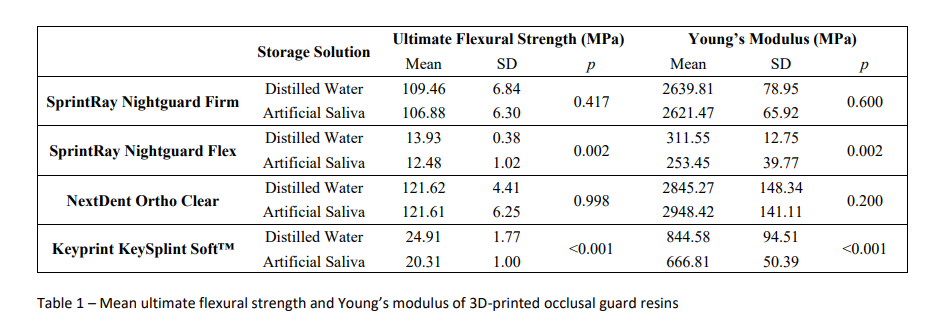
Results: As shown in Table 1, the two flexible 3-D printed materials tested: SprintRay Nightguard Flex and KeySplint Soft™ exhibited significantly lower mean ultimate flexural strength and mean Young’s modulus when stored in saliva instead of distilled water. However, there was no significant difference between the storage conditions for the two firm 3-D printed materials: SprintRay Nightguard Firm and NextDent Ortho Clear (Table 1).
Conclusions: Within the confines of this study, saliva may affect the mechanical properties (ultimate flexural strength and flexibility) of flexible 3D-printed occlusal guard materials. However, there was no evidence that saliva affects the mechanical properties of firm 3D-printed occlusal guard materials within 50±2 hours at body temperature. This study demonstrates that it is important to assess the integrity of the 3D-printed occlusal guards, as saliva may weaken the mechanical properties with time.
Methods: Four 3D-printed materials (SprintRay Nightguard Firm, SprintRay Nightguard Flex, NextDent Ortho Clear, and Keyprint KeySplint Soft™) were stored in two different solutions (distilled water (control) and artificial saliva (BZ 323, Biochemazone, Canada)), creating 8 groups (n=9). The specimens were printed at 90° (3.5x12x64mm) at a layer height of 100mm and polished to 3.3x10x64mm. The control group was stored in distilled water for 50±2 hours at 37±1°C. The experimental group was stored in artificial saliva with pH of 6.8 (BZ323, Biochemazone, Canada) for 50±2 hours at 37±1°C. After storage, ultimate flexural strength and Young’s modulus were determined by a three-point bending test, according to ISO 20795-2:2013. Data were statistically analyzed with the independent-samples t-test and Mann-Whitney U test to compare the two different storage solutions in terms of ultimate flexural strength and Young’s modulus (p<0.05).
Results: As shown in Table 1, the two flexible 3-D printed materials tested: SprintRay Nightguard Flex and KeySplint Soft™ exhibited significantly lower mean ultimate flexural strength and mean Young’s modulus when stored in saliva instead of distilled water. However, there was no significant difference between the storage conditions for the two firm 3-D printed materials: SprintRay Nightguard Firm and NextDent Ortho Clear (Table 1).
Conclusions: Within the confines of this study, saliva may affect the mechanical properties (ultimate flexural strength and flexibility) of flexible 3D-printed occlusal guard materials. However, there was no evidence that saliva affects the mechanical properties of firm 3D-printed occlusal guard materials within 50±2 hours at body temperature. This study demonstrates that it is important to assess the integrity of the 3D-printed occlusal guards, as saliva may weaken the mechanical properties with time.
IMAGES
4007260_File000000.jpg
4007260_File000000.jpg