IADR Abstract Archives
Modelling of Anti-Microbial Activity of CPC Using Diffusion Ordered Spectroscopy
Objectives: Diffusion Ordered Spectroscopy was used to characterise and quantify the degree of interaction between a model anti-microbial cationic surfactant, cetylpyridium chloride (CPC) and a cellulose mimic, hydroxyethylcellulose (HEC) in a variety of formulations. This Nuclear Magentic Resonance (NMR) technqiue yields binding information, which was then was then compared with the results of formulation analysis by tradiational Disc Retention Assay (DRA) and seperately anti-microbial activity against E. coli and S. mutans.
Methods: A Bruker Avance III 600MHz NMR Spectrometer at 300 K was used for all NMR acquisitions. NMR tubes used were 5 mm, Ultra-Thin Wall Precision NMR Sample Tubes 7" L, 600MHz, (545-PPT-7), from GPE-Scientific. All cetylpyridinium chloride (CPC) containing samples were prepared at a range of 0.01% w/v to 0.01% w/v.
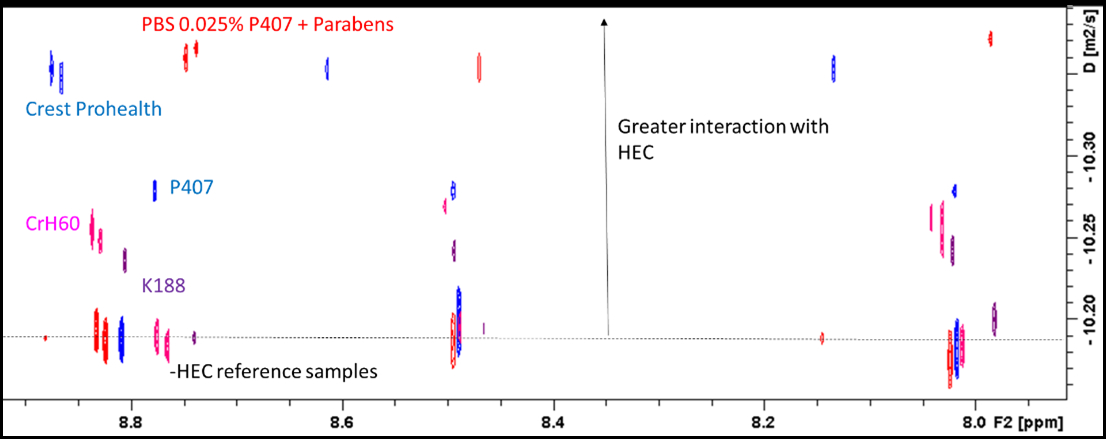
Results: The significance of CPC as a micelle-forming surfactant is not reflected in the Microkill data, where the quantity of CPC introduced to bacterial species is more important than the state of CPC. NMR can be used not only to provide a physiochemical characterization of CPC but also to identify compounds that CPC is interacting with and its micellization state,(Figure 1).
Figure1. Overlaid 2D DOSY NMR spectrum for 5 representative formulations showing diffusion of CPC NMR signals in the y axid and chemical shift of those signals along the x axis.
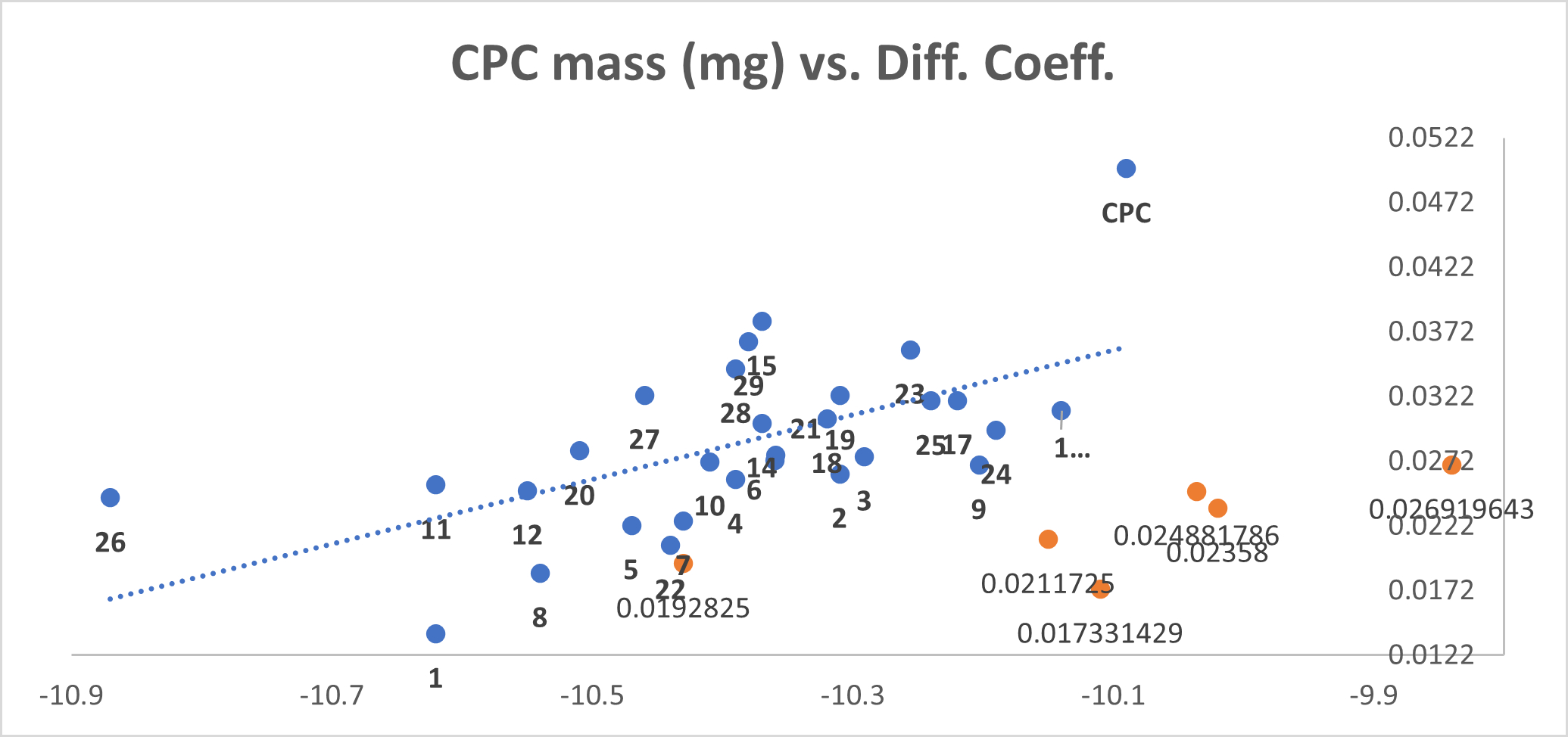
Figure 2. Correlation between CPC quantity (y axis, (mg)) and observed diffusion (Log10) for mutliple formulation samples.
Correlations can be established between changes in diffusion, chemical shift, and signal attenuation for specific formulations and mixtures with experimental DRA results and Microkill data to evaluate the physiochemical properties of CPC that are relevant for success in these tests, alongside a greater understanding of how they perform in real-world applications.
Conclusions: Statistcal analysis showed a strong relationship between the degree of binding as per the NMR technique and both DRA and anti-microbial activity. This evidences the value of this NMR technique as a rapid, non-destructive method for screening experimetnal anti-microbial formulations for efficacy ahead of more involved evaluation.
Methods: A Bruker Avance III 600MHz NMR Spectrometer at 300 K was used for all NMR acquisitions. NMR tubes used were 5 mm, Ultra-Thin Wall Precision NMR Sample Tubes 7" L, 600MHz, (545-PPT-7), from GPE-Scientific. All cetylpyridinium chloride (CPC) containing samples were prepared at a range of 0.01% w/v to 0.01% w/v.
Results: The significance of CPC as a micelle-forming surfactant is not reflected in the Microkill data, where the quantity of CPC introduced to bacterial species is more important than the state of CPC. NMR can be used not only to provide a physiochemical characterization of CPC but also to identify compounds that CPC is interacting with and its micellization state,(Figure 1).
Figure1. Overlaid 2D DOSY NMR spectrum for 5 representative formulations showing diffusion of CPC NMR signals in the y axid and chemical shift of those signals along the x axis.
Figure 2. Correlation between CPC quantity (y axis, (mg)) and observed diffusion (Log10) for mutliple formulation samples.
Correlations can be established between changes in diffusion, chemical shift, and signal attenuation for specific formulations and mixtures with experimental DRA results and Microkill data to evaluate the physiochemical properties of CPC that are relevant for success in these tests, alongside a greater understanding of how they perform in real-world applications.
Conclusions: Statistcal analysis showed a strong relationship between the degree of binding as per the NMR technique and both DRA and anti-microbial activity. This evidences the value of this NMR technique as a rapid, non-destructive method for screening experimetnal anti-microbial formulations for efficacy ahead of more involved evaluation.
IMAGES
4006493_File000000.jpg
4006493_File000001.jpg
4006493_File000000.jpg
4006493_File000001.jpg