IADR Abstract Archives
Immediately Injectable Polysaccharide-Based in Situ Hydrogels for new Bone Formation in Vitro and in Vivo
Objectives: Bioactive molecules such as graphene oxide (GO) incorporated hydrogels have received great attention and have shown excellent potential for use in the field of bone tissue engineering due to their unique osteogenic functionalities. However, current hydrogel systems are limited in their ability to provide an appropriate amount of GO and stem cells to the lesion area as well as inconvenient transplantation processes. For instance, it has only been applied using thermosensitive injectable hydrogels.
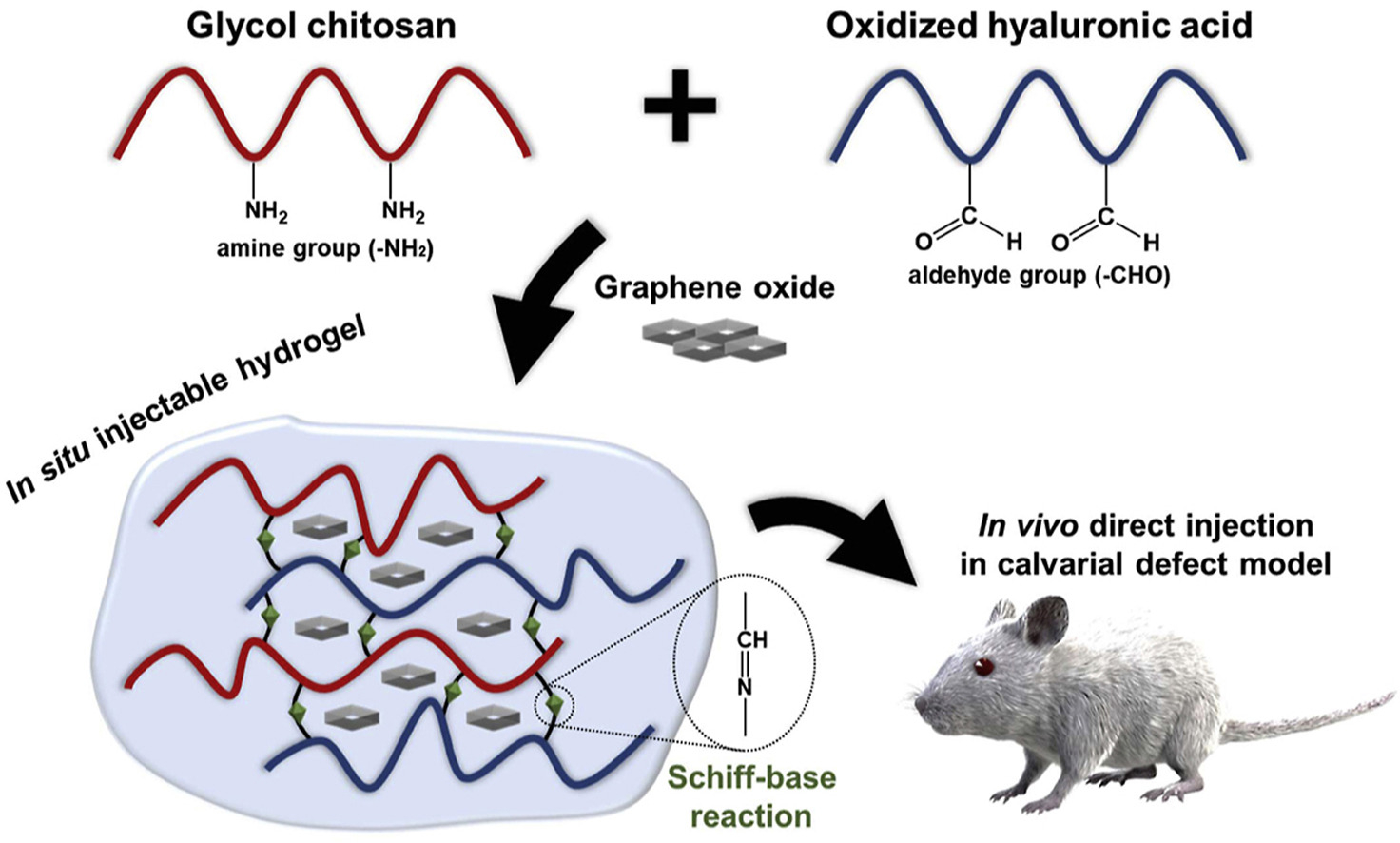
Methods: To overcome this issue, we developed a GO-incorporated injectable hydrogel system by using glycol chitosan (gC) and oxidized hyaluronic acid (oHA). Chitosan (CTS) is the second most abundant natural polysaccharide and has many valuable characteristics including biodegradability and biocompatibility, HA has also shown potential for use in the biomedical engineering area. In this study, we prepared oHA to form a hydrogel through simple and facile solution mixing without using any additional chemical or radiological crosslinking.
Results: Through oxidation, aldehyde groups were introduced onto the HA. Blending this with gC allowed for the formation of an aqueous hydrogel matrix. Physico-chemical characterization demonstrated that the gC/oHA/GO hydrogel matrix exhibited robust mechanical properties and stability. The gC/oHA injectable hydrogel could easily modulate the GO content and had robust mechanical properties with improved stability. As an in vitro assessment, GO-incorporated injectable hydrogel exhibited very little toxicity, but showed excellent osteogenic activity. This was confirmed by both in vitro and in vivo assessments. There results showed that GO-incorporated injectable hydrogels enhanced bone tissue regeneration as compared to control injectable hydrogels.
Conclusions: Therefore, our results indicate that our injectable hydrogel system could be used for delivering GO. This material may serve as an excellent tissue scaffold for use in treating bone defects. This preliminary study will pave the way for these future investigations.
Methods: To overcome this issue, we developed a GO-incorporated injectable hydrogel system by using glycol chitosan (gC) and oxidized hyaluronic acid (oHA). Chitosan (CTS) is the second most abundant natural polysaccharide and has many valuable characteristics including biodegradability and biocompatibility, HA has also shown potential for use in the biomedical engineering area. In this study, we prepared oHA to form a hydrogel through simple and facile solution mixing without using any additional chemical or radiological crosslinking.
Results: Through oxidation, aldehyde groups were introduced onto the HA. Blending this with gC allowed for the formation of an aqueous hydrogel matrix. Physico-chemical characterization demonstrated that the gC/oHA/GO hydrogel matrix exhibited robust mechanical properties and stability. The gC/oHA injectable hydrogel could easily modulate the GO content and had robust mechanical properties with improved stability. As an in vitro assessment, GO-incorporated injectable hydrogel exhibited very little toxicity, but showed excellent osteogenic activity. This was confirmed by both in vitro and in vivo assessments. There results showed that GO-incorporated injectable hydrogels enhanced bone tissue regeneration as compared to control injectable hydrogels.
Conclusions: Therefore, our results indicate that our injectable hydrogel system could be used for delivering GO. This material may serve as an excellent tissue scaffold for use in treating bone defects. This preliminary study will pave the way for these future investigations.
IMAGES
4006313_File000000.jpg
4006313_File000000.jpg