IADR Abstract Archives
Effect of Print Orientation and Graphene Nanoplatelets on Biaxial-Strength and Cytotoxicity of a 3D-Printable Resin
Objectives: The aim of this study was to assess the effect of print orientation and the addition of graphene nanoplatelets (GNP) on biaxial strength of a 3D-printable resin for occlusal splints compared to polymethyl methacrylate (PMMA), which has been routinely used for splints for many years and to evaluate the cytotoxicity of these materials.
Methods: Multilayered graphene nanoplatelet powder (GNP; Merck, Germany) was added to a resin (BioMedClearResin-V1; Formlabs, Germany) and specimens were printed with a stereolithography (SLA) printer (Formlabs). Homogeneity of printed specimens was confirmed with Raman spectroscopy (Shamrock SR 303i, AndorTechnology, Northern Ireland). Biaxial strength was evaluated according to ISO 6872:2015 on vertically and horizontally printed specimens. Data were compared by unpaired t-test with Bonferroni correction.
Specimens and fracture surfaces were assessed with scanning electron microscopy. Cytotoxicity of specimens was investigated by cell counting of L929 cells with a flow cytometer.
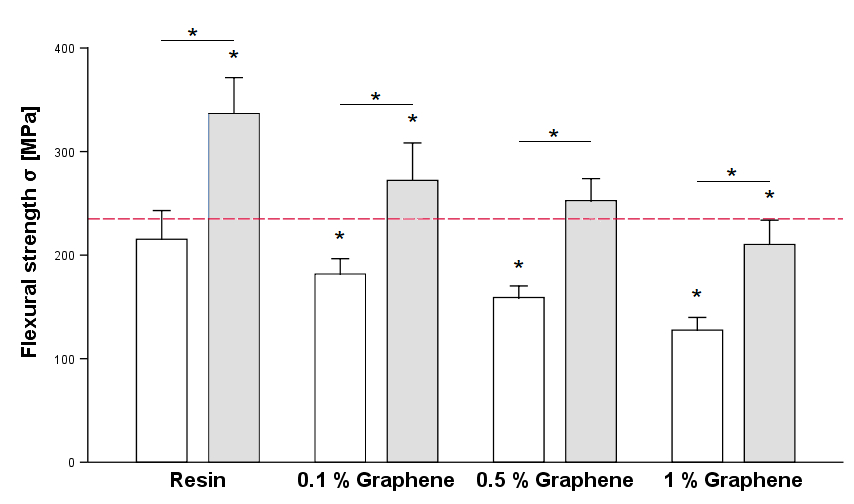
Results: Biaxial flexural strength was significantly higher in horizontally than in vertically printed specimens in all test groups (Figure 1). When printed horizontally, resin specimens and specimens with 0.1% GNP had a significantly higher biaxial flexural strength than PMMA while it was lower in specimens with 1% GNP (Figure 1). While there was no significant difference in biaxial flexural strength between vertically printed resin (without GNP) and PMMA (Figure 1), these specimens with 0.1, 0.5 and 1% GNP exhibited lower flexural strength than PMMA. Altogether, data showed a concentration-dependent decrease of biaxial flexural strength of resin by GNP in both, vertically and horizontally printed specimens.
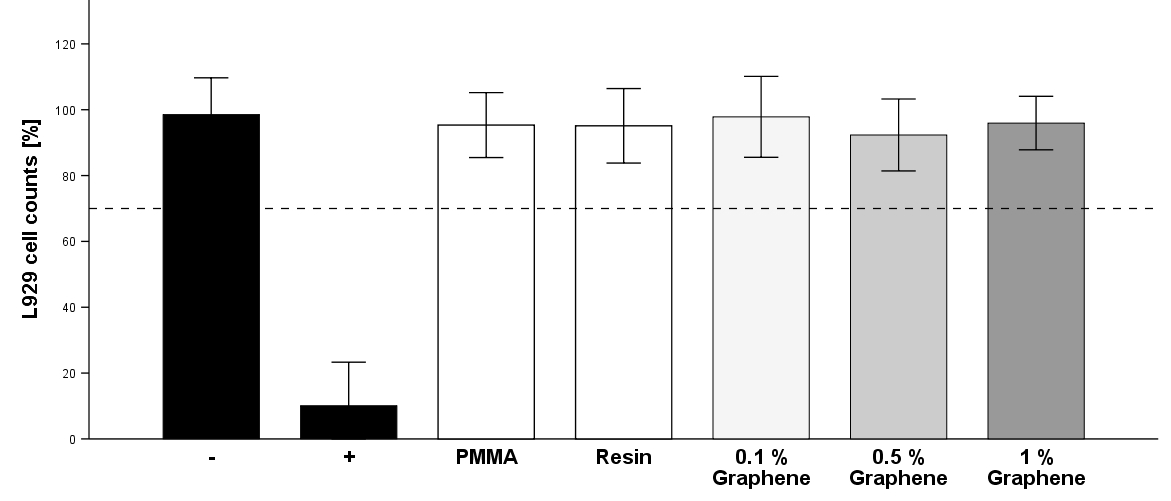
After a 72h incubation with specimens made of PMMA, resin or resin containing 0.1%, 0.5% or 1% GNP, L929 cell-counts were comparable to those of the plastic control (Figure 2), indicating that resin supplemented with 0.1%, 0.5% or 1% GNP has no cytotoxic effect on L929 cells.
Conclusions: The 3D-printable resin (printed horizontally) achieved comparable biaxial compressive strength to PMMA or exceeded it when printed vertically and therefore represents an interesting alternative to PMMA for occlusal splints. GNP had no beneficial effects on the biaxial strength of the 3D-printable resin.
Methods: Multilayered graphene nanoplatelet powder (GNP; Merck, Germany) was added to a resin (BioMedClearResin-V1; Formlabs, Germany) and specimens were printed with a stereolithography (SLA) printer (Formlabs). Homogeneity of printed specimens was confirmed with Raman spectroscopy (Shamrock SR 303i, AndorTechnology, Northern Ireland). Biaxial strength was evaluated according to ISO 6872:2015 on vertically and horizontally printed specimens. Data were compared by unpaired t-test with Bonferroni correction.
Specimens and fracture surfaces were assessed with scanning electron microscopy. Cytotoxicity of specimens was investigated by cell counting of L929 cells with a flow cytometer.
Results: Biaxial flexural strength was significantly higher in horizontally than in vertically printed specimens in all test groups (Figure 1). When printed horizontally, resin specimens and specimens with 0.1% GNP had a significantly higher biaxial flexural strength than PMMA while it was lower in specimens with 1% GNP (Figure 1). While there was no significant difference in biaxial flexural strength between vertically printed resin (without GNP) and PMMA (Figure 1), these specimens with 0.1, 0.5 and 1% GNP exhibited lower flexural strength than PMMA. Altogether, data showed a concentration-dependent decrease of biaxial flexural strength of resin by GNP in both, vertically and horizontally printed specimens.
After a 72h incubation with specimens made of PMMA, resin or resin containing 0.1%, 0.5% or 1% GNP, L929 cell-counts were comparable to those of the plastic control (Figure 2), indicating that resin supplemented with 0.1%, 0.5% or 1% GNP has no cytotoxic effect on L929 cells.
Conclusions: The 3D-printable resin (printed horizontally) achieved comparable biaxial compressive strength to PMMA or exceeded it when printed vertically and therefore represents an interesting alternative to PMMA for occlusal splints. GNP had no beneficial effects on the biaxial strength of the 3D-printable resin.
IMAGES
4004487_File000003.jpg
4004487_File000004.jpg
4004487_File000003.jpg
4004487_File000004.jpg