IADR Abstract Archives
Research on Cervical Vertebrae Bone Age Staging System Based on Joint Model Deep Learning
Objectives: The timing of early orthodontic intervention is a crucial factor for successful treatment. Cervical vertebrae bone age staging is an important assessment tool for predicting the peak period of mandibular growth through bone age, assisting doctors in determining the optimal treatment timing and improving diagnostic efficiency. However, existing cervical vertebrae bone age staging lacks uniform standards, and the results highly depend on the subjective judgment of doctors and are influenced by the quality of the images, leading to inaccurate assessments and insufficient repeatability. AI-based bone age staging methods can assist doctors in qualitatively and quantitatively staging bone age. Still, existing AI methods use a single model for bone age staging, resulting in unstable and inaccurate outcomes.
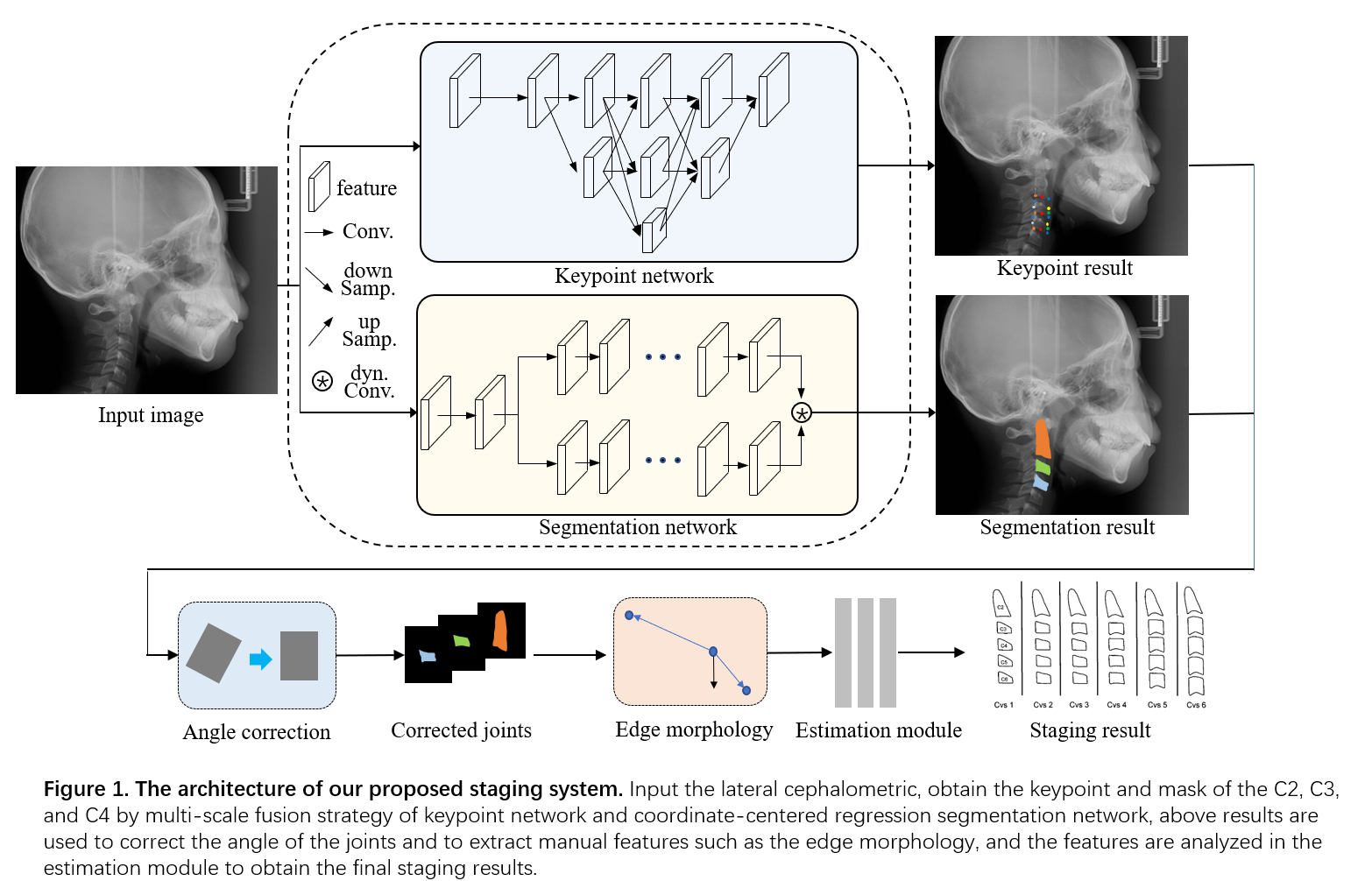
Methods: This paper proposes a multi-model joint bone age staging method. Firstly, a position-based Solov2 instance segmentation model is used, which accurately segments the C2, C3, and C4 vertebrae by regressing the coordinates of the object center. Then, a multi-scale fusion HRNet keypoint detection model is employed to generate multi-scale perception high-resolution heatmaps, precisely detecting 19 key points on the bone edges. The bone morphology, lower edge curvature, and other features are accurately extracted by jointly optimizing the bone age staging results using segmentation and keypoint detection results.
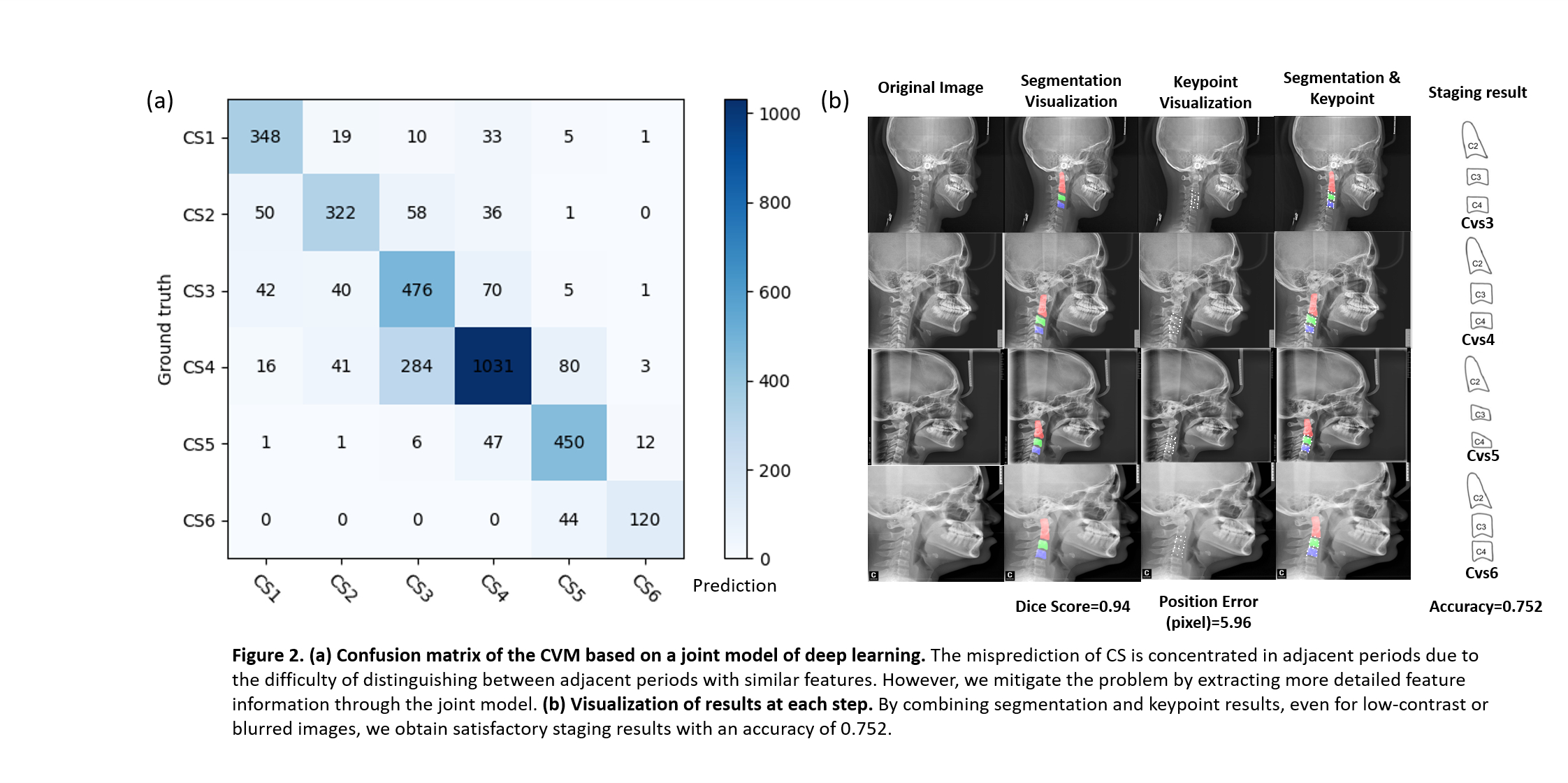
Results: This study used a total of 6762 lateral skull X-rays from 8 centers, divided into a training set and a test set at an 8:2 ratio. The cervical vertebrae segmentation Dice coefficient reached 0.94, the average keypoint error was 5.96 pixels, and the staging accuracy was 75.2%, all superior to existing methods.
Conclusions: The cervical vertebrae bone age staging system proposed in this study achieves accurate and highly generalized automated bone age staging by integrating instance segmentation and keypoint detection algorithms. This significantly improves the accuracy and stability of cervical vertebrae bone age staging.
Methods: This paper proposes a multi-model joint bone age staging method. Firstly, a position-based Solov2 instance segmentation model is used, which accurately segments the C2, C3, and C4 vertebrae by regressing the coordinates of the object center. Then, a multi-scale fusion HRNet keypoint detection model is employed to generate multi-scale perception high-resolution heatmaps, precisely detecting 19 key points on the bone edges. The bone morphology, lower edge curvature, and other features are accurately extracted by jointly optimizing the bone age staging results using segmentation and keypoint detection results.
Results: This study used a total of 6762 lateral skull X-rays from 8 centers, divided into a training set and a test set at an 8:2 ratio. The cervical vertebrae segmentation Dice coefficient reached 0.94, the average keypoint error was 5.96 pixels, and the staging accuracy was 75.2%, all superior to existing methods.
Conclusions: The cervical vertebrae bone age staging system proposed in this study achieves accurate and highly generalized automated bone age staging by integrating instance segmentation and keypoint detection algorithms. This significantly improves the accuracy and stability of cervical vertebrae bone age staging.
IMAGES
4004272_File000006.jpg
4004272_File000005.jpg
4004272_File000006.jpg
4004272_File000005.jpg