IADR Abstract Archives
Evaluation of Shock Absorption in Various Designed 3D Printed Samples
Objectives: While sports mouthguards (MGs) are mandatory in some contact sports, conventional custom-made MGs still have limitations, including complexity and manual craftsmanship. 3D printing offers a potential solution. The purpose of this study was to evaluate the shock absorption capability of various layer-designed material samples compared to conventional samples under simulated oral conditions.
Methods: 3D-designed material samples (D-ABS, Agilus series, Stratasys Ltd.) were printed. Depending on the shore A hardness of Agilus series materials, they were further divided into 7 samples (Shore A hardness: 30-95). Both the single Agilus series (3mm) and each combination of D-ABS (0.5mm) and Agilus series (2.5mm) were printed. Two conventional material samples were evaluated as the comparison group, which were an ethylene vinyl acetate-based material and a polyolefin-based material. A free-falling steel ball (32.6g weight) test was conducted to evaluate impact absorption capability at intraoral temperatures (≒37 celsius). Maximum impact force (MIF) and the arrival time of maximum impact force (MIF-t) were evaluated and analyzed by one-way analysis of variance (ANOVA) analysis and Tukey test.
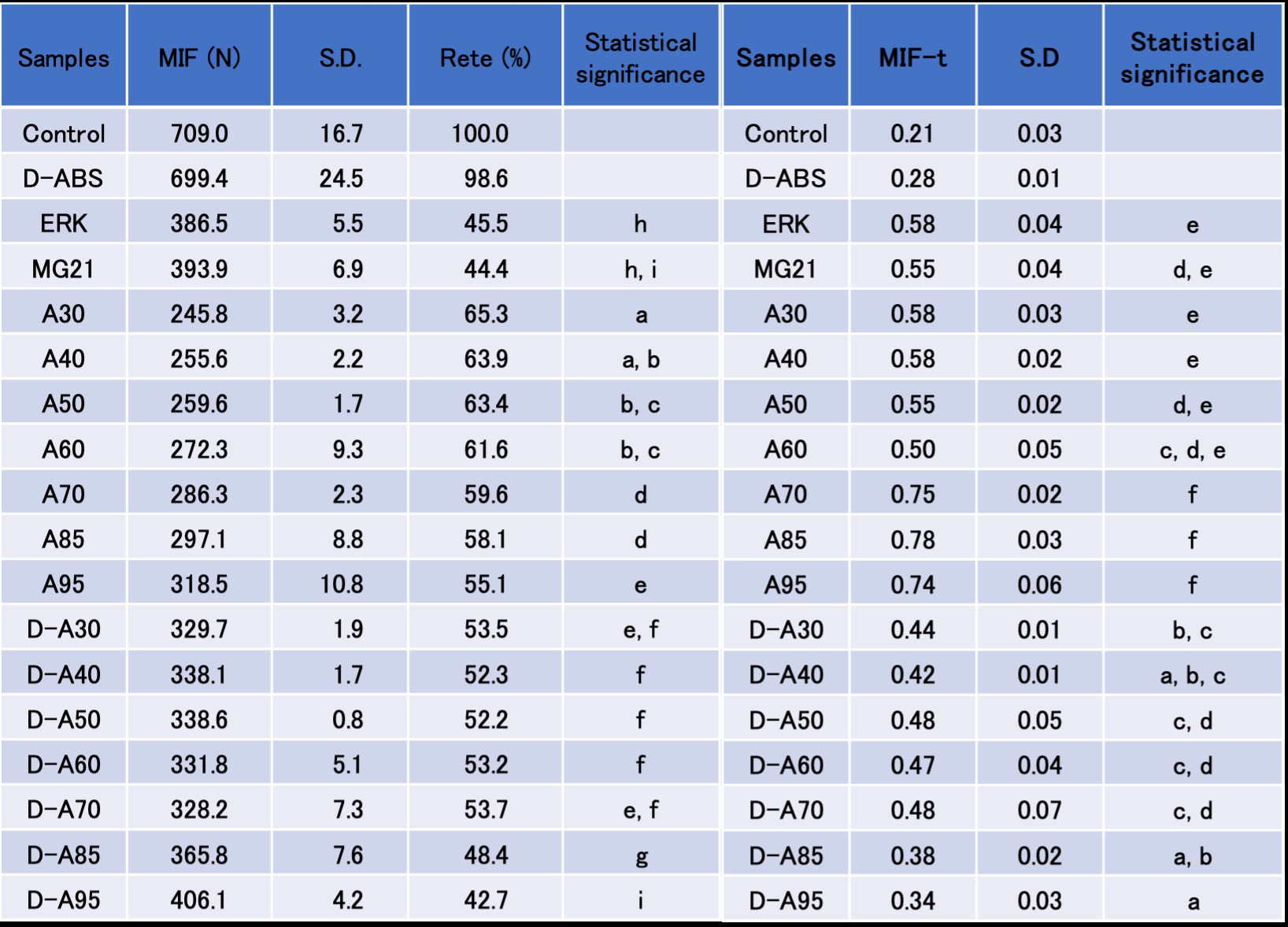
Results: The MIF and MIF-t without a sample were 709.0±16.7N and 0.21±0.03ms. Conventional materials did not differ much, but the 3D printed samples differed significantly at room temperature results reported previously. All 3D printed samples, except for double-layer sample (Shore A 95), demonstrated superior impact absorption compared to conventional materials based on the results of MIF. All single-layer samples and double-layer 3 samples (Shore A 50, 60, and 70) performed better or similar to conventional MGs in MIF-t.
Conclusions: This study evaluated the impact absorption capability of various designs of 3D printed samples compared to conventional samples under simulated oral conditions. Both Single-layer and double-layer 3D printed samples had better impact absorption capability than conventional samples. These findings highlighted the potential of 3D printing as a viable replacement for conventionally manufactured sports MGs.
Methods: 3D-designed material samples (D-ABS, Agilus series, Stratasys Ltd.) were printed. Depending on the shore A hardness of Agilus series materials, they were further divided into 7 samples (Shore A hardness: 30-95). Both the single Agilus series (3mm) and each combination of D-ABS (0.5mm) and Agilus series (2.5mm) were printed. Two conventional material samples were evaluated as the comparison group, which were an ethylene vinyl acetate-based material and a polyolefin-based material. A free-falling steel ball (32.6g weight) test was conducted to evaluate impact absorption capability at intraoral temperatures (≒37 celsius). Maximum impact force (MIF) and the arrival time of maximum impact force (MIF-t) were evaluated and analyzed by one-way analysis of variance (ANOVA) analysis and Tukey test.
Results: The MIF and MIF-t without a sample were 709.0±16.7N and 0.21±0.03ms. Conventional materials did not differ much, but the 3D printed samples differed significantly at room temperature results reported previously. All 3D printed samples, except for double-layer sample (Shore A 95), demonstrated superior impact absorption compared to conventional materials based on the results of MIF. All single-layer samples and double-layer 3 samples (Shore A 50, 60, and 70) performed better or similar to conventional MGs in MIF-t.
Conclusions: This study evaluated the impact absorption capability of various designs of 3D printed samples compared to conventional samples under simulated oral conditions. Both Single-layer and double-layer 3D printed samples had better impact absorption capability than conventional samples. These findings highlighted the potential of 3D printing as a viable replacement for conventionally manufactured sports MGs.
IMAGES
4004254_File000000.jpg
4004254_File000000.jpg