IADR Abstract Archives
Marginal Fidelity and Damage Induction of Chairside Milling Machines.
Objectives: Chairside milling machines offer clinicians advantages such as same-day dentistry, efficiency and elimination of laboratory fees. Recently, milling machines with novel design innovations have been introduced. This study measured the faithfulness of the milled crown margin to the STL CAD design file and damage induction with different classes of milling block materials.
Methods: Three representative CAD/CAM block materials were used (N=10/group): LG-Fully crystalized leucite-reinforced glass ceramic (EmpressCAD,Ivoclar); LD-Semi-crystalized lithium disilicate ceramic (e.MaxCAD,Ivoclar); RC-Resin composite (TetricCAD,Ivoclar). 4 milling systems tested: (PM1)PrograMill One- Milling tool fixed, block moves in 5-axiis (Ivoclar); (Z4)- 4-axis (vhf); (E4)- 4-axis, requires no compressed air (vhf); (PM7)PrograMill (Ivoclar)- 5-axis laboratory milling machine as control. A full molar crown was designed,120 crowns milled. Each crown scanned with intraoral scanner (IOS)(Trios3,3shape) and precision calculated. STL files compared to reference CAD design (Convince,3shape). Root Mean Square (RMS) and 95% tolerance interval data exported to evaluate fidelity of margin area. Data analyzed using one-way ANOVA and Duncan Multiple Range Test (alpha=0.05). Milling damage reckoned as chips that were ≥50um and mean number of chips per group calculated.
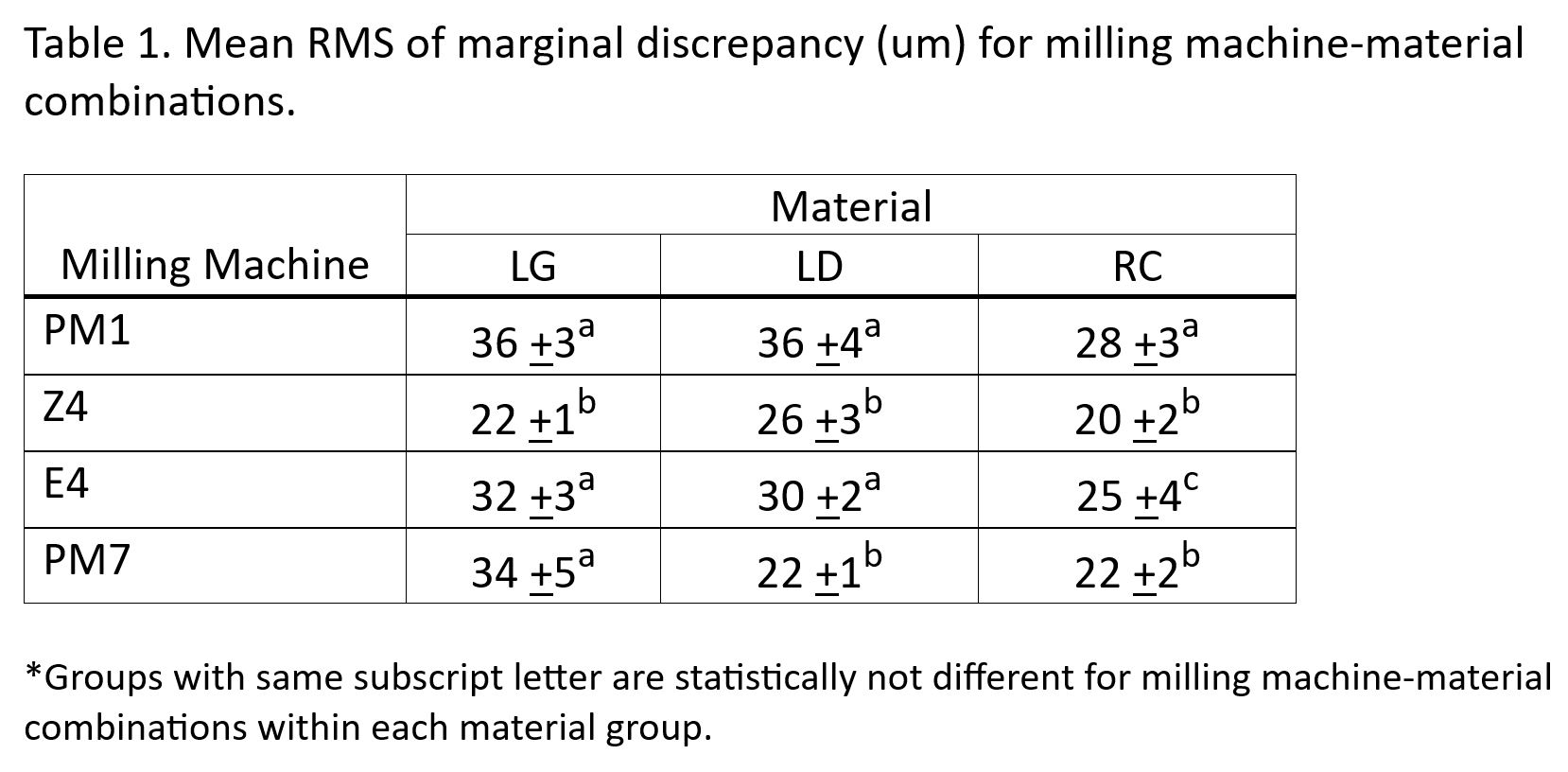
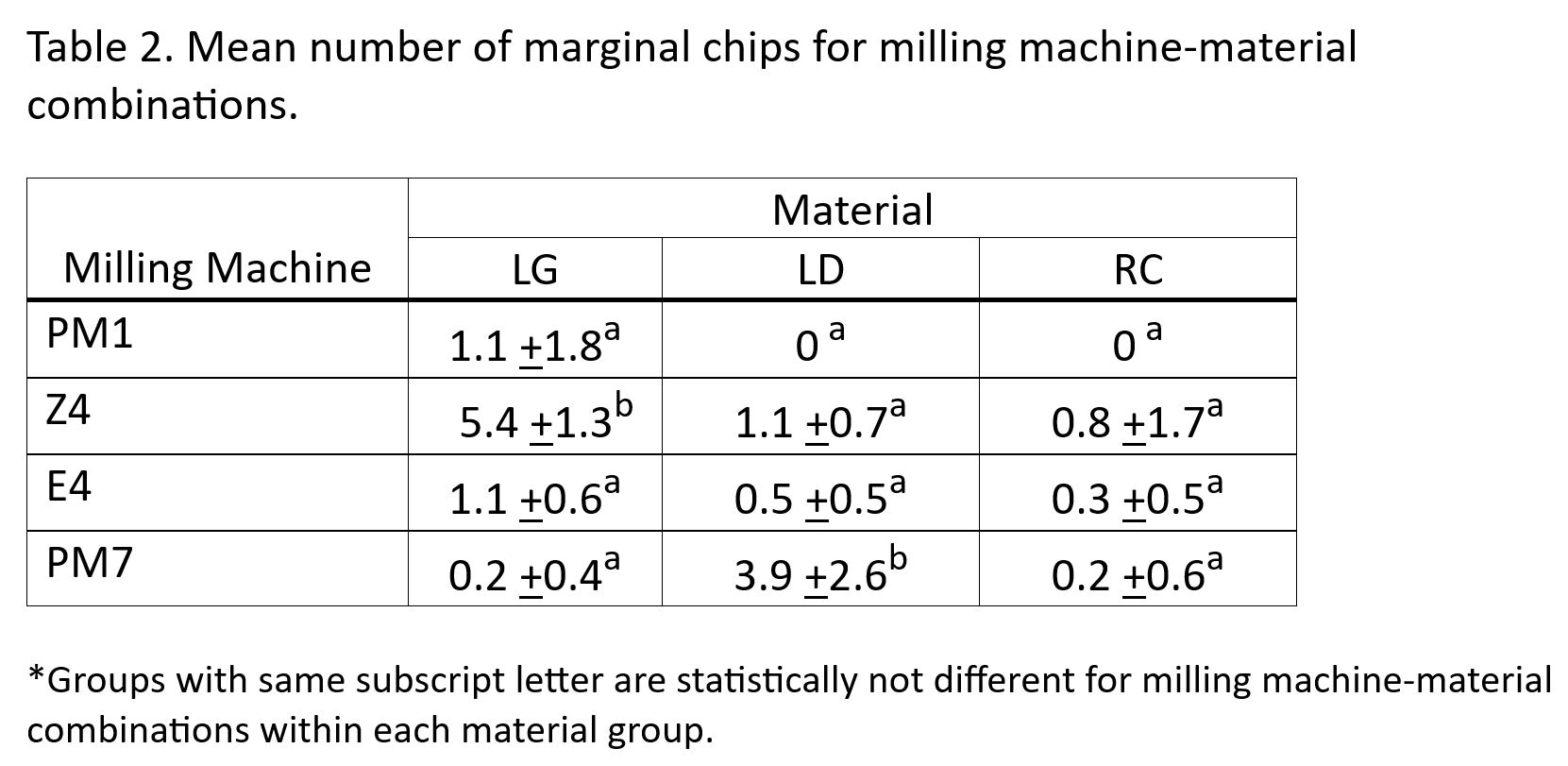
Results: Precision analysis showed 95% of specimens fell within (-17um-+19um) difference (IOS accuracy was ±20um). 3D discrepancies in ROI had RMS values varying from 20um to 36um (Table 1) and groups significantly different (p<.01). Table 2 summarizes milling damage with the mean number of chips per group (n=10) with significant differences (p<.01). PM1 system had 2 groups with zero chipping. RC material had significantly less chipping for all systems.
Conclusions: The Convince software was highly sensitive for detection of 3D deviations of milled crown margins. Data showed an interaction between milling machines and materials affecting marginal accuracy and amount of chipping. The novel PM1 milling system design had 2 groups with NO chipping. Marginal accuracy of chairside systems was equal to the laboratory milling system. Despite statistical differences between milling systems the differences between systems were clinically insignificant.
Methods: Three representative CAD/CAM block materials were used (N=10/group): LG-Fully crystalized leucite-reinforced glass ceramic (EmpressCAD,Ivoclar); LD-Semi-crystalized lithium disilicate ceramic (e.MaxCAD,Ivoclar); RC-Resin composite (TetricCAD,Ivoclar). 4 milling systems tested: (PM1)PrograMill One- Milling tool fixed, block moves in 5-axiis (Ivoclar); (Z4)- 4-axis (vhf); (E4)- 4-axis, requires no compressed air (vhf); (PM7)PrograMill (Ivoclar)- 5-axis laboratory milling machine as control. A full molar crown was designed,120 crowns milled. Each crown scanned with intraoral scanner (IOS)(Trios3,3shape) and precision calculated. STL files compared to reference CAD design (Convince,3shape). Root Mean Square (RMS) and 95% tolerance interval data exported to evaluate fidelity of margin area. Data analyzed using one-way ANOVA and Duncan Multiple Range Test (alpha=0.05). Milling damage reckoned as chips that were ≥50um and mean number of chips per group calculated.
Results: Precision analysis showed 95% of specimens fell within (-17um-+19um) difference (IOS accuracy was ±20um). 3D discrepancies in ROI had RMS values varying from 20um to 36um (Table 1) and groups significantly different (p<.01). Table 2 summarizes milling damage with the mean number of chips per group (n=10) with significant differences (p<.01). PM1 system had 2 groups with zero chipping. RC material had significantly less chipping for all systems.
Conclusions: The Convince software was highly sensitive for detection of 3D deviations of milled crown margins. Data showed an interaction between milling machines and materials affecting marginal accuracy and amount of chipping. The novel PM1 milling system design had 2 groups with NO chipping. Marginal accuracy of chairside systems was equal to the laboratory milling system. Despite statistical differences between milling systems the differences between systems were clinically insignificant.
IMAGES
4003523_File000000.JPG
4003523_File000001.JPG
4003523_File000000.JPG
4003523_File000001.JPG