IADR Abstract Archives
Indentation Method for Polymeric Elastic Modulus Measurement: Validity Assessment
Objectives: The purpose of the study was to assess the applicability of microhardness indentation techniques, typically used for calculating the elastic modulus in brittle materials, to determine the elastic modulus of unfilled thermoplastic polymers.
Methods: Square plate specimens of Teflon (n=4) and Nylon 11 (n=4) were prepared, polished to a 30-micron surface finish, and gold sputter coated. Indentations were made with 500 g and 100 g loads for Vickers (n=24) and Knoop (n=24) indentations, respectively, with a 15-second dwell time using a microhardness tester (Clark Microhardness tester CM-400AT). Vickers hardness (H), along with the Knoop indentation residual in-surface minor diagonal (2bR) and major diagonal (2a*), were recorded. Young's modulus (E) of the specimens was determined using (1) the indentation technique, originally developed for ceramics (Marshall et al., 1982) and (2) an ASTM D2845-compliant ultrasonic pulse apparatus (Panametrics 25DL PLUS). Sample density was measured using Archimedes' principle density apparatus (Denver Instruments). These new data were combined with our previous measurements on soft unfilled polymers (Satpathy et al., 2019) and dental composites (Nader et al., 2020).
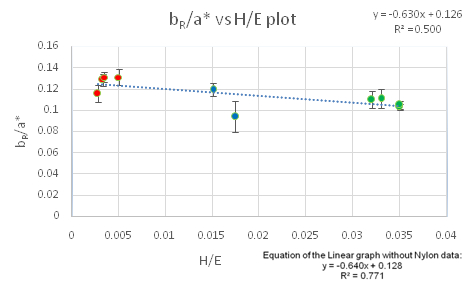
Results: Our data on rigid unfilled polymers (blue points), soft unfilled polymers (orange points), and dental composites (green points) fit well to the same linear regression equation (shown in the bR/a* vs H/E graph). However, Nylon 11 displayed a slight deviation from the model, potentially due to measurement challenges with Knoop indentation dimensions (see larger standard deviation) and elastic modulus values obtained using the ultrasonic pulse apparatus (high signal attenuation).
Conclusions: In conclusion, microhardness testers can effectively determine the Young's modulus of thermoplastic polymeric materials, offering an alternative to the standard ultrasonic pulse apparatus (ASTM D2845). This research underscores the utility of microhardness techniques for characterizing the mechanical properties of unfilled and filled polymers, with implications for material testing in various academic laboratory settings.
Methods: Square plate specimens of Teflon (n=4) and Nylon 11 (n=4) were prepared, polished to a 30-micron surface finish, and gold sputter coated. Indentations were made with 500 g and 100 g loads for Vickers (n=24) and Knoop (n=24) indentations, respectively, with a 15-second dwell time using a microhardness tester (Clark Microhardness tester CM-400AT). Vickers hardness (H), along with the Knoop indentation residual in-surface minor diagonal (2bR) and major diagonal (2a*), were recorded. Young's modulus (E) of the specimens was determined using (1) the indentation technique, originally developed for ceramics (Marshall et al., 1982) and (2) an ASTM D2845-compliant ultrasonic pulse apparatus (Panametrics 25DL PLUS). Sample density was measured using Archimedes' principle density apparatus (Denver Instruments). These new data were combined with our previous measurements on soft unfilled polymers (Satpathy et al., 2019) and dental composites (Nader et al., 2020).
Results: Our data on rigid unfilled polymers (blue points), soft unfilled polymers (orange points), and dental composites (green points) fit well to the same linear regression equation (shown in the bR/a* vs H/E graph). However, Nylon 11 displayed a slight deviation from the model, potentially due to measurement challenges with Knoop indentation dimensions (see larger standard deviation) and elastic modulus values obtained using the ultrasonic pulse apparatus (high signal attenuation).
Conclusions: In conclusion, microhardness testers can effectively determine the Young's modulus of thermoplastic polymeric materials, offering an alternative to the standard ultrasonic pulse apparatus (ASTM D2845). This research underscores the utility of microhardness techniques for characterizing the mechanical properties of unfilled and filled polymers, with implications for material testing in various academic laboratory settings.
IMAGES
4002819_File000000.jpg
4002819_File000000.jpg