IADR Abstract Archives
Dynamic-Mechanical-Analysis Testing of Materials Used to Produce Orthodontic Sequential Aligners
Objectives: Currently, there is no single dental standard that specifically addresses materials used to produce orthodontic sequential aligners. Our previous research has focused on test methods that can be used to characterize the physical, thermal, and mechanical behaviors of these materials. For mechanical behaviors, work has focused on characterization using ASTM 3-point and 4-point flexural loading methods along with a tensile test method. The objective of this study was to further characterize the mechanical behaviors of these viscoelastic materials by measuring their stress-relaxation using a Dynamic-Mechanical-Analysis (DMA) method.
Methods: Three thermoformable orthodontic materials (Table1) were evaluated for stress-relaxation using a DMA-850 system (TA-instruments). Rectangular specimens (12.7mm x 35mm) were milled from sheets with a nominal 1 mm thickness that were thermoformed (Biostar) over a fabricated aluminum mold. Stress relaxation was performed using a single-cantilever test system to displace the specimen to a constant-strain of 1% at 37°C and 90% relative-humidity and monitor stress as a function of time for 24 hours. Percent stress-relaxation was calculated as the stress measured at 24 hours (and 8 and 12 hours) divided by the stress measured at 0 hours multiplied by 100%. For each material, five specimens were tested after conditioning in 37°C ISO Grade-2 water for 24 hours ± 1 hour. Descriptive statistics (averages and standard-deviations) are reported with no comparative statistics between materials warranted.
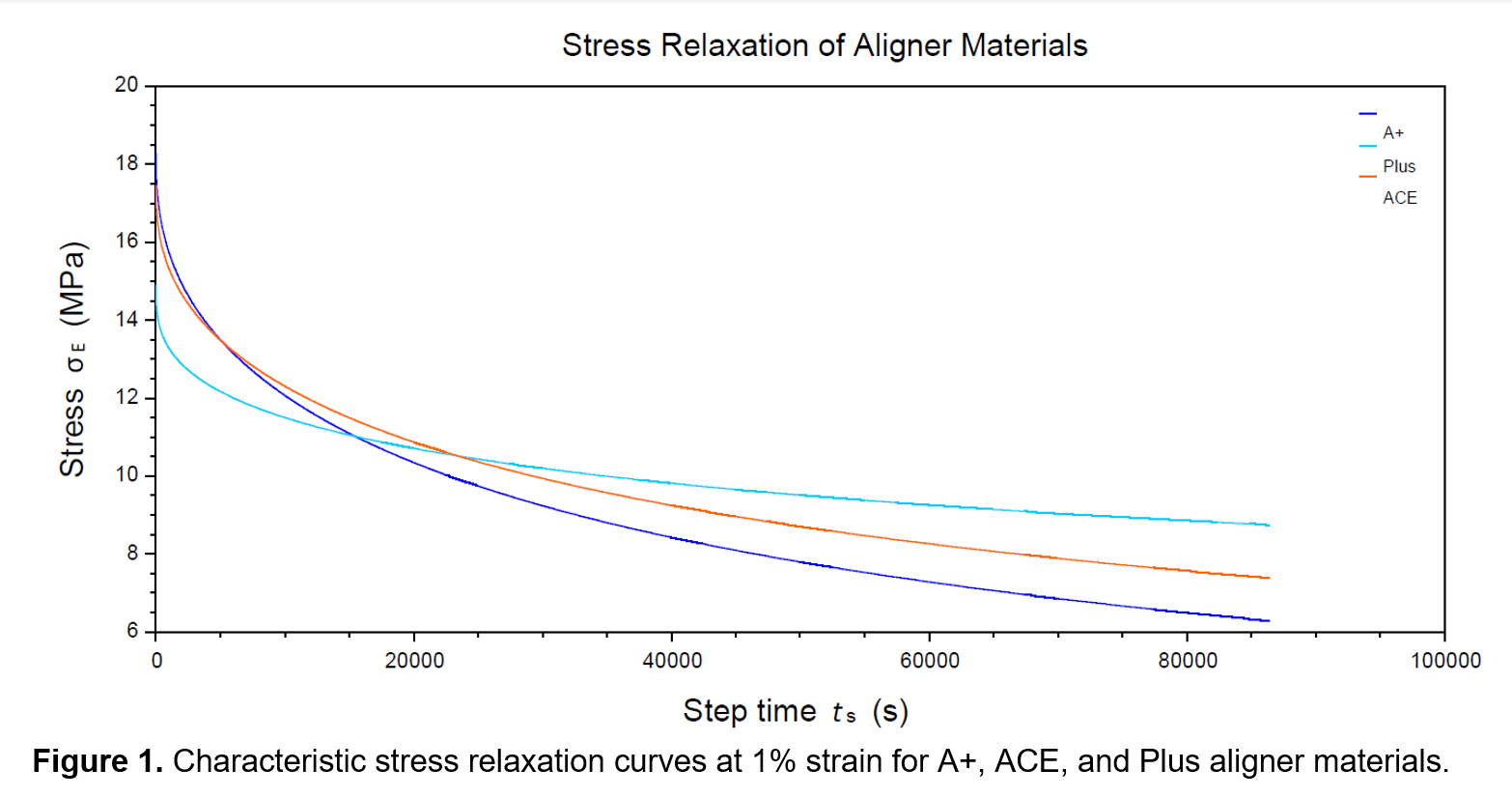
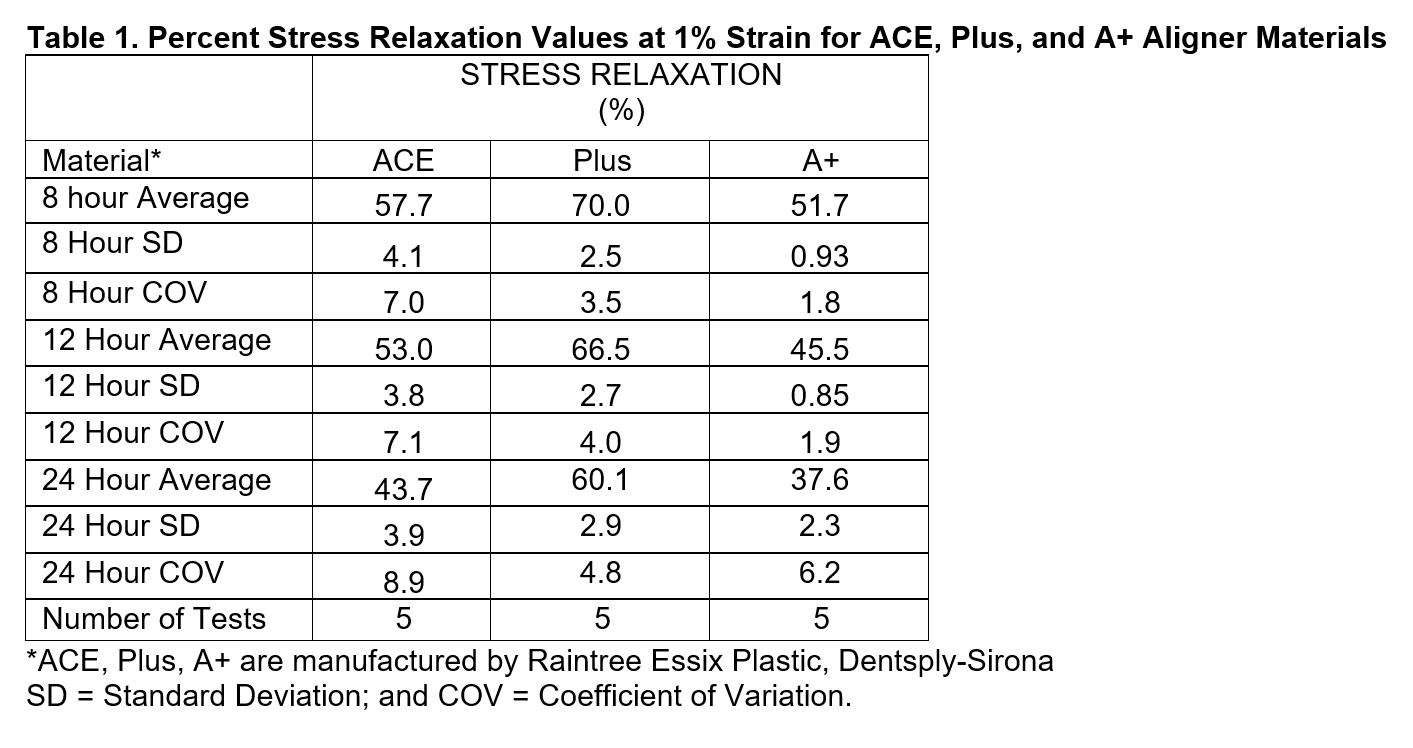
Results: Figure1 shows representative stress-relaxation curves for each material, and Table 1 shows the percent stress-relaxation results for the materials after 8, 12, and 24 hours. After 24 hours, the % stress-relaxation of the initial values ranged from 60.1% (Plus) to 37.6% (A+).
Conclusions: Dynamic-Mechanical-Analysis of the stress-relaxation of the orthodontic-materials in this study demonstrated a viscoelastic, first-order exponential decay in stress in response to a 1% applied constant-strain, and it was further demonstrated that DMA is a suitable method to characterize the viscoelastic mechanical behaviors of these materials.
Methods: Three thermoformable orthodontic materials (Table1) were evaluated for stress-relaxation using a DMA-850 system (TA-instruments). Rectangular specimens (12.7mm x 35mm) were milled from sheets with a nominal 1 mm thickness that were thermoformed (Biostar) over a fabricated aluminum mold. Stress relaxation was performed using a single-cantilever test system to displace the specimen to a constant-strain of 1% at 37°C and 90% relative-humidity and monitor stress as a function of time for 24 hours. Percent stress-relaxation was calculated as the stress measured at 24 hours (and 8 and 12 hours) divided by the stress measured at 0 hours multiplied by 100%. For each material, five specimens were tested after conditioning in 37°C ISO Grade-2 water for 24 hours ± 1 hour. Descriptive statistics (averages and standard-deviations) are reported with no comparative statistics between materials warranted.
Results: Figure1 shows representative stress-relaxation curves for each material, and Table 1 shows the percent stress-relaxation results for the materials after 8, 12, and 24 hours. After 24 hours, the % stress-relaxation of the initial values ranged from 60.1% (Plus) to 37.6% (A+).
Conclusions: Dynamic-Mechanical-Analysis of the stress-relaxation of the orthodontic-materials in this study demonstrated a viscoelastic, first-order exponential decay in stress in response to a 1% applied constant-strain, and it was further demonstrated that DMA is a suitable method to characterize the viscoelastic mechanical behaviors of these materials.
IMAGES
4001561_File000003.jpg
4001561_File000002.jpg
4001561_File000003.jpg
4001561_File000002.jpg