IADR Abstract Archives
Quantifying Error Introduced by Iterative Closest Point Image Registration
Objectives: Registering two 3D scans together, from registering occlusion to registering a CBCT with an intraoral scan during implant assessment, is an integral part of a digital clinical work flow. However, few researchers and fewer clinicians are recognising the inherent errors associated with the registration process. The objectives of this paper was to quantify analysis error of 3D inspection software with and without registration. We also aimed to investigate whether a subsequent subtraction process could reduce the process error.
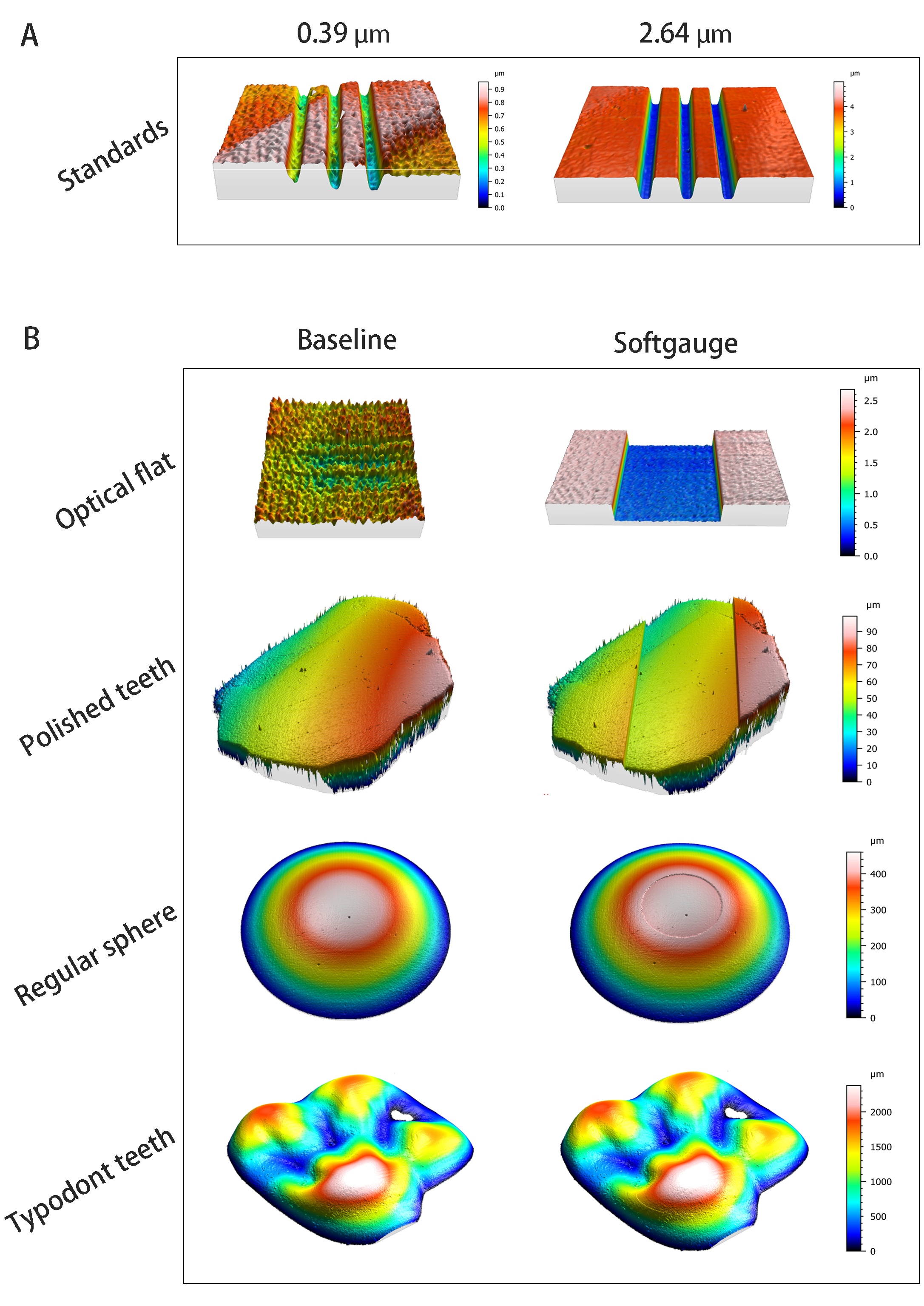
Methods: We tested metrology and two 3D inspection software using calibration standards (0.39 μm, 2.64 μm) and mathematically created softgauges (2 μm, 20 μm), on free form surfaces of increasing complexity and area, both with and without reference area registration. Analysis errors were calculated in percentages relative to the size of the defect being measured. Data were analysed in GraphPad Prism 9, normal and two-way ANOVA with post-hoc Tukey’s was applied. Significance was inferred at p<0.05.
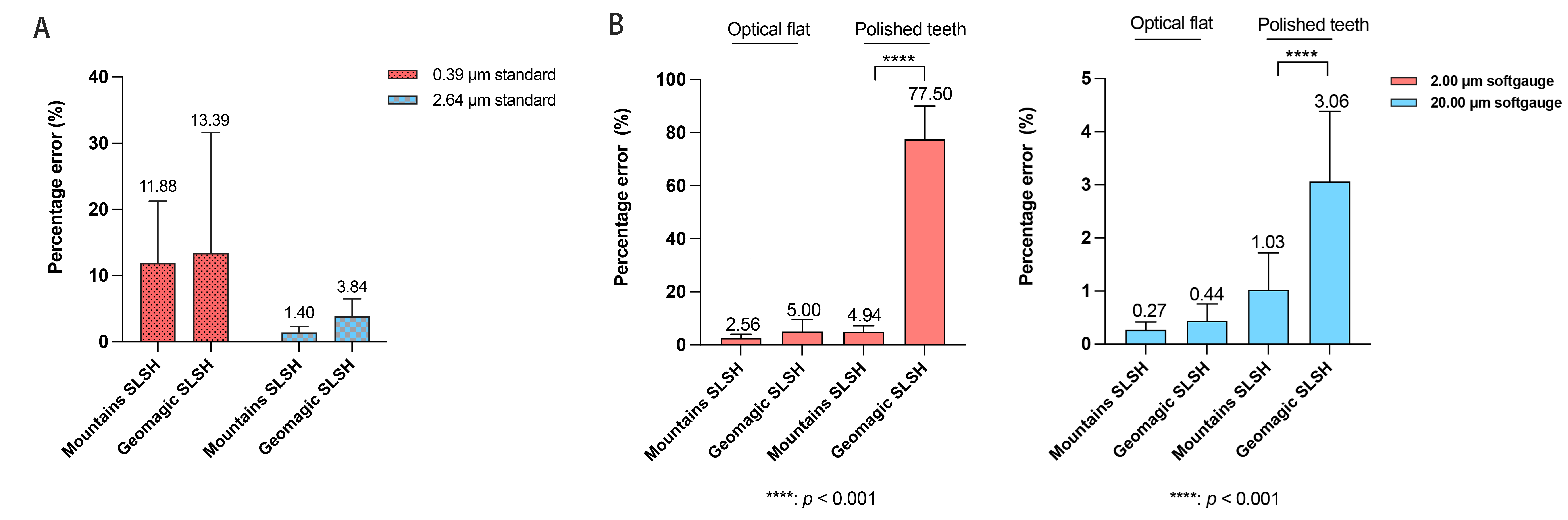
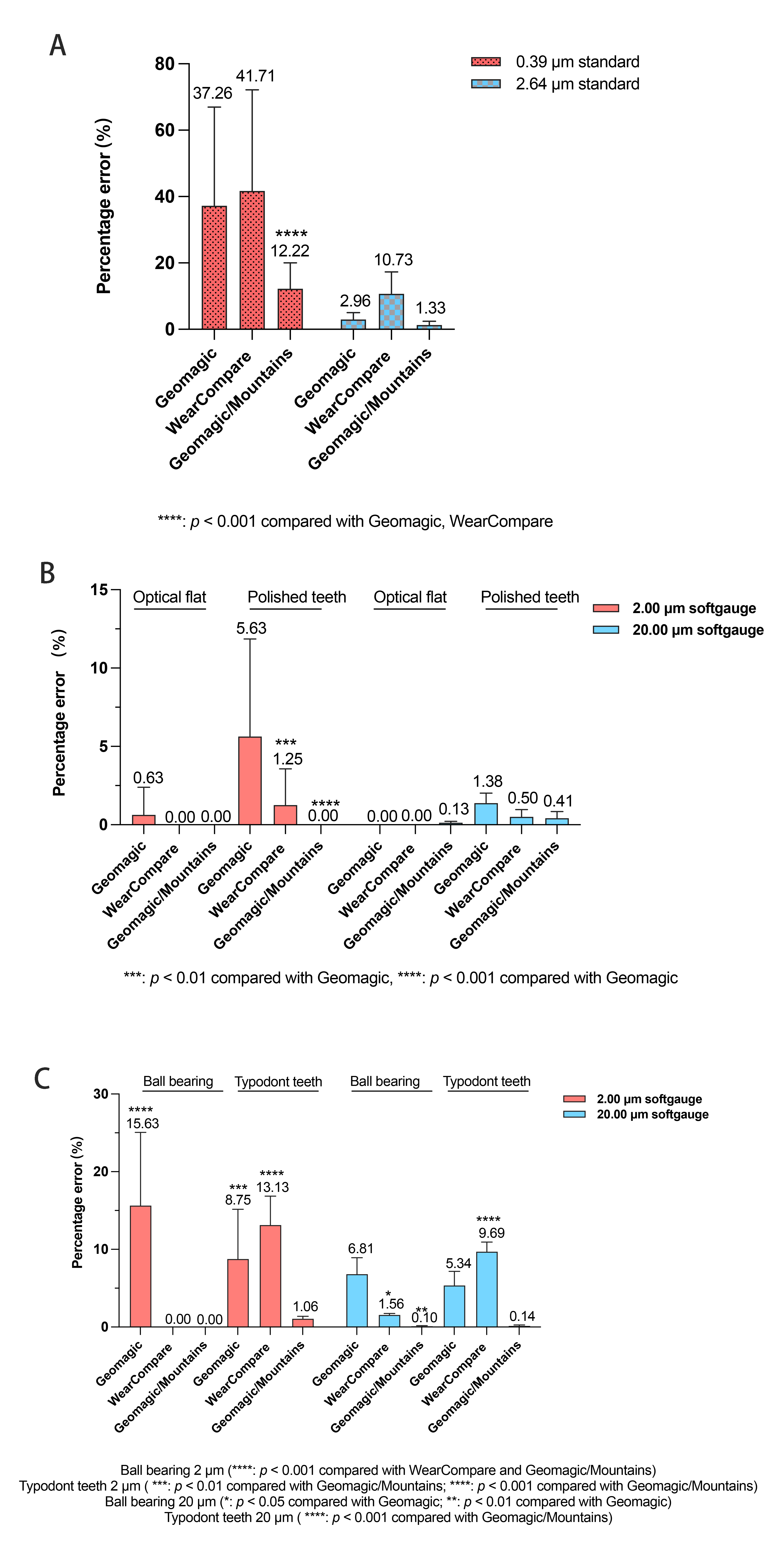
Results: 3D inspection software produced substantial measurement error (13.39 - 77.50% of defect size) when measuring 0.39 μm and 2.64 μm defects independent of an ICP registration step. On larger defects (2 μm and 20 μm), introducing a registration step created errors ranging from 0 % to 15.63 % of the defect size depending on the surface complexity and area. Adding an additional data subtraction process reduced registration error to negligible levels (<1% independent of surface complexity or area). Significant differences were observed in analysis measurements between metrology and 3D inspection software and within different 3D inspection software.
Conclusions: This data demonstrates that significant errors will consistently be introduced after an ICP registration regardless of the accuracy of adjacent registration surfaces. Analysis output between software are not comparable, particularly when they don’t conform to ISO standards. Subtracting 3D datasets and analysing residual difference reduced error to negligible levels.
Methods: We tested metrology and two 3D inspection software using calibration standards (0.39 μm, 2.64 μm) and mathematically created softgauges (2 μm, 20 μm), on free form surfaces of increasing complexity and area, both with and without reference area registration. Analysis errors were calculated in percentages relative to the size of the defect being measured. Data were analysed in GraphPad Prism 9, normal and two-way ANOVA with post-hoc Tukey’s was applied. Significance was inferred at p<0.05.
Results: 3D inspection software produced substantial measurement error (13.39 - 77.50% of defect size) when measuring 0.39 μm and 2.64 μm defects independent of an ICP registration step. On larger defects (2 μm and 20 μm), introducing a registration step created errors ranging from 0 % to 15.63 % of the defect size depending on the surface complexity and area. Adding an additional data subtraction process reduced registration error to negligible levels (<1% independent of surface complexity or area). Significant differences were observed in analysis measurements between metrology and 3D inspection software and within different 3D inspection software.
Conclusions: This data demonstrates that significant errors will consistently be introduced after an ICP registration regardless of the accuracy of adjacent registration surfaces. Analysis output between software are not comparable, particularly when they don’t conform to ISO standards. Subtracting 3D datasets and analysing residual difference reduced error to negligible levels.
IMAGES
4001009_File000000.jpg
4001009_File000001.jpg
4001009_File000002.jpg
4001009_File000000.jpg
4001009_File000001.jpg
4001009_File000002.jpg