IADR Abstract Archives
Ultra-Processed Food Intake and Dental Caries in Brazilian Adolescents
Objectives: To evaluate the association between ultra-processed food (UPF) intake and dental caries, considering bone mineral density (BMD), muscle mass (MM), and oral hygiene habits (OHH) as mediators.
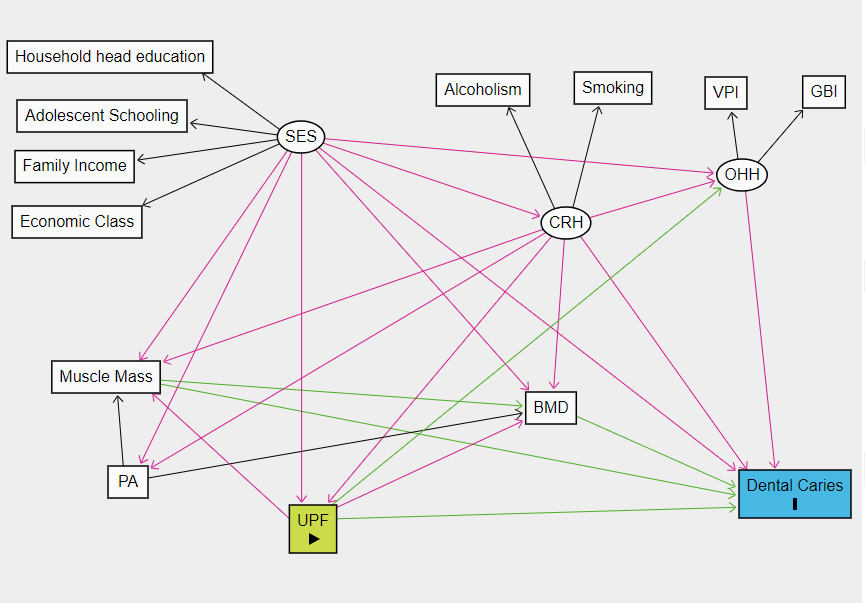
Methods: This is a cross-sectional study with 2,515 Brazilian adolescents (18-19 years) of the RPS Cohorts Consortium. The main exposure – proportion of UPF intake – was established using the food frequency questionnaire. The outcome was the number of decayed teeth, according to the DMFT Index. Three latent variables were considered: SES (family income, economic class, household head, and adolescent education), OHH (gingival bleeding index and visible plate index), and CRH (concurrent risk habit - alcohol and tobacco dependence). Structural equation modeling (α=5%), based on a theoretical model, estimated the standardized coefficient (SC) in three models, according to BMD location: lumbar BMD(1), femoral BMD(2), and total BMD(3).
Results: UPF consumption had a direct (SCmodel1=0.071, P=0.003; SCmodel2=0.072, P=0.003; SCmodel3=0.071, P=0.003) and total (SCmodel1=0.067, P=0.004; SCmodel2=0.068, P=0.004; SCmodel3=0.068, P=0.004) effect on the number of decayed teeth in the three models. The indirect association mediated by OHH (SCmodel1=0.041, P=0,02; SCmodel2=0.040, P=0,02; SCmodel3=0.039, P=0,03) was significant in all analyses, but the pathways mediated by BMD and MM were not significant (P>0.05). Dental caries was also explained in specific pathways: SES→UPF→Dental Caries (SCmodel1=0.009, P=0.008; SCmodel2=0.009, P=0.008; SCmodel3=0.009, P=0.008); SES→OHH→Dental Caries (SCmodel1=0.033, P<0.001; SCmodel2=0.033, P<0.001; SCmodel3=0.034, P<0.001); CRH→UPF→Dental Caries (SCmodel1=0.009, P=0.038; SCmodel2=0.008, P=0.040; SCmodel3=0.008, P=0.041), and CRH→OHH→DC (SCmodel1=0.029, P<0.001; SCmodel2=0.027, P=0.001; SCmodel3=0.027, P=0.001).
Conclusions: UPF-rich diet is a risk factor for dental caries in a direct relationship and mediated by OHH, but not by the BMD and MM, indicating different mechanisms of hard tissue demineralization. Worse SES, inadequate OHH, and CRH also explain dental caries. Dental caries prevention should include encouraging good OHH, healthy eating, and the development of equitable public policies in middle and low-income countries, such as Brazil.
Methods: This is a cross-sectional study with 2,515 Brazilian adolescents (18-19 years) of the RPS Cohorts Consortium. The main exposure – proportion of UPF intake – was established using the food frequency questionnaire. The outcome was the number of decayed teeth, according to the DMFT Index. Three latent variables were considered: SES (family income, economic class, household head, and adolescent education), OHH (gingival bleeding index and visible plate index), and CRH (concurrent risk habit - alcohol and tobacco dependence). Structural equation modeling (α=5%), based on a theoretical model, estimated the standardized coefficient (SC) in three models, according to BMD location: lumbar BMD(1), femoral BMD(2), and total BMD(3).
Results: UPF consumption had a direct (SCmodel1=0.071, P=0.003; SCmodel2=0.072, P=0.003; SCmodel3=0.071, P=0.003) and total (SCmodel1=0.067, P=0.004; SCmodel2=0.068, P=0.004; SCmodel3=0.068, P=0.004) effect on the number of decayed teeth in the three models. The indirect association mediated by OHH (SCmodel1=0.041, P=0,02; SCmodel2=0.040, P=0,02; SCmodel3=0.039, P=0,03) was significant in all analyses, but the pathways mediated by BMD and MM were not significant (P>0.05). Dental caries was also explained in specific pathways: SES→UPF→Dental Caries (SCmodel1=0.009, P=0.008; SCmodel2=0.009, P=0.008; SCmodel3=0.009, P=0.008); SES→OHH→Dental Caries (SCmodel1=0.033, P<0.001; SCmodel2=0.033, P<0.001; SCmodel3=0.034, P<0.001); CRH→UPF→Dental Caries (SCmodel1=0.009, P=0.038; SCmodel2=0.008, P=0.040; SCmodel3=0.008, P=0.041), and CRH→OHH→DC (SCmodel1=0.029, P<0.001; SCmodel2=0.027, P=0.001; SCmodel3=0.027, P=0.001).
Conclusions: UPF-rich diet is a risk factor for dental caries in a direct relationship and mediated by OHH, but not by the BMD and MM, indicating different mechanisms of hard tissue demineralization. Worse SES, inadequate OHH, and CRH also explain dental caries. Dental caries prevention should include encouraging good OHH, healthy eating, and the development of equitable public policies in middle and low-income countries, such as Brazil.
IMAGES
3999929_File000000.jpg
3999929_File000000.jpg