IADR Abstract Archives
Implant-Abutment Prosthetic Junction Elements That Increase Fixed Partial Denture Stability
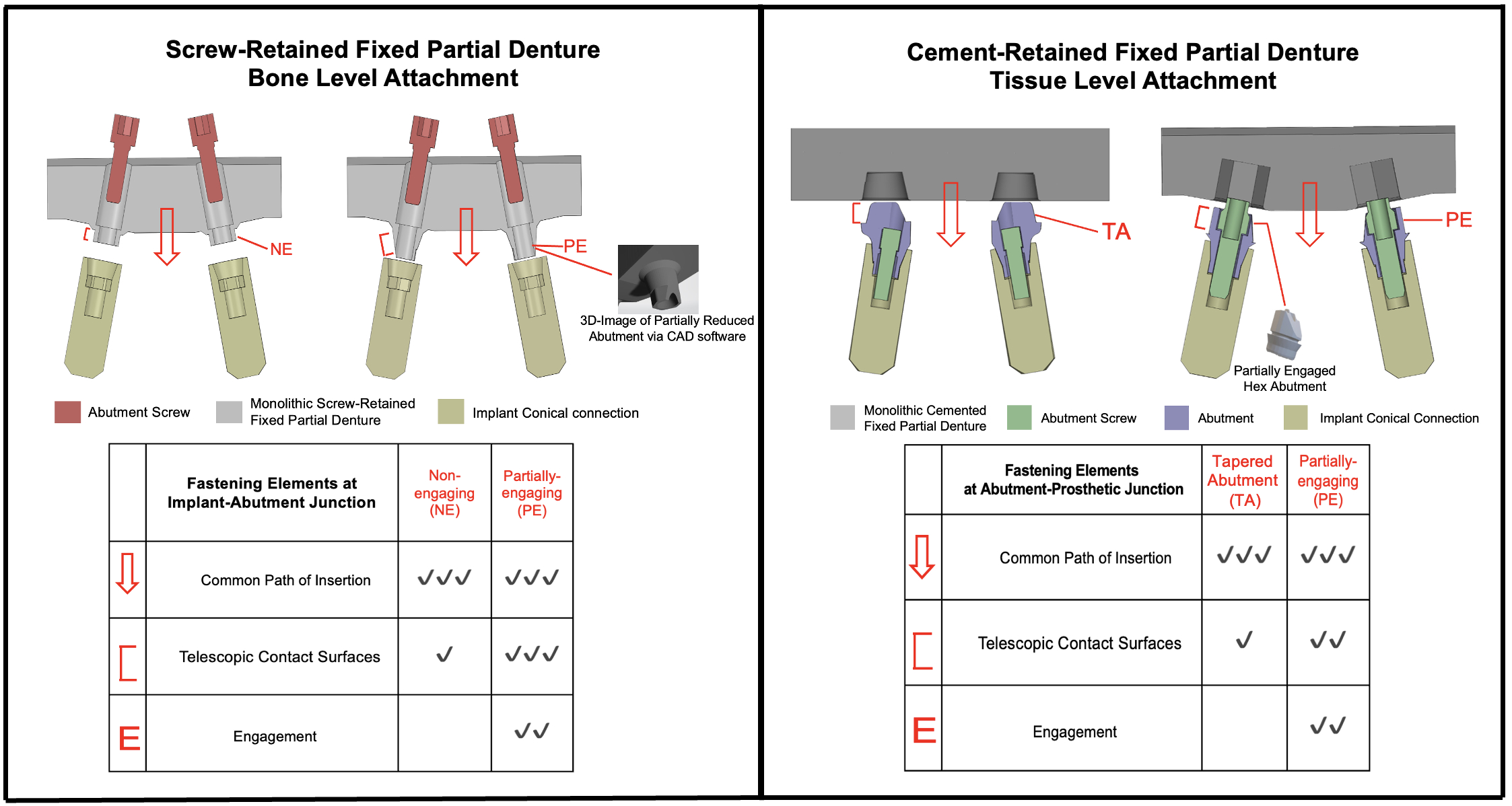
Objectives: Prosthetic complications, such as screw loosening and fractures, are common in implant-supported fixed partial dentures (FPDs). The International Organization for Standardization (ISO) 14801 standard is specifically designed for single implant-abutment testing. Many legally marketed restorative components for multiple implants have been widely adopted for clinical use without proper biomechanical testing. The claims of critical intimate contact at the level of the implant abutment junction (IAJ) are absent in multiple implant restorations. The aim of this study is to investigate 3 critical elements: 1) Engagement; 2) Contact Surface; and 3) Telescopic Insertion Path, at the implant-abutment-prosthetic junction (IAPJ) that contribute to the stability of the FPD.
Methods: Two 10 mm conical connection implants were placed 12 mm apart converging at 15° upwardly to the vertical axis in 16 epoxy resin blocks. Resistance tests were performed by vertical compressive cyclic loading applied onto 10 screw-retained metal FPDs supported by partially engaging and non-engaging abutments (3 vs 1 elements). Retention tests were performed by vertical pull out forces to dislodge six cemented metal FPDs on partially reduced hexagonal abutments and 8° tapered abutments (3 vs 2 elements). Results were assessed using independents samples t-test and one-way ANOVA with post-hoc tests.
Results: Screw-retained FPDs supported with 3 elements and 1 element had a mean failure cycle of 457,890 ± SD 265,734 and 27,180 ± SD 29,420, respectively (p < 0.05). The common mode of failure observed in the screw-retained FPD sample group was abutment screw fractures. Dislodgment forces of cement-retained FPDs with 3 elements and 2 elements were 98.87 kgF ± SD 13.85 and 43.85 kgF ± SD 8.12, respectively (p < 0.05).
Conclusions: The presence of engagement, telescopic insertion path, and contact surfaces at the IAPJ significantly enhance the resistance and retention forces of screw and cement-retained FPDs, respectively. Clinicians can identify these three elements in any IAPJ and qualitatively evaluate the relative efficacy of any implant-supported FPD when mechanical data is not available.
Methods: Two 10 mm conical connection implants were placed 12 mm apart converging at 15° upwardly to the vertical axis in 16 epoxy resin blocks. Resistance tests were performed by vertical compressive cyclic loading applied onto 10 screw-retained metal FPDs supported by partially engaging and non-engaging abutments (3 vs 1 elements). Retention tests were performed by vertical pull out forces to dislodge six cemented metal FPDs on partially reduced hexagonal abutments and 8° tapered abutments (3 vs 2 elements). Results were assessed using independents samples t-test and one-way ANOVA with post-hoc tests.
Results: Screw-retained FPDs supported with 3 elements and 1 element had a mean failure cycle of 457,890 ± SD 265,734 and 27,180 ± SD 29,420, respectively (p < 0.05). The common mode of failure observed in the screw-retained FPD sample group was abutment screw fractures. Dislodgment forces of cement-retained FPDs with 3 elements and 2 elements were 98.87 kgF ± SD 13.85 and 43.85 kgF ± SD 8.12, respectively (p < 0.05).
Conclusions: The presence of engagement, telescopic insertion path, and contact surfaces at the IAPJ significantly enhance the resistance and retention forces of screw and cement-retained FPDs, respectively. Clinicians can identify these three elements in any IAPJ and qualitatively evaluate the relative efficacy of any implant-supported FPD when mechanical data is not available.
IMAGES
3987648_File000000.jpg
3987648_File000000.jpg