IADR Abstract Archives
Wettability of Titanium Implant Surfaces After Glycine and Erythritol Treatment
Objectives: This in-vitro study aims to investigate if the wettability of two titanium implant surfaces are affected by glycine and erythritol air-polishing.
Methods: Two groups of titanium disks were utilized: Machined and SLA surfaces. The wettability of the surfaces was evaluated by the contact angle analysis. Ten microliters of four different liquids, saline, bovine serum albumin (BSA), bovine thrombin (Biopharm), and bovine whole blood (Lampire) were dropped at the centers of each untreated disk which served as the control. Air-polishing was performed with AIRFLOW® PERIO Powder (EMS) for 15 seconds on disk surfaces (n=20 per group) using glycine or erythritol powders. Statistical analysis was performed using the one-way analysis of variance and Fisher post-test.
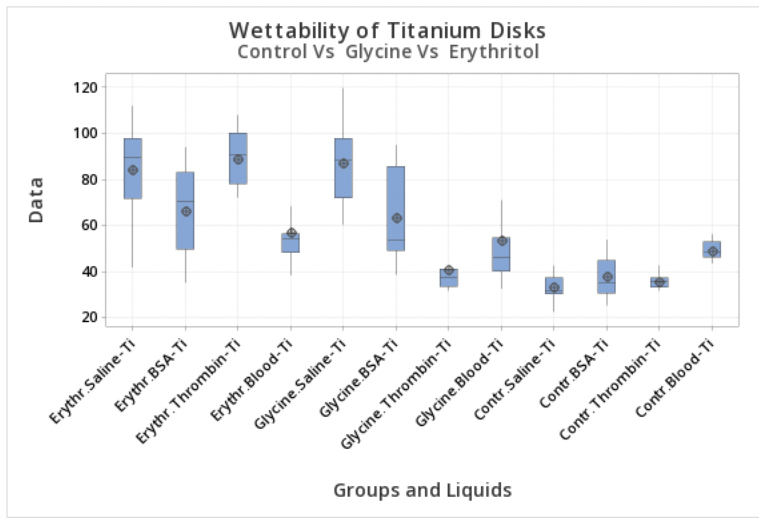
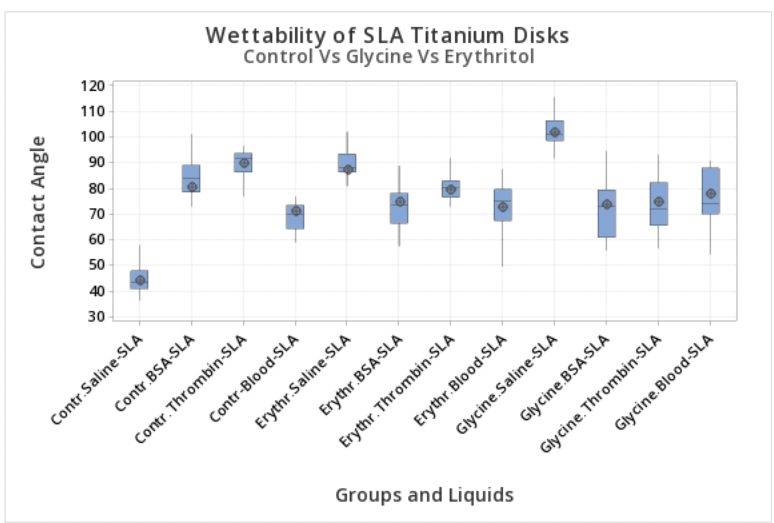
Results: The results indicate machined titanium surfaces have a better wettability than SLA before and after air-polishing (p < 0.05). The wettability of surfaces treated with glycine and erythritol was lower than the wettability of untreated titanium surfaces (p < 0.05) and comparable to SLA surfaces. However, there was not a significant difference in wettability between the groups of glycine and erythritol (p > 0.05) (see Figures).
Conclusions: The wettability of machined and SLA titanium surfaces is lower after air-polishing with glycine or erythritol.
Methods: Two groups of titanium disks were utilized: Machined and SLA surfaces. The wettability of the surfaces was evaluated by the contact angle analysis. Ten microliters of four different liquids, saline, bovine serum albumin (BSA), bovine thrombin (Biopharm), and bovine whole blood (Lampire) were dropped at the centers of each untreated disk which served as the control. Air-polishing was performed with AIRFLOW® PERIO Powder (EMS) for 15 seconds on disk surfaces (n=20 per group) using glycine or erythritol powders. Statistical analysis was performed using the one-way analysis of variance and Fisher post-test.
Results: The results indicate machined titanium surfaces have a better wettability than SLA before and after air-polishing (p < 0.05). The wettability of surfaces treated with glycine and erythritol was lower than the wettability of untreated titanium surfaces (p < 0.05) and comparable to SLA surfaces. However, there was not a significant difference in wettability between the groups of glycine and erythritol (p > 0.05) (see Figures).
Conclusions: The wettability of machined and SLA titanium surfaces is lower after air-polishing with glycine or erythritol.
IMAGES
3895406_File000000.jpg
3895406_File000001.jpg
3895406_File000000.jpg
3895406_File000001.jpg