IADR Abstract Archives
Initial Thread Engagment Allows Crestal Placement and Bone Height Maintenance
Objectives: The endosseous surface margin of transgingival implants is often placed subcrestally to increase primary stability via bone engagement with the flared implant collar. Some argue implant collar/bone engagement results in increased bone height loss. Modern transgingival implant (e.g. TLX) incorporate threads designed to better engage the bone at the time of placement, theoretically removing the need for subcrestal placement. The present study hypothesized that TLX implants placed 1.5 mm subcrestally would result in more bone height loss than the same implant place crestally.
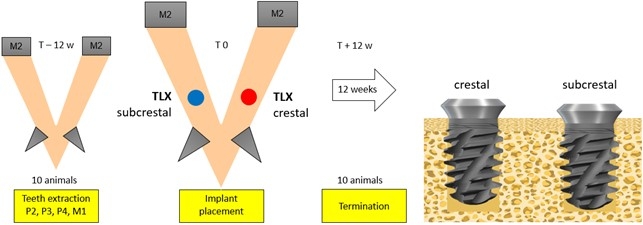
Methods: Insertion torque and ISQ were measured at the time of placement (10 minipigs; split mouth placement; n = 10) and various morphometric analyses were performed after a 3-month healing period.
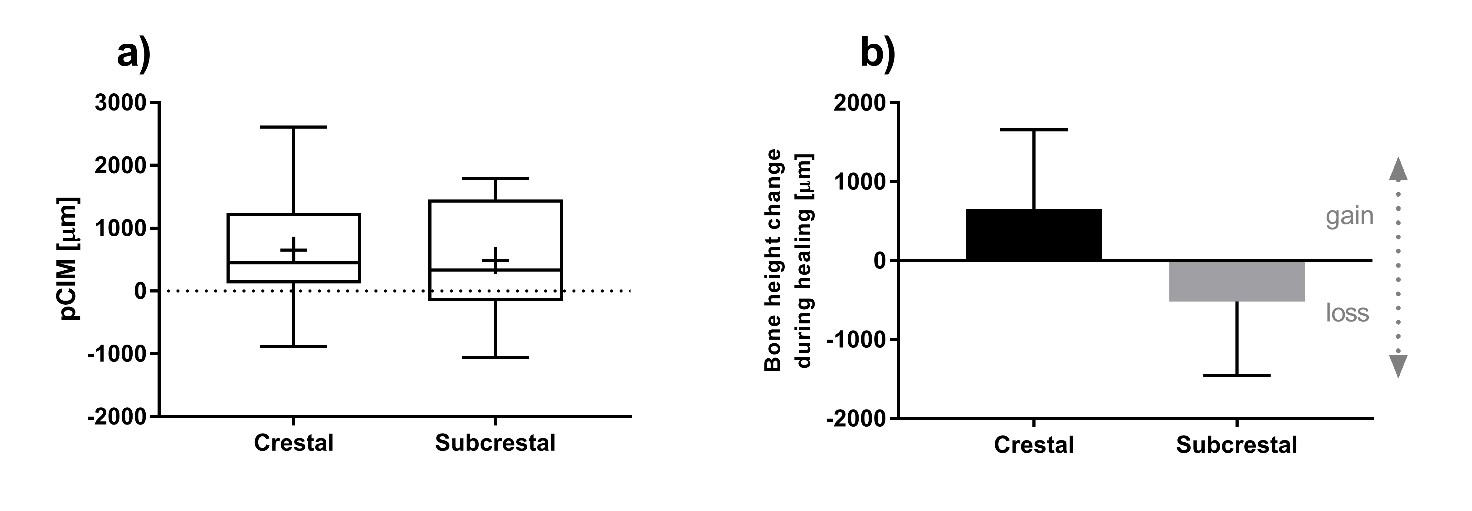
Results: Insertion torque and ISQ were significantly lower for crestally placed implants. However, relative bone height changes were found to be significantly higher for the subcrestally placed implants, with an average bone loss of 0.5 mm as compared to a bone gain of 0.7 mm for the crestally placed group. These bone height changes did not appear to have any effect on the overall osseointegration (as measured by BIC and fBIC), with both groups showing similar results.
Conclusions: These results show that with the TLX implant, subcrestal placement led to inferior bone height maintenance compared to crestal placement. This combined with the increased primary stability coming from the high engagement of the thread design (as compared to more traditional TL implants), the authors propose crestal placement of TLX implants in healed sites.
Methods: Insertion torque and ISQ were measured at the time of placement (10 minipigs; split mouth placement; n = 10) and various morphometric analyses were performed after a 3-month healing period.
Results: Insertion torque and ISQ were significantly lower for crestally placed implants. However, relative bone height changes were found to be significantly higher for the subcrestally placed implants, with an average bone loss of 0.5 mm as compared to a bone gain of 0.7 mm for the crestally placed group. These bone height changes did not appear to have any effect on the overall osseointegration (as measured by BIC and fBIC), with both groups showing similar results.
Conclusions: These results show that with the TLX implant, subcrestal placement led to inferior bone height maintenance compared to crestal placement. This combined with the increased primary stability coming from the high engagement of the thread design (as compared to more traditional TL implants), the authors propose crestal placement of TLX implants in healed sites.
IMAGES
3894481_File000002.jpg
3894481_File000001.jpg
3894481_File000002.jpg
3894481_File000001.jpg