IADR Abstract Archives
Novel Hybridized Conjugates of Saliva–Derived Proteins/Peptides for Boosted Biofilm Dispersal
Objectives: Dental Caries remains the most common chronic disease globally that originates within accumulated biofilms on dental tissue. We previously presented novel salivary protein/peptide pellicles comprised a mix of antimicrobial and antifouling domains for effectual biofilm dispersion. With conjugating these domains, their preventive effect was remarkably boosted and herein we unravel their structure-function relationships.
Methods: Antibiofilm efficacy of 6 saliva-derived protein/peptide candidates were conducted against S. mutans U159 with sucrose supplement. Hydroxyapatite discs were used as substrates to be pellicle-coated with 200uM of tested candidates either as a hybrid mix (DR9/2+His5, DR9/2+His3, DR9/2+RR14) or hybridized conjugates (DR9/2His5, DR9/2His3, DR9/2RR14). Whole pooled saliva and peptide-free suspension buffer were used to pellicle-coat positive and negative controls, respectively. Crystal violet assay was performed to analyze the biomass of 96h biofilms of the exclusively attached cells to pellicle coatings grown on solid agar. Secondary structures of same candidates suspended in 50% trifluoroethanol were measured using circular Dichroism (CD). Estimations for secondary structures were obtained using BeStSel software. All experiments were conducted in triplicates and repeated 3 times. ANOVA+post-hoc tests determined statistically significant differences.
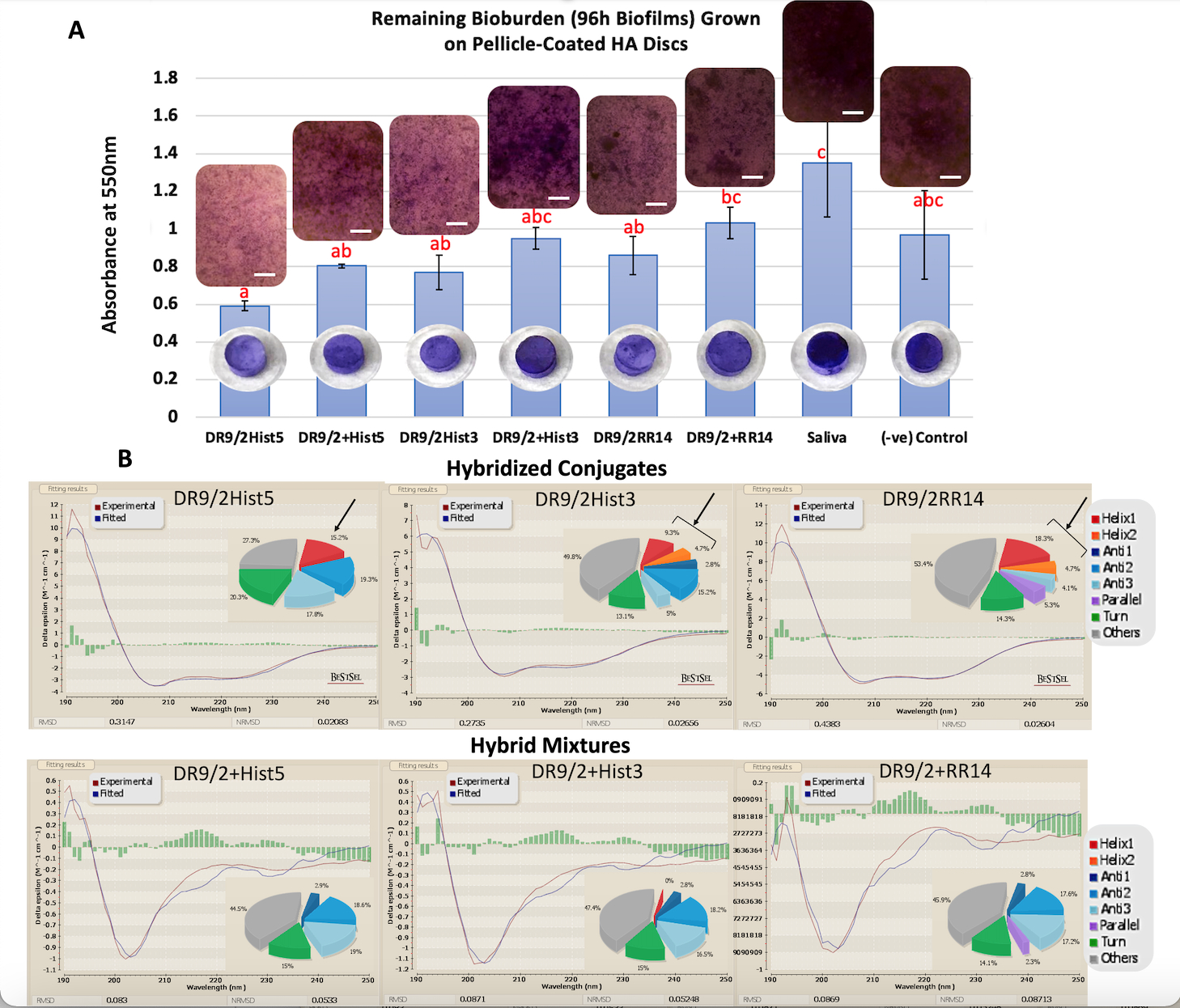
Results: All hybridized conjugates consistently grew less bioburden compared to their hybrid mix and significantly less than the saliva–associated biofilms (Figure 1A). The CD spectra revealed a significant increase in adopting α-helix for hybridized conjugates compared to hybrid mixtures (Figure 1B).
Conclusions: Integrating bioinhibitory protein/peptide hybrid domains is a novel approach for a synergistic prevention. Conjugating these domains notably boosted their biofilm-dispersal effect by adopting more α-helical conformation. α-helices characterized by their amphipathic, surfactant-like, nature crucial for lytic activity and biofilm dispersal promoted by their function as a hinge region between the two domains. These data are valuable for bioengineering enamel pellicles to prevent/arrest dental caries which otherwise requires invasive treatments and massive expenses in healthcare budgets.
Methods: Antibiofilm efficacy of 6 saliva-derived protein/peptide candidates were conducted against S. mutans U159 with sucrose supplement. Hydroxyapatite discs were used as substrates to be pellicle-coated with 200uM of tested candidates either as a hybrid mix (DR9/2+His5, DR9/2+His3, DR9/2+RR14) or hybridized conjugates (DR9/2His5, DR9/2His3, DR9/2RR14). Whole pooled saliva and peptide-free suspension buffer were used to pellicle-coat positive and negative controls, respectively. Crystal violet assay was performed to analyze the biomass of 96h biofilms of the exclusively attached cells to pellicle coatings grown on solid agar. Secondary structures of same candidates suspended in 50% trifluoroethanol were measured using circular Dichroism (CD). Estimations for secondary structures were obtained using BeStSel software. All experiments were conducted in triplicates and repeated 3 times. ANOVA+post-hoc tests determined statistically significant differences.
Results: All hybridized conjugates consistently grew less bioburden compared to their hybrid mix and significantly less than the saliva–associated biofilms (Figure 1A). The CD spectra revealed a significant increase in adopting α-helix for hybridized conjugates compared to hybrid mixtures (Figure 1B).
Conclusions: Integrating bioinhibitory protein/peptide hybrid domains is a novel approach for a synergistic prevention. Conjugating these domains notably boosted their biofilm-dispersal effect by adopting more α-helical conformation. α-helices characterized by their amphipathic, surfactant-like, nature crucial for lytic activity and biofilm dispersal promoted by their function as a hinge region between the two domains. These data are valuable for bioengineering enamel pellicles to prevent/arrest dental caries which otherwise requires invasive treatments and massive expenses in healthcare budgets.
IMAGES
3721351_File000004.jpg
3721351_File000004.jpg