IADR Abstract Archives
The Different Osteogenic Differentiation of Periosteum-Derived Cells Regulated by YAP
Objectives: The regeneration ability of the periosteum has been proved to be site-specific, which in turn determines the fate of bone repair to some extent. However, the specific mechanism has not been elucidated yet. Additionally, previous studies showed yes-associated protein (YAP) could regulate the osteogenic differentiation of osteogenesis associated cells, except periosteum derived cells (PDCs). Hence, this study aims to explore the site-specificity of PDCs, between mandible periosteum derived cells (mPDCs) and femur periosteum derived cells (fPDCs) to be exact and the difference of their osteogenic potential regulated by YAP.
Methods: The PDCs were obtained from mandible and femur of Sprague-Dawley rats. Cytoskeleton staining was designed to analyze the morphology differences between PDCs of different sources. Cell cycle analysis was used to evaluate the proliferation ability of PDCs. Verteporfin was utilized to inhibit YAP cascade signaling for further exploration. Detection of relevant osteogenic markers was performed through real-time PCR at the mRNA level. Alkaline phosphatase (ALP) activity of each group was detected as well.
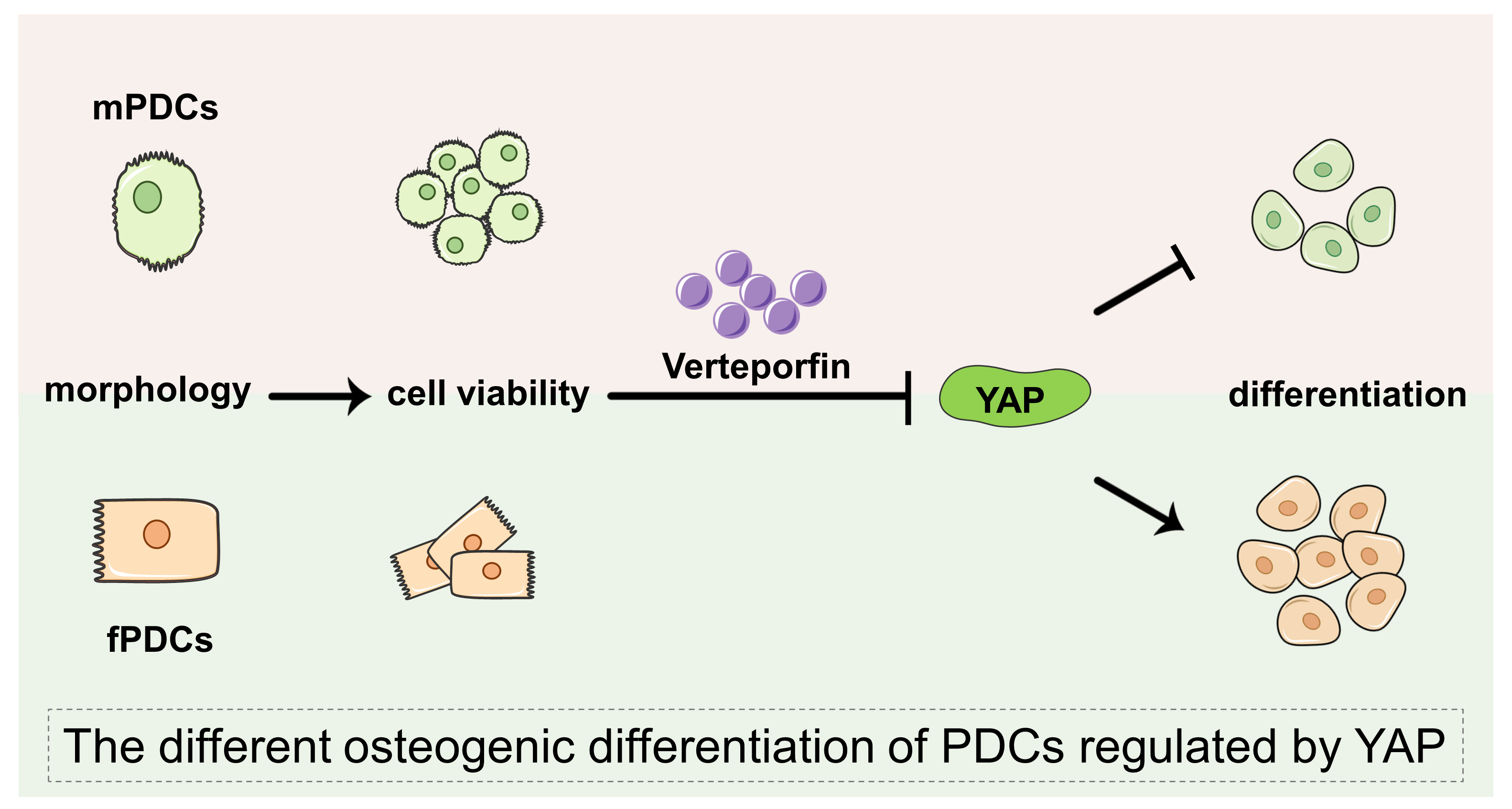
Results: The immunofluorescent images of cytoskeleton staining demonstrated that mPDCs were more cubic while fPDCs were with slender shape. Plus, mPDCs were proved to have better proliferative ability. After treated with verteporfin, the mRNA expression of ALP and OCN in fPDCs was upregulated while in mPDCs was reduced. The results ALP activity exhibited the same trend as real-time PCR.
Conclusions: This study demonstrates that there are slight differences between PDCs from different sources. Their different responses to the downregulation of YAP may result from the differences of their embryonic origins and their way of bone formation. Our findings suggest the source of cell should be taken into consideration in subsequent studies and clinical applications.
Methods: The PDCs were obtained from mandible and femur of Sprague-Dawley rats. Cytoskeleton staining was designed to analyze the morphology differences between PDCs of different sources. Cell cycle analysis was used to evaluate the proliferation ability of PDCs. Verteporfin was utilized to inhibit YAP cascade signaling for further exploration. Detection of relevant osteogenic markers was performed through real-time PCR at the mRNA level. Alkaline phosphatase (ALP) activity of each group was detected as well.
Results: The immunofluorescent images of cytoskeleton staining demonstrated that mPDCs were more cubic while fPDCs were with slender shape. Plus, mPDCs were proved to have better proliferative ability. After treated with verteporfin, the mRNA expression of ALP and OCN in fPDCs was upregulated while in mPDCs was reduced. The results ALP activity exhibited the same trend as real-time PCR.
Conclusions: This study demonstrates that there are slight differences between PDCs from different sources. Their different responses to the downregulation of YAP may result from the differences of their embryonic origins and their way of bone formation. Our findings suggest the source of cell should be taken into consideration in subsequent studies and clinical applications.
IMAGES
3716076_File000001.jpg
3716076_File000001.jpg