IADR Abstract Archives
Tunable Calcium Phosphate Cement Formulations for Predictable Local Release of Doxycycline
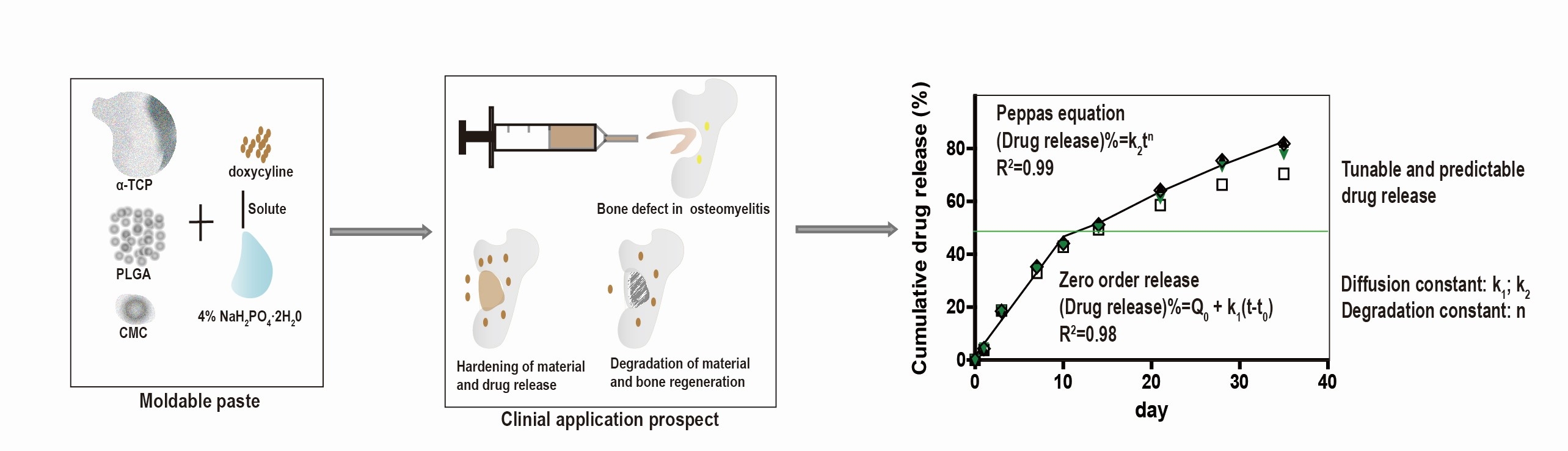
Objectives: Osteomyelitis is a bacterial infection, which leads to bone loss. Local treatment is focused on elimination of bacteria, which is preferable for simultaneous management of the bone defect after sequestrectomy and bone reconstruction in one-stage treatment of osteomyelitis. Calcium phosphate cements (CPCs) have attracted increased attention as bone substitute material because of their injectability and in situ self-setting properties, which allows for minimally invasive surgical procedures and local drug delivery. We herein established a system to achieve different release profiles of the antibiotic drug doxycycline from CPC by finetuning their formulation.
Methods: These CPC formulations were generated via facile addition of hydrolytically degrading PLGA particles, varying doses of doxycycline, and addition of the lubricant CMC. CPC and CPC containing poly (d,l-lactic-co-glycolic acid) PLGA particles as porogens, CPC containing carboxyl methylcellulose (CMC) as a cohesion promoter, CPC containing both PLGA and CMC with different concentration doxycycline were investigated on the handling properties, porosity, degradation and drug release and antimicrobial effect in vitro.
Results: The CPC formulations exhibited appropriate handling properties in terms of injectability and setting time. Furthermore, doxycycline release profiles showed an adequate burst release followed by a cumulative release of up to 100% over a period of 8 weeks. Importantly, the released doxycycline retained its antibacterial activity against Staphylococcus aureus, the major pathogen causing osteomyelitis. Using an in vivo implantation model, antibacterial efficacy was demonstrated by a rapid decrease of inoculated S. aureus at the CPC surface and within surrounding tissues.
Conclusions: Doxycycline can be loaded into CPC-formulations via the liquid phase without adverse effects on handling properties. Release is characterized by a linear sustained profile, which effectively inhibits bacterial growth. Our data show the versatility of the CPC system toward local antibacterial therapy, extending its application beyond bone substitution.
Methods: These CPC formulations were generated via facile addition of hydrolytically degrading PLGA particles, varying doses of doxycycline, and addition of the lubricant CMC. CPC and CPC containing poly (d,l-lactic-co-glycolic acid) PLGA particles as porogens, CPC containing carboxyl methylcellulose (CMC) as a cohesion promoter, CPC containing both PLGA and CMC with different concentration doxycycline were investigated on the handling properties, porosity, degradation and drug release and antimicrobial effect in vitro.
Results: The CPC formulations exhibited appropriate handling properties in terms of injectability and setting time. Furthermore, doxycycline release profiles showed an adequate burst release followed by a cumulative release of up to 100% over a period of 8 weeks. Importantly, the released doxycycline retained its antibacterial activity against Staphylococcus aureus, the major pathogen causing osteomyelitis. Using an in vivo implantation model, antibacterial efficacy was demonstrated by a rapid decrease of inoculated S. aureus at the CPC surface and within surrounding tissues.
Conclusions: Doxycycline can be loaded into CPC-formulations via the liquid phase without adverse effects on handling properties. Release is characterized by a linear sustained profile, which effectively inhibits bacterial growth. Our data show the versatility of the CPC system toward local antibacterial therapy, extending its application beyond bone substitution.
IMAGES
3709871_File000000.jpg
3709871_File000000.jpg