IADR Abstract Archives
Clinical Experience Levels to Diagnose Radiolucent Lesions From Peri-Apical Radiographs
Objectives: Radiographic imaging in addition to clinical examination has been considered the gold standard approach to diagnose periodontal disease. Conventional 2-D imaging does not entirely capture 3-D aspects of the patient’s condition and has the potential to be ambiguous1. Therefore, the accuracy and reliability of radiographs can pose a diagnostic challenge between multiple dental providers. The purpose of this study was to assess if clinical experience plays a significant role on the ability to diagnose radiolucent lesions from peri-apical radiographs.
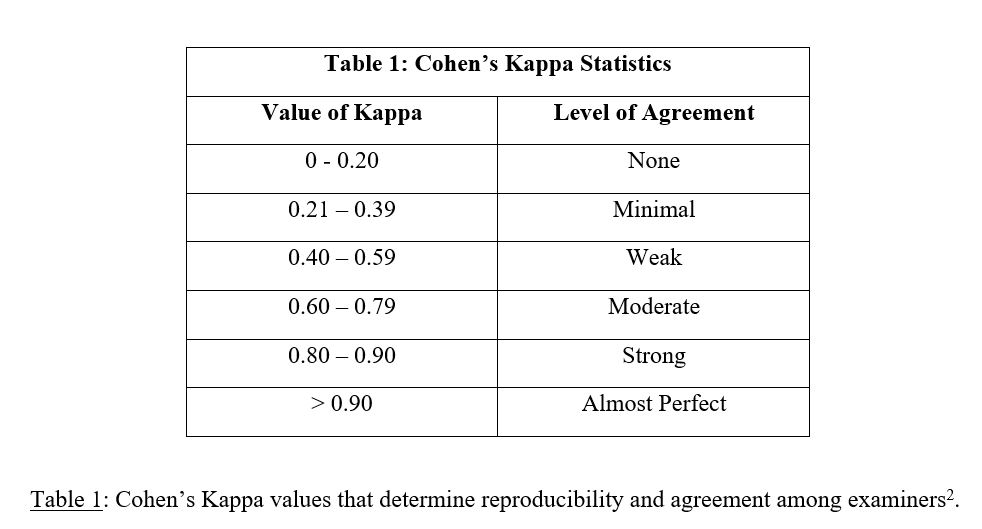
Methods: Two incoming dental students (S1 and S2) were given three distinct training sessions on radiographic dental anatomy. An additional 2-hour training session was devoted to calibrating diagnosis of periodontal bone loss configuration (horizontal or vertical), interproximal or buccal/lingual furcation involvement, and periapical lesions to one board-certified periodontist. Peri-apical radiographs from full mouth series of 139 patients were evaluated independently by students and one board-certified periodontist (F1). Following categorization, comparison between examiners was determined by calculating the Cohen's kappa coefficient, a statistic parameter that is used to measure inter-rater reliability for qualitative items (Table 1).
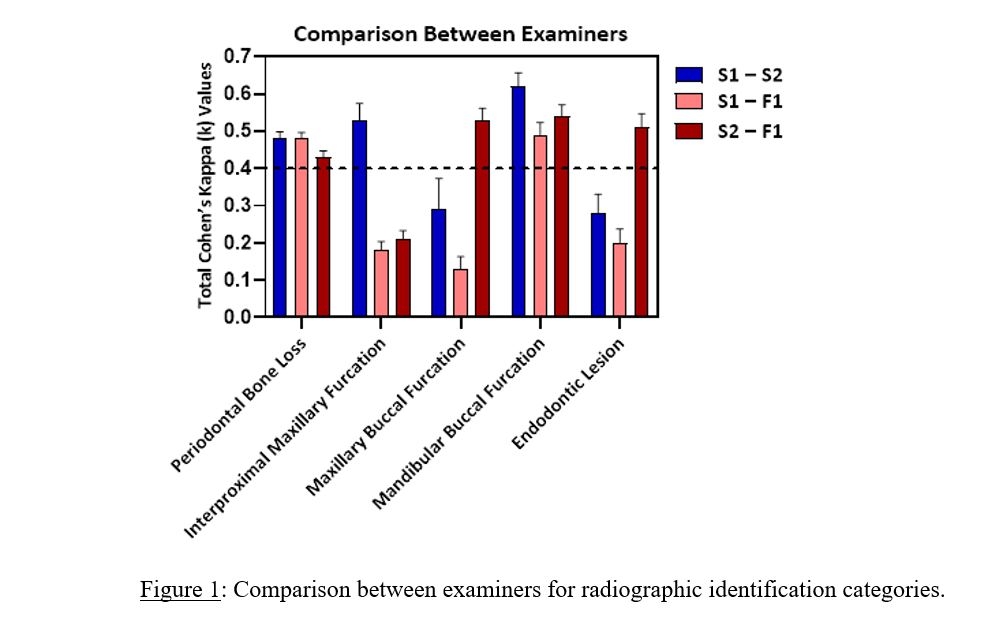
Results: Diagnosis of periodontal bone loss configuration and mandibular buccal furcation showed the highest agreement score between all examiners (Figure 1). Interproximal maxillary furcation was the most challenging diagnosis for the students, showing the lowest agreement score with the faculty examiner.
Conclusions: The order of difficulty (least to most) to assess radiographically is: mandibular buccal furcation, periodontal bone loss, endodontic lesion, maxillary buccal furcation, and then interproximal maxillary furcation. The results of this study could provide insight for dental educators to understand areas that inexperienced clinicians might require extra attention.
Methods: Two incoming dental students (S1 and S2) were given three distinct training sessions on radiographic dental anatomy. An additional 2-hour training session was devoted to calibrating diagnosis of periodontal bone loss configuration (horizontal or vertical), interproximal or buccal/lingual furcation involvement, and periapical lesions to one board-certified periodontist. Peri-apical radiographs from full mouth series of 139 patients were evaluated independently by students and one board-certified periodontist (F1). Following categorization, comparison between examiners was determined by calculating the Cohen's kappa coefficient, a statistic parameter that is used to measure inter-rater reliability for qualitative items (Table 1).
Results: Diagnosis of periodontal bone loss configuration and mandibular buccal furcation showed the highest agreement score between all examiners (Figure 1). Interproximal maxillary furcation was the most challenging diagnosis for the students, showing the lowest agreement score with the faculty examiner.
Conclusions: The order of difficulty (least to most) to assess radiographically is: mandibular buccal furcation, periodontal bone loss, endodontic lesion, maxillary buccal furcation, and then interproximal maxillary furcation. The results of this study could provide insight for dental educators to understand areas that inexperienced clinicians might require extra attention.
IMAGES
3576178_File000000.JPG
3576178_File000001.JPG
3576178_File000000.JPG
3576178_File000001.JPG