IADR Abstract Archives
Microfluidics-Based Coaxial Bioprinting of Hydrogels for Salivary Tissue Engineering
Objectives: Hyposalivation results from disease or injury to the salivary gland. Only palliative treatments exist for xerostomia, and many patients suffer from poor oral health and quality of life. Tissue engineering offers a permanent solution for salivary gland replacement. We have shown that 3D hydrogel-based encapsulation of primary human salivary stem/progenitor cells (hS/PCs) promoted self-assembly into organized acini-like spheroids with coordinated, functional response. 3D bioprinting methods potentiate spatially cell deposition into defined architectures mimicking thin epithelia. Here we adopt a microfluidics-based bioprinter, with coaxial polymer and crosslinker streams, to fabricate thin, reproducible, and biocompatible hydrogel features. Our ultimate aim is to expand this platform to generate complex, branched, 3D salivary neotissues that can restore salivary function.
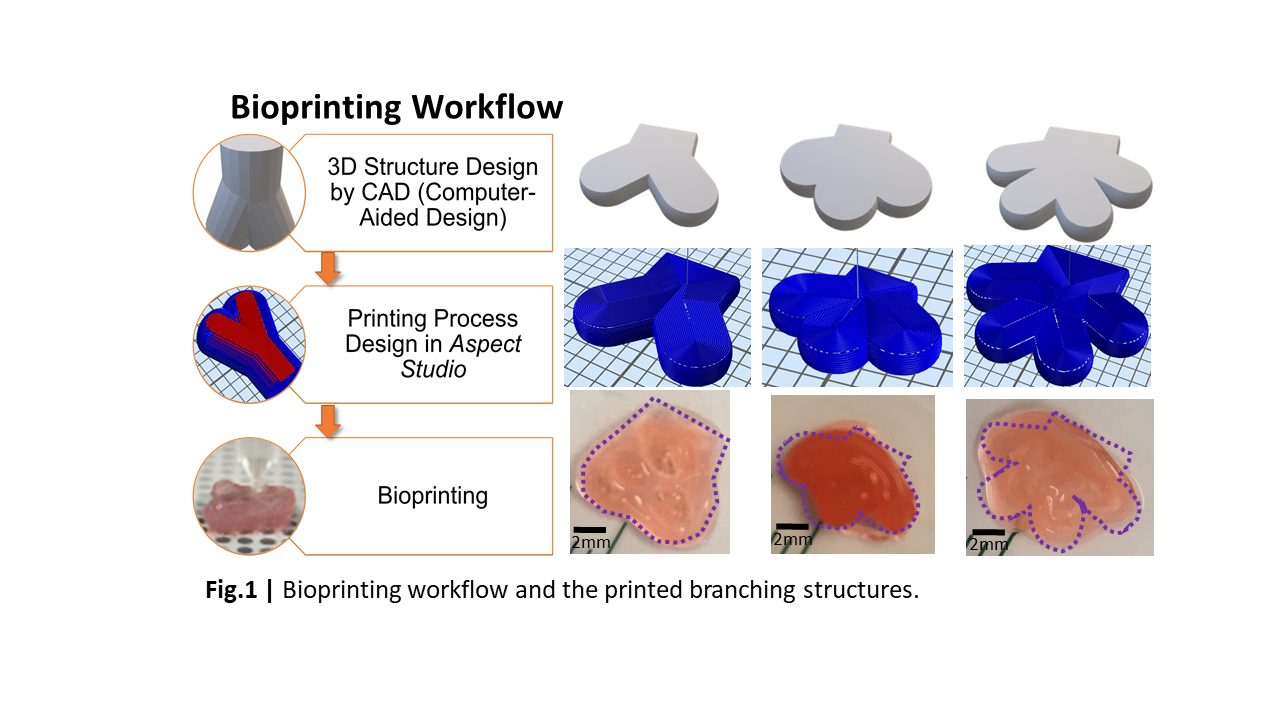
Methods: 3D branched structures were designed using computer aided design (CAD) software and imported as .STL files into Aspect Studio to create printing pathways. Hydrogel structures were printed using AG-10 matrix (1.5% alginate) and CAT-2 crosslinker from an RX1 bioprinter and DUO-1 printhead (Aspect Biosystems, Canada). Either hS/PCs or fluorescent microbeads (as a mimic of multiple salivary cell populations) were mixed with sterile filtered alginate. Encapsulated cell structures were cultured in humanized salivary media after bioprinting. Cell viability was assessed by live/dead assays.
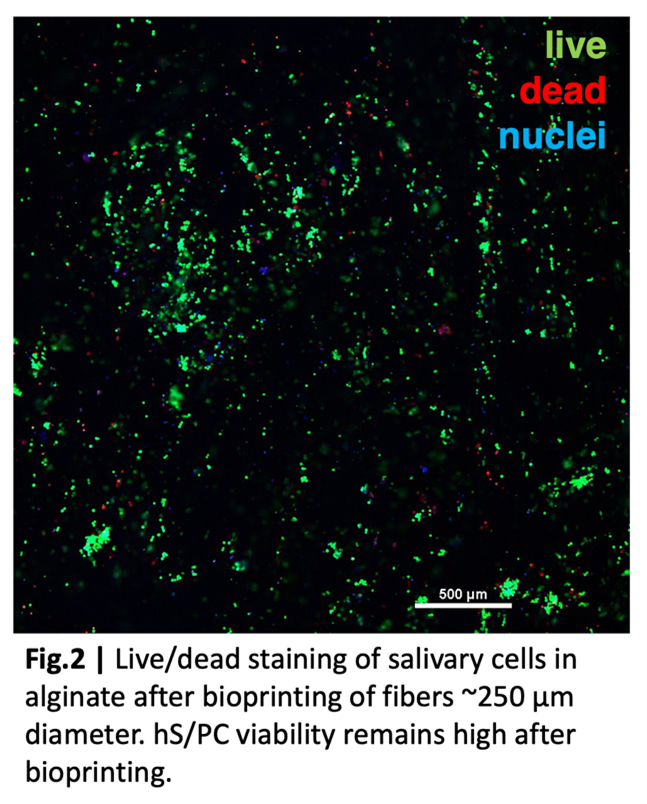
Results: Cell-laden, self-adherent hydrogel fibers can be printed to create complex 3D structures within minutes. Adjusting absolute and relative pressures for the alginate and crosslinker solutions enables fine control over fiber diameters, down to <100µm. Bioprinted structures preserved the designed characteristics and maintained structural integrity throughout culture. hS/PCs remained viable after bioprinting over several days.
Conclusions: Our pilot studies demonstrated that microfluidics-based 3D bioprinting is a promising method to create complex branching structures with improved control over structural geometry and resolution. Salivary cell viability is ensured during and post-bioprinting. This 3D bioprinting system generates architecturally relevant salivary gland units using highly-tunable and scalable bioactive materials.
Methods: 3D branched structures were designed using computer aided design (CAD) software and imported as .STL files into Aspect Studio to create printing pathways. Hydrogel structures were printed using AG-10 matrix (1.5% alginate) and CAT-2 crosslinker from an RX1 bioprinter and DUO-1 printhead (Aspect Biosystems, Canada). Either hS/PCs or fluorescent microbeads (as a mimic of multiple salivary cell populations) were mixed with sterile filtered alginate. Encapsulated cell structures were cultured in humanized salivary media after bioprinting. Cell viability was assessed by live/dead assays.
Results: Cell-laden, self-adherent hydrogel fibers can be printed to create complex 3D structures within minutes. Adjusting absolute and relative pressures for the alginate and crosslinker solutions enables fine control over fiber diameters, down to <100µm. Bioprinted structures preserved the designed characteristics and maintained structural integrity throughout culture. hS/PCs remained viable after bioprinting over several days.
Conclusions: Our pilot studies demonstrated that microfluidics-based 3D bioprinting is a promising method to create complex branching structures with improved control over structural geometry and resolution. Salivary cell viability is ensured during and post-bioprinting. This 3D bioprinting system generates architecturally relevant salivary gland units using highly-tunable and scalable bioactive materials.
IMAGES
3574793_File000000.jpg
3574793_File000001.jpg
3574793_File000000.jpg
3574793_File000001.jpg