IADR Abstract Archives
Shear Strengths and Failure Modes of Universal Bonding Agents
Objectives: The aim of the present study was to evaluate the shear strength to dentin and the respective failure modes of three universal bonding agents applied by inexperienced experimenters.
Methods: The experiments were conducted by 14 dental students during der regular courses (2019). The bond strengths of three so-called self-etch “universal bonding agents“ (SBU, Scotchbond universal, 3M-Espe; PBactive, Prime&Bond active, Dentsply-Sirona; OBU, Optibond Universal, KaVo-Kerr) were evaluated. 252 composite-cylinders were fixed onto bovine teeth with the bonded-systems perpendicular to the exposed dentin surfaces. Shear-tests were conducted with a universal testing-machine (Zwick). Data were analysed by mixed-model ANOVA.
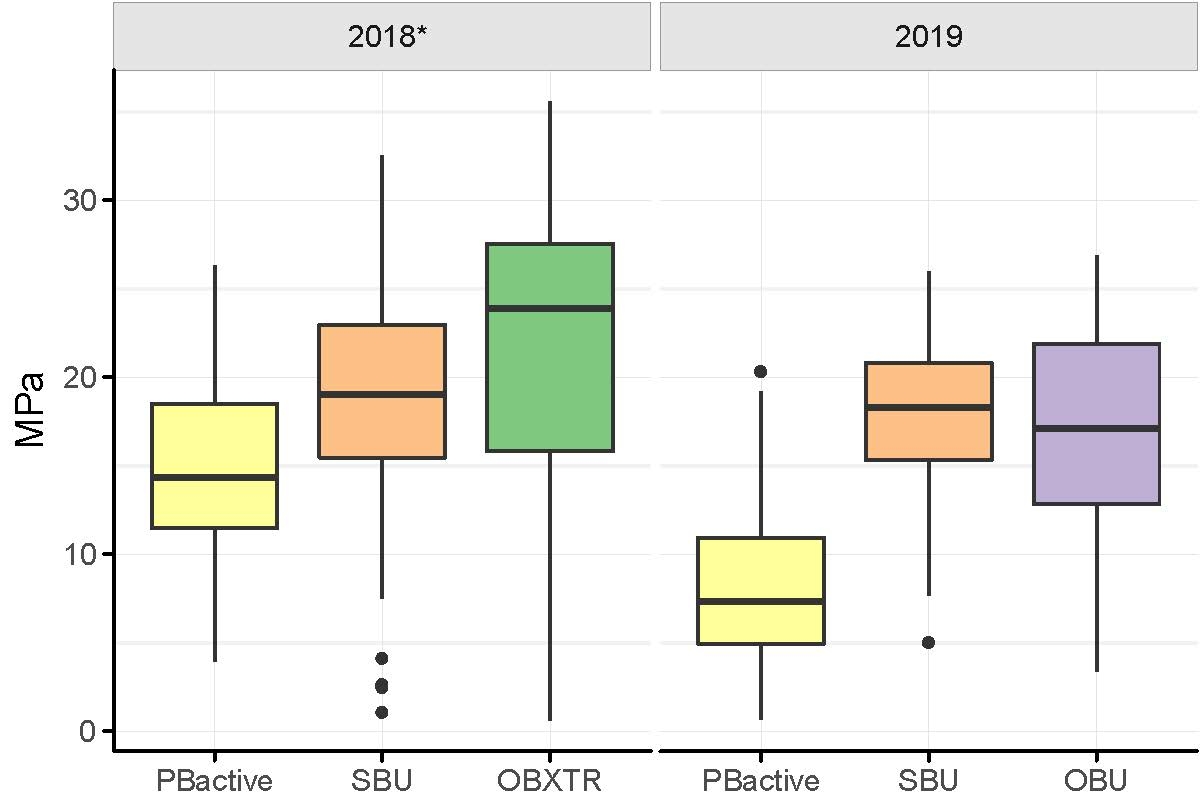
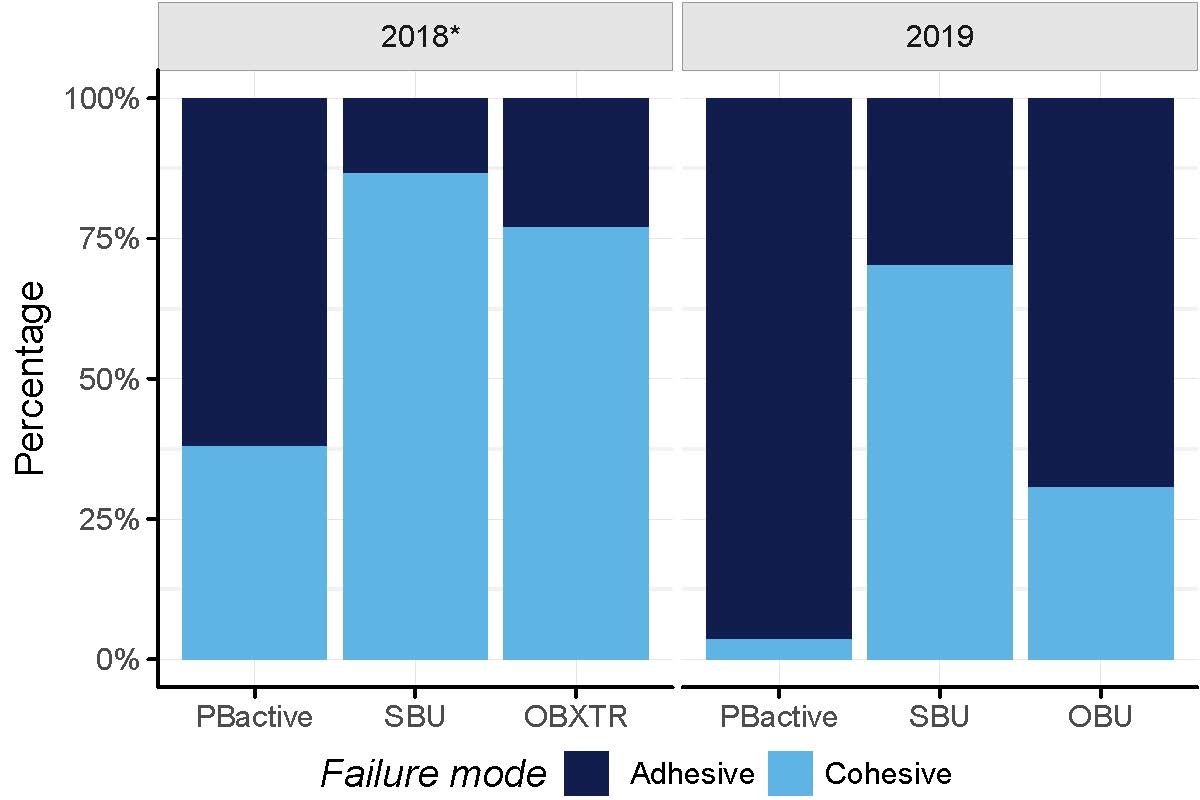
Results: Results: OBU and SBU showed significantly higher shear-strengths than PBact (p<0.001, Fig. 1), whereas there was no significant difference between OBU and SBU. Initial testing failures (specimens broke spontaneously or adhesion was too low to be registered) were observed with all materials tested (OBU [7,1%] > SBU [3,6%] > PBactive [2,4%]). SBU (cohesive 70%; adhesive 30%) showed predominantly cohesive fractures (within dentin), whereas OBU (cohesive 30%; adhesive 70%) and PBactive (cohesive 4%; adhesive 96%) showed predominantly adhesive fractures (between adhesive layer and dentin).
Compared to a previous study with the same experimental setting two universal bonding agents (SBU und OBU) showed similar shear-strengths as a two-step self-etching bonding system [OBXTR] (Fig 1). Although the shear-strength values of OBU were comparable to SBU and OBXTR, OBU showed predominantly adhesive failures, whereas OBXTR and SBU showed essentially cohesive failures (Fig 2).
Conclusions: Two universal (one-step) bonding systems (OBU and SBU) show similar shear strengths as the two-step system OBXTR, but differences in failure mode indicate that the load-bearing capacity of the hybrid-layer for materials with predominantly cohesive failures (OBXTR and SBU) might be stronger than for the material with predominantly adhesive failures (OBU).
Methods: The experiments were conducted by 14 dental students during der regular courses (2019). The bond strengths of three so-called self-etch “universal bonding agents“ (SBU, Scotchbond universal, 3M-Espe; PBactive, Prime&Bond active, Dentsply-Sirona; OBU, Optibond Universal, KaVo-Kerr) were evaluated. 252 composite-cylinders were fixed onto bovine teeth with the bonded-systems perpendicular to the exposed dentin surfaces. Shear-tests were conducted with a universal testing-machine (Zwick). Data were analysed by mixed-model ANOVA.
Results: Results: OBU and SBU showed significantly higher shear-strengths than PBact (p<0.001, Fig. 1), whereas there was no significant difference between OBU and SBU. Initial testing failures (specimens broke spontaneously or adhesion was too low to be registered) were observed with all materials tested (OBU [7,1%] > SBU [3,6%] > PBactive [2,4%]). SBU (cohesive 70%; adhesive 30%) showed predominantly cohesive fractures (within dentin), whereas OBU (cohesive 30%; adhesive 70%) and PBactive (cohesive 4%; adhesive 96%) showed predominantly adhesive fractures (between adhesive layer and dentin).
Compared to a previous study with the same experimental setting two universal bonding agents (SBU und OBU) showed similar shear-strengths as a two-step self-etching bonding system [OBXTR] (Fig 1). Although the shear-strength values of OBU were comparable to SBU and OBXTR, OBU showed predominantly adhesive failures, whereas OBXTR and SBU showed essentially cohesive failures (Fig 2).
Conclusions: Two universal (one-step) bonding systems (OBU and SBU) show similar shear strengths as the two-step system OBXTR, but differences in failure mode indicate that the load-bearing capacity of the hybrid-layer for materials with predominantly cohesive failures (OBXTR and SBU) might be stronger than for the material with predominantly adhesive failures (OBU).
IMAGES
3572625_File000000.jpg
3572625_File000001.jpg
3572625_File000000.jpg
3572625_File000001.jpg